Ontong Java Atoll
Ontong Java Atoll is a large coral formation located in the Solomon Islands in the southwestern Pacific Ocean, situated approximately 160 miles (257 km)…
What is Ontong Java Atoll?
Ontong Java Atoll is a large coral formation located in the Solomon Islands in the southwestern Pacific Ocean, situated approximately 160 miles (257 km) north of Santa Isabel Island.1
Measuring about 20 miles (32 km) by 50 miles (80 km), the atoll features an encircling reef with passages into the lagoon that are notoriously difficult to navigate. The atoll was visited by the Dutch navigator Abel Janszoon Tasman in 1643 and was later renamed Lord Howe Islands by Capt. John Hunter of the British Navy in 1791. The local Polynesian inhabitants primarily trade in copra, and the principal settlement is located on the largest islet, Luangiua.1
How are coral atolls formed?
Coral atolls are primarily formed through the gradual process of subsidence of extinct volcanic islands, a theory first proposed by Charles Darwin in 1842.23
The development typically follows these stages:
- Fringing Reef: Coral begins growing in shallow waters around a volcanic island.23
- Barrier Reef: As the island slowly sinks or the sea level rises, the reef continues to grow upward and outward, creating a lagoon between the reef and the shoreline.23
- Atoll: Once the volcanic cone is completely submerged, only the ring-shaped reef remains, enclosing a central lagoon.23
While Darwin’s subsidence model remains fundamental, modern science also incorporates the impact of sea-level fluctuations during the Pleistocene Epoch and plate-tectonic theory, which explains how the ocean floor subsides as it spreads from oceanic ridges. Additionally, some annular reefs may form through the erosion and subsequent submergence of uplifted limestone platforms.2
What is the significance of Polynesian culture in the Solomon Islands?
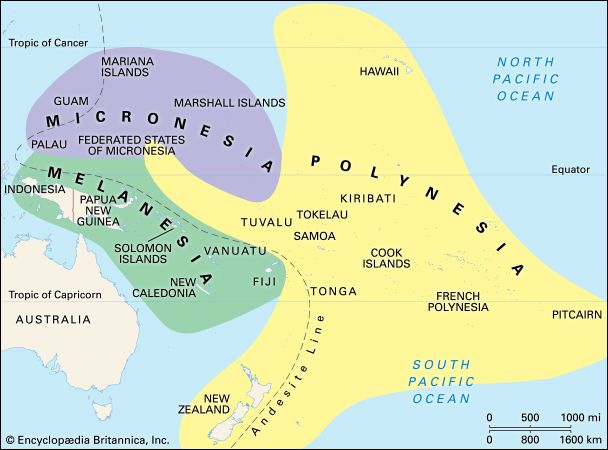
In the Solomon Islands, the Polynesian population represents a small minority that primarily inhabits outlying atolls, including Ontong Java Atoll, Rennell Island, Bellona, the Reef Islands, the Stewart Islands (Sikaiana), Tikopia, and Anuta.4
While the vast majority of the country’s population is ethnically Melanesian, the presence of Polynesian communities highlights the diverse cultural landscape of the region. Historically, the ancestors of these groups were part of the Austronesian expansion, which brought maritime technology and sophisticated social structures to the Pacific. Culturally, these Austronesian-speaking communities often share deeper affinities with other Polynesian and eastern Micronesian societies than with the Papuan-descended populations of the interior. Their traditional belief systems, for instance, incorporate concepts such as mana (potency) and tapu (sacred), which are central to broader Polynesian culture.456
Today, these communities maintain their distinct identity while existing within the broader national framework of the Solomon Islands, contributing to the nation’s rich cultural tapestry.47
What is copra and how is it produced?
Copra is the dried meat of the coconut, which is the fruit of the coconut palm. It is primarily valued for the coconut oil extracted from it, while the remaining residue, known as coconut-oil cake, is commonly used as livestock feed.1213
The production process involves several steps:
- Preparation: Coconuts are husked, either by hand or mechanically, and the shells are cracked into halves to expose the meat.12
- Drying: The meat, which initially contains about 50 percent water, must be dried to reduce moisture to 4–5 percent, which concentrates the oil content to 63–70 percent. Common methods include:1213
- Extraction: Once dried, the copra is cleaned and crushed, and the oil is extracted through pressing or solvent extraction.1213
Sources
- Ontong Java Atoll — Encyclopædia Britannica
- coral reef - Origin and development of reefs — Encyclopædia Britannica
- atoll — Encyclopædia Britannica
- Solomon Islands - People — Encyclopædia Britannica
- Solomon Islands - Cultural life — Encyclopædia Britannica
- Melanesian culture - Traditional Melanesia — Encyclopædia Britannica
- Polynesian culture - Traditional Polynesia — Encyclopædia Britannica
- Oceanic art and architecture - The Solomon Islands — Encyclopædia Britannica
- Pacific Islands - Origins of Oceanian peoples — Encyclopædia Britannica
- Solomon Islands — Encyclopædia Britannica
- Pacific Ocean - Early exploration and settlement — Encyclopædia Britannica
- Copra — Encyclopædia Britannica
- coconut oil — Encyclopædia Britannica
- Seychelles - Agriculture, forestry, and fishing — Encyclopædia Britannica
Published on · 3 min read