Hawk Moth
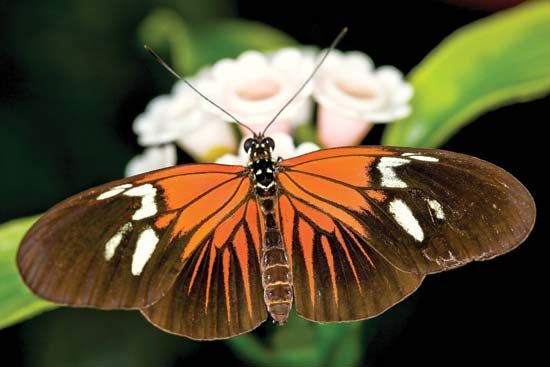
Hawk moths and butterflies are both members of the order Lepidoptera, but they exhibit distinct physical and behavioral differences.
What are the main differences between hawk moths and butterflies?
Hawk moths and butterflies are both members of the order Lepidoptera, but they exhibit distinct physical and behavioral differences.12
Key Differences
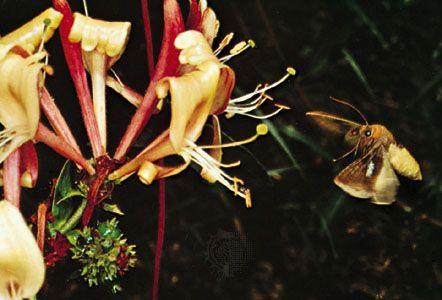
- Feeding Behavior: A primary distinction is how they feed. Butterflies typically alight on a flower to feed, whereas hawk moths are known for hovering while they feed.2
- Activity Patterns: Most butterflies are diurnal (active during the day), while most moths, including many hawk moths, are nocturnal. However, some exceptions exist, such as the hummingbird hawk moth, which is active in daylight.12
- Antennae: Butterflies generally possess simple, club-tipped antennae, whereas the majority of moths have distinctive thick or feathery antennae.1
- Resting Position: When at rest, butterflies typically hold their wings vertically over their backs. Moths, by contrast, often fold their wings tentlike over the body, wrap them around the body, or hold them extended at the sides.1
- Metamorphosis: During their transformation, butterflies form a chrysalis, while most moths build a fibrous cocoon.1
How have hawk moths inspired technological innovations or scientific research?
Hawk moths have become significant subjects in scientific research, particularly for their contributions to insect physiology and the mechanics of animal flight.4
Scientific and Technological Contributions
- Neurohormone Research: The tobacco hornworm has been instrumental in advancing the study of neurohormones. Specifically, research on these moths has provided critical insights into allatotropins and their role in regulating the biosynthesis of juvenile hormone. of juvenile hormone.4
- Bio-inspired Robotics: Scientists have studied the tobacco hornworm’s unique ability to maintain stability while hovering. By observing how the moth uses abdominal articulation to finely tune its flight control, researchers have gained valuable data that informs the development of small, autonomous flying robots.4
These studies highlight how the biological adaptations of the hawk moth—evolved for swift, precise movement—serve as a model for engineering challenges in modern technology.4
What role do hawk moths play in various ecosystems, and are there any species of concern?
Hawk moths (family Sphingidae) play a vital role in ecosystems primarily as pollinators. Many species possess long proboscises that allow them to feed on and pollinate deep-tubed flowers, such as orchids and petunias, which other insects cannot reach. In some cases, these relationships are highly specialized; for example, the hawk moth Xanthopan morganii praedicta is the exclusive pollinator of the Madagascar orchid Angraecum sesquipedale4.465
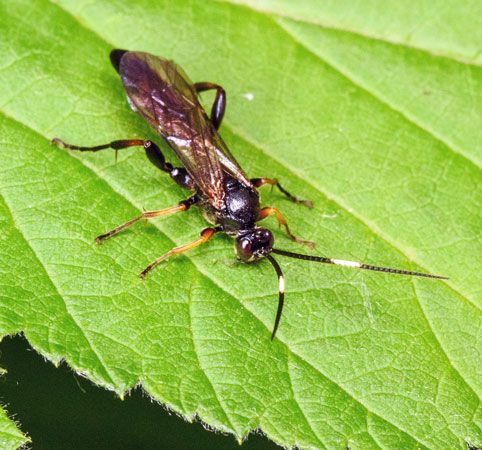
Regarding species of concern, certain hawk moths are considered economically destructive pests. The tobacco hornworm (Manduca sexta) and the tomato hornworm (M. quinquemaculata) are significant agricultural threats in North America, as their larvae feed on tobacco, tomato, and potato crops. To manage these populations, farmers often utilize natural biological controls, such as the braconid wasp (Apanteles congregatus), which parasitizes the larvae.46
What are the distinguishing physical characteristics of hawk moths?
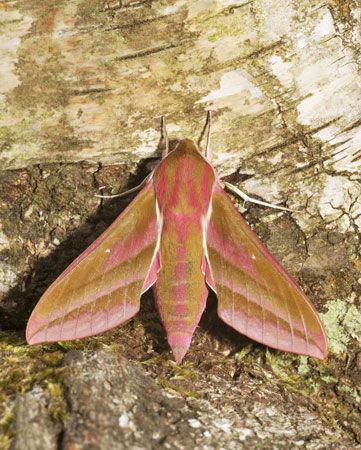
Hawk moths, belonging to the family Sphingidae, are characterized by several distinct physical features that facilitate their swift, hovering flight patterns:
- Body Shape: They possess stout, bullet-shaped bodies.5
- Wings: These moths have long, narrow forewings and shorter hind wings. Their wingspans typically range from 5 to 20 cm (2 to 8 inches). Some species lack scales on their wings, leading them to be referred to as “clearwings”.54
- Proboscis: A defining feature is a very long, coiled feeding organ known as a proboscis, which can reach lengths of up to 32.5 cm (13 inches) in some species, allowing them to feed on nectar from deep-tubed flowers.45
- Larval Characteristics: In their larval stage, these insects are often called hornworms due to a characteristic hornlike extension on their hind end.45
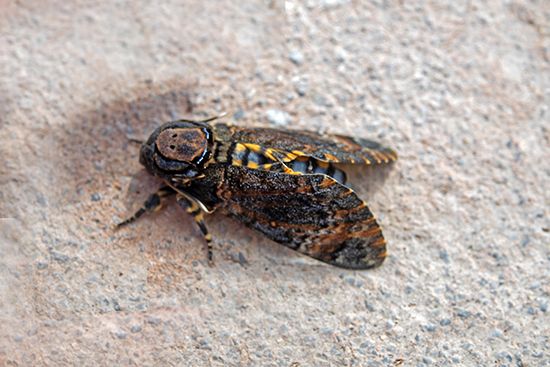
Additionally, some species exhibit unique traits, such as the death’s head moth, which features a marking resembling a human skull on its body and is capable of producing loud chirping or squeaking sounds.5
Sources
- What’s the difference between moths and butterflies? — Encyclopædia Britannica
- pollination - Butterflies and moths — Encyclopædia Britannica
- Lepidoptera - Protection against danger — Encyclopædia Britannica
- hawk moth — Encyclopædia Britannica
- hawk moth — Merriam-Webster
- Lepidoptera - Food selection by the adult — Encyclopædia Britannica
Published on · 3 min read