Lepidoptera
Lepidopteran wings—the defining feature of butterflies and moths—are complex structures characterized by their unique covering of scales and their…
What special features do lepidopteran wings have, and how do they function?
Lepidopteran wings—the defining feature of butterflies and moths—are complex structures characterized by their unique covering of scales and their specialized aerodynamic function.12
Structure and Development
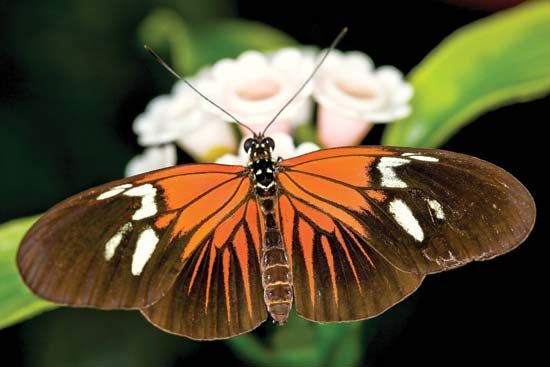
Wings develop as epidermal invaginations that flatten into large, thin structures supported by tubular veins containing tracheae. The wings function as airfoils, featuring a thickened, stiffened leading (costal) edge and a thinner, more flexible trailing edge. To coordinate flight, the forewings and hind wings are often coupled; this is achieved in many moths by a frenulum (a bristle or cluster of bristles) that engages a catch on the forewing, while in butterflies and skippers, the wings are coordinated by the friction of overlapping areas.1
Scales and Coloration
The wings are covered in overlapping, rigid, air-filled scales that serve several purposes:1
- Coloration: Colors are produced by chemical pigments (such as melanins) and structural phenomena, where the microstructure of the scales refracts light to create iridescent, metallic, or pearly effects.1
- Communication: Males often possess specialized scent scales called androconia, which distribute pheromones essential for courtship.1
- Defense: Scales and hairs can make the insect slippery, aiding escape from spiderwebs.3
What are some of the largest and smallest species of lepidopterans?
The order Lepidoptera exhibits a vast range in size, with wingspans varying from just a few millimeters to nearly a foot.7
Largest Species
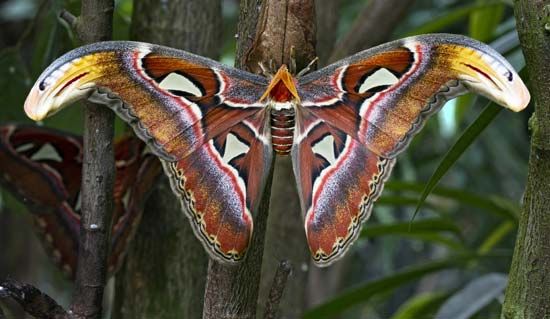
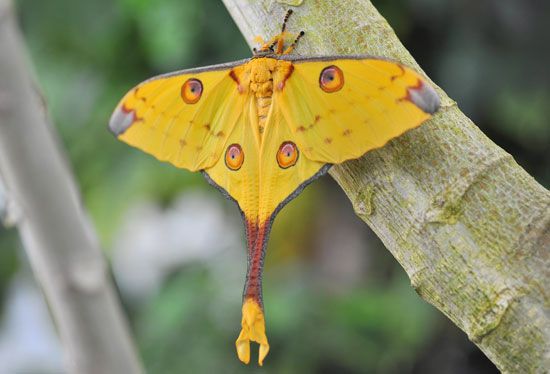
The white witch moth (Thysania agrippina) is widely considered to have the largest wingspan of any living insect, reaching 28 cm (11 inches) or more. Another notable giant is the atlas moth (Attacus atlas), which is one of the largest moths in the world by total wing surface area, with females often reaching a wingspan of 25 cm (10 inches).89
Smallest Species
At the other end of the spectrum, some of the smallest lepidopterans belong to the family Nepticulidae, commonly known as midget moths11. These insects are part of a group often referred to as microlepidoptera, which encompasses various families of minute to medium-sized moths. Midget moths typically have wingspans ranging from only 3 to 6 mm (1/8 to 2/5 inch).1011
What are the four stages of a lepidopteran’s life cycle?
The life cycle of a lepidopteran (butterflies, moths, and skippers) consists of four distinct stages, a process known as complete metamorphosis:131415
- Egg: The life cycle begins when an adult female lays eggs, often on a specific host plant that will serve as food for the emerging offspring.14
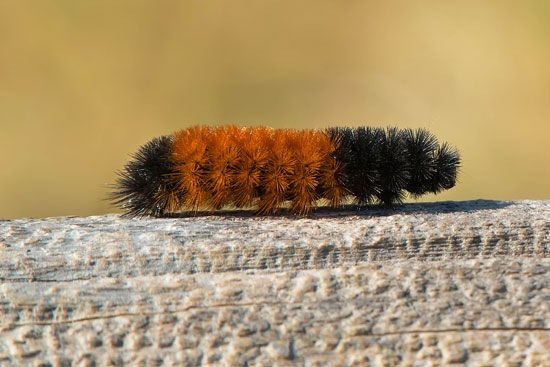
- Larva: Commonly known as a caterpillar, this stage is primarily focused on growth and feeding. Larvae are wingless and differ significantly in form and habit from the adult.1314
- Pupa: In this resting stage, the larva undergoes a dramatic transformation. Whether protected by a cocoon (common in moths) or a chrysalis (common in butterflies), the insect’s larval tissues break down and are rebuilt into adult structures, such as wings.161417
- Adult: Also called the imago, the mature insect emerges from the pupal stage. The adult is typically winged and focused on reproduction and pollination.1314
How do butterflies and moths differ within the order Lepidoptera?
While both butterflies and moths belong to the order Lepidoptera, they exhibit several distinct physical and behavioral differences.
Physical Characteristics
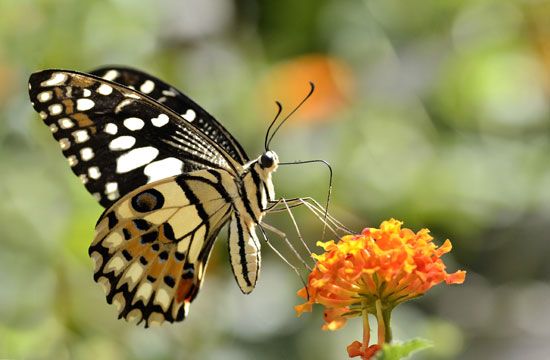
- Antennae: Most moths possess thick or feathery antennae, whereas butterflies typically have simple, club-tipped antennae.18
- Body Shape: Butterflies generally have slim, dainty bodies, while moths are typically stout and often fuzzy.18
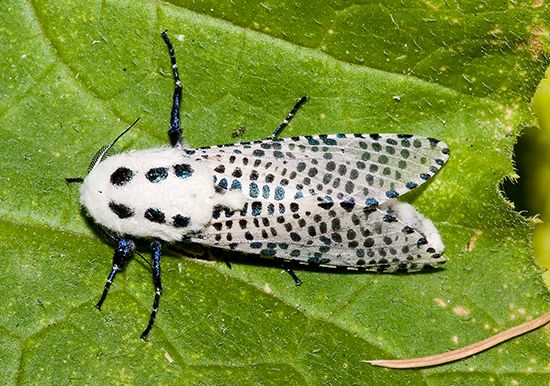
- Appearance: Butterflies are often colorful with dramatic wing patterns, while moths are frequently more drab, though notable exceptions exist in both groups.18
Behavioral and Developmental Differences
- Activity: Butterflies are primarily diurnal (active during the day), while most moths are nocturnal.18
- Resting Position: When at rest, butterflies usually hold their wings vertically over their backs. Moths typically fold their wings tentlike over the body, wrap them around the body, or hold them extended at the sides.18
- Metamorphosis: During the pupal stage, butterflies form a naked chrysalis. In contrast, most moths build protective cocoons made of silk and other materials.1816
Sources
- heteropteran - Wings — Encyclopædia Britannica
- Lepidoptera - Thorax — Encyclopædia Britannica
- Lepidoptera - Protection against danger — Encyclopædia Britannica
- scalewing — Merriam-Webster
- Locomotion - Wings of insects — Encyclopædia Britannica
- Wing — Encyclopædia Britannica
- Defying Gravity: 7 of the Biggest Things That Ever Flew — Encyclopædia Britannica
- atlas moth — Encyclopædia Britannica
- Lepidoptera - Size range and distribution — Encyclopædia Britannica
- microlepidoptera — Merriam-Webster
- midget moth — Encyclopædia Britannica
- butterfly — Encyclopædia Britannica
- pupa — Encyclopædia Britannica
- Metamorphosis — Encyclopædia Britannica
- Lepidoptera — Encyclopædia Britannica
- Lepidoptera - Pupa , or chrysalis — Encyclopædia Britannica
- insect - Types of metamorphosis — Encyclopædia Britannica
- What’s the difference between moths and butterflies? — Encyclopædia Britannica
Published on · 3 min read