Guzmania
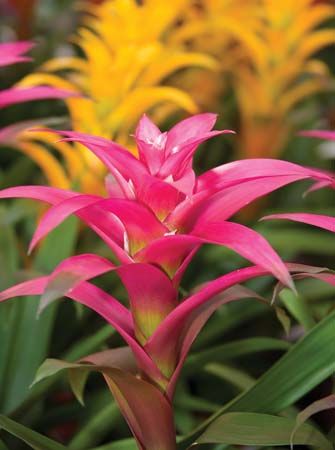
Guzmania is a genus comprising approximately 85 species of tropical American and West Indian plants belonging to the pineapple family (Bromeliaceae). These…
What is Guzmania?
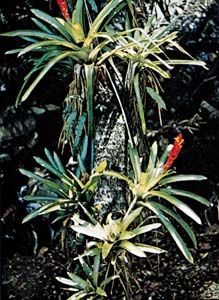
Guzmania is a genus comprising approximately 85 species of tropical American and West Indian plants belonging to the pineapple family (Bromeliaceae). These plants can be either terrestrial or epiphytic, meaning they are supported by other plants and utilize aerial roots to absorb moisture from the humid atmosphere.12
Characterized by their handsome appearance, Guzmania plants are frequently cultivated as indoor ornamentals. They typically feature stiff leaves that grow in a rosette pattern, either stemless or on short stems. Their flowers, which are generally white or yellow, emerge on stalks in clusters often surrounded by colorful, showy bracts. The genus was named in honor of the Spanish naturalist A. Guzmán.12
What are epiphytes and how do they grow?
An epiphyte is any plant that grows upon another plant or object solely for physical support. Unlike parasitic plants, which derive nutrients or water from their hosts, epiphytes are not parasitic; they use their host merely as a structure to reach better environmental conditions.34
How Epiphytes Grow
Most epiphytes are found in moist tropical regions, where growing high in the tree canopy allows them to access sunlight that is otherwise blocked in dense, shaded forests. They thrive by exploiting nutrients from organic debris, such as decaying leaves, that collects on tree branches.3
- Water Acquisition: Epiphytes obtain moisture from rain and water vapor in the air. While most absorb water through their roots, many species possess specialized leaves that also capture moisture.3
- Nutrient Absorption: Minerals are often absorbed directly from rain or from the organic matter accumulated on the supporting plant.3
- Dispersal: Because their habitat requirements are narrow, many epiphytes rely on the wind to spread their feathery or dustlike seeds. Others produce edible fruits that are dispersed by birds and tree-dwelling animals.3
Common examples include many orchids, ferns, mosses, and members of the pineapple family.35
What other plants belong to the Bromeliaceae family?
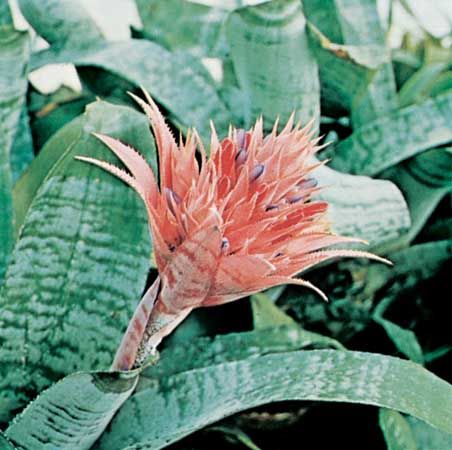
The Bromeliaceae family, commonly known as the pineapple family, consists of approximately 56 genera and 3,000 species of perennial flowering plants. While the pineapple (Ananas comosus) and Spanish moss (Tillandsia usneoides) are among the most well-known, the family includes a diverse range of genera.67
Major genera within the family include:
- Aechmea
- Billbergia
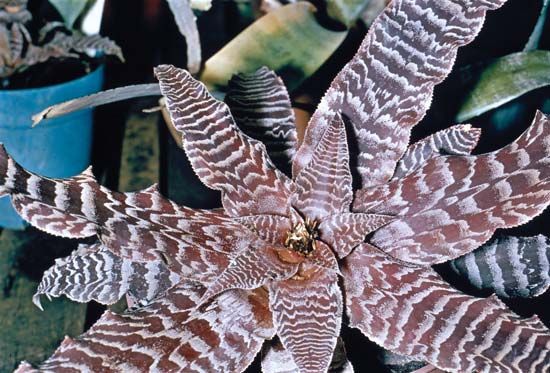
- Cryptanthus (earth stars)
- Dyckia
- Guzmania
- Hechtia
- Neoglaziovia
- Neoregelia
- Nidularium
- Puya (including the giant Puya raimondii)
- Tillandsia (air plants)
- Vriesea
Additionally, some species are notable for unique traits, such as the carnivorous plants Brocchinia reducta, B. hectioides, and Catopsis berteroniana. These plants exhibit a wide variety of forms, ranging from terrestrial rosettes to epiphytes that thrive in tree canopies.768
How do showy bracts help a plant attract pollinators?
Showy bracts help a plant attract pollinators by functioning as visual advertisements that mimic the appearance of petals. While a bract is technically a modified, often leaflike structure positioned beneath a flower or inflorescence, its bright coloration—such as the vibrant pinks or whites seen in dogwood blossoms or the bold hues of poinsettias—serves to draw the attention of insects, birds, and other pollinators from a distance.9
In the broader context of plant pollination, these structures act as part of the plant’s advertising coloration. By providing a conspicuous signal, they guide pollinators toward the actual reproductive parts of the plant. Once a pollinator is attracted to the general area, the plant may use additional cues, such as specific patterns or nectar guides, to orient the visitor toward the proper location for pollen transfer. This visual strategy is essential for ensuring that pollinators visit multiple flowers of the same species, thereby facilitating successful fertilization.1011
Sources
- Guzmania — Encyclopædia Britannica
- guzmania — Merriam-Webster
- epiphyte — Encyclopædia Britannica
- Did you know? — Merriam-Webster
- parasitic plant — Encyclopædia Britannica
- list of plants in the family Bromeliaceae — Encyclopædia Britannica
- Bromeliaceae — Encyclopædia Britannica
- houseplant - Foliage plants — Encyclopædia Britannica
- coloration - Interspecific signals — Encyclopædia Britannica
- bract — Encyclopædia Britannica
- Botanical Sex: 9 Alluring Adaptations — Encyclopædia Britannica
- pollination - Bees — Encyclopædia Britannica
- bract — Merriam-Webster
Published on · 3 min read