Loma Mountains
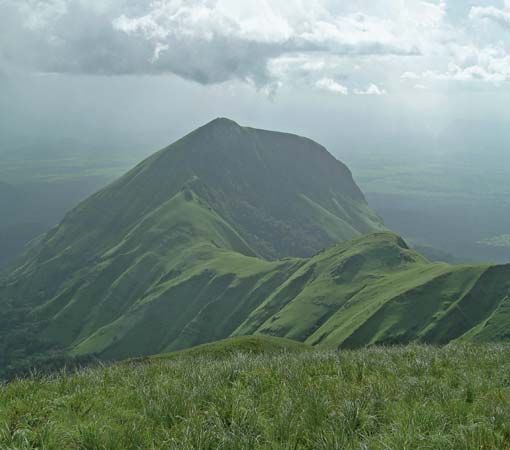
The Loma Mountains are a mountain range located in northeastern Sierra Leone, extending approximately 20 miles (32 km) in a north-south direction within the…
What is Loma Mountains?
The Loma Mountains are a mountain range located in northeastern Sierra Leone, extending approximately 20 miles (32 km) in a north-south direction within the Guinea Highlands.1
Rising abruptly from a granite plateau and savanna grasslands, the range is home to Mount Loma Mansa (also known as Bintimani), which stands at 6,391 feet (1,948 meters) and serves as the highest peak in the country. The area is sparsely populated, and portions of the range have been designated as a forest reserve. Additionally, the mountains act as a watershed, giving rise to several streams that feed into the Bagbe and Bafi tributaries of the Sewa River.12
What is the significance of Mount Loma Mansa?
Mount Loma Mansa, also known as Bintimani, holds significant status as the highest peak in Sierra Leone, reaching an elevation of 6,391 feet (1,948 meters).12
Located within the Loma Mountains in the northeastern part of the country, the peak is a prominent feature of the Guinea Highlands. Its significance lies primarily in its role as a major geographical landmark that rises abruptly above the surrounding granite plateau and savanna grasslands. As part of the interior plateau and mountain region, it defines the high-altitude topography of the nation’s eastern half.12
How do the Guinea Highlands influence the region’s climate?
The Guinea Highlands play a significant role in shaping the regional climate, primarily through their influence on precipitation and moisture distribution. As a mountainous plateau, the highlands act as a critical divide for water systems, separating streams that flow northward toward the Niger River from those that flow southward toward the Atlantic Ocean.3
The presence of these highlands is essential for generating orographic (mountain-induced) rainfall, which helps sustain the humid conditions of the region. In contrast, areas lacking such highlands—such as the coast from Ghana to Benin—experience significantly lower annual precipitation, partly because the absence of elevated terrain deprives those regions of this orographic effect.4
The highlands are characterized by being well-watered, with precipitation occurring throughout most of the year, supporting diverse ecosystems like humid savanna and rainforests. By modifying local atmospheric conditions, the highlands help mitigate the enervating effects of high temperatures and humidity, providing a more temperate environment in their higher elevations compared to the surrounding lowlands.354
What are the main physical regions of Sierra Leone?
Sierra Leone is geographically divided into four distinct physical regions:2
- Coastal Swamp: This region extends along the Atlantic Ocean for approximately 200 miles. It is a low-lying, flat area composed primarily of sands and clays, characterized by numerous creeks, estuaries, and mangrove swamps.2
- Sierra Leone Peninsula: Located along the coast, this area features thickly wooded mountains that run parallel to the sea. The Peninsula Mountains rise from the coastal swamps, reaching elevations of about 2,900 feet at Picket Hill.2
- Interior Plains: Situated inland from the coastal plain, this region varies in character. In the north, it consists of seasonal swamps known as “Bolilands,” while the south features rolling, wooded country with isolated hills rising over 1,000 feet.2
- Interior Plateau and Mountain Region: Encompassing roughly the eastern half of the country, this region is primarily composed of granite. It contains significant mountain masses, including the Loma Mountains and the Tingi Mountains, which host the country’s highest peaks, such as Mount Loma Mansa.2
Sources
- Loma Mountains — Encyclopædia Britannica
- Sierra Leone - Relief — Encyclopædia Britannica
- Guinea Highlands — Encyclopædia Britannica
- Guinea - Climate — Encyclopædia Britannica
- Ghana - Climate — Encyclopædia Britannica
- Africa - Climatic regions — Encyclopædia Britannica
- West African monsoon — Encyclopædia Britannica
- Sierra Leone — Encyclopædia Britannica
- Sierra Leone River — Encyclopædia Britannica
- Guinea-Bissau - Climate — Encyclopædia Britannica
Published on · 2 min read