Eyjafjallajökull
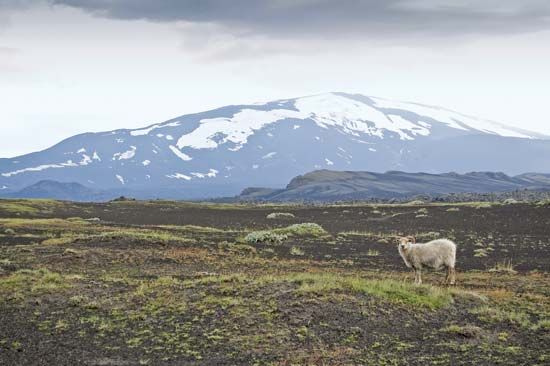
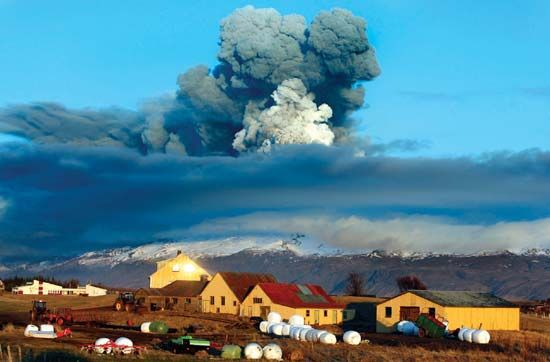
The name Eyjafjallajökull is derived from an Icelandic phrase meaning "the island's mountain glacier." It refers to the glacier located in southern Iceland…
How do Icelanders pronounce Eyjafjallajökull, and what does the name mean?
The name Eyjafjallajökull is derived from an Icelandic phrase meaning “the island’s mountain glacier.” It refers to the glacier located in southern Iceland that covers the Eyjafjallajökull volcano.12
Regarding your request for pronunciation, the provided search results do not contain information on how to phonetically pronounce the name.
How has climate change affected Eyjafjallajökull and other glaciers in Iceland?
Glaciers in Iceland, including Eyjafjallajökull, have experienced significant fluctuations due to changing environmental conditions. While these glaciers are sustained by heavy snowfall, they have generally undergone a major retreat since approximately 1890, with rapid recession observed since the 1930s, punctuated only by a brief period of interruption in the 1970s.1
This trend is consistent with the broader experience of Arctic glaciers, the majority of which recorded negative mass balances throughout the 20th century, leading to the thinning of ice and the retreat of glacier fronts. The melting of these ice masses contributes to global sea-level rise, a process driven by both the loss of glacier mass and the thermal expansion of warming oceans. Furthermore, the influx of fresh water from melting glaciers into the North Atlantic has been studied for its potential to weaken the thermohaline circulation, which plays a critical role in moderating the climate of the North Atlantic region.134
How does the combination of a glacier and volcano make Eyjafjallajökull unique?
The uniqueness of Eyjafjallajökull lies in its status as a subglacial volcano, where the interaction between molten magma and the overlying glacier ice creates distinct and powerful geological phenomena.
When volcanic activity occurs beneath the ice, the intense heat rapidly melts and vaporizes the glacier, leading to two primary consequences:
- Explosive Eruptions: The rapid vaporization of ice creates a massive buildup of gas pressure. This results in phreatomagmatic explosions—caused by the contact between water and magma—which can propel plumes of steam and ash high into the atmosphere. During the 2010 eruption, this process sent ash plumes nearly 7 miles (11 km) high, causing widespread disruption to air travel across Europe.1
- Glacial Flooding: The melting ice releases significant volumes of water, mud, and debris. These flows can swell local rivers, causing catastrophic flooding that damages infrastructure and farmland.21
This dynamic relationship between fire and ice is a defining characteristic of many Icelandic volcanoes, which are situated atop the Mid-Atlantic Ridge and often buried under extensive ice fields.78
What other notable volcanoes are there in Iceland, and how do they compare to Eyjafjallajökull?
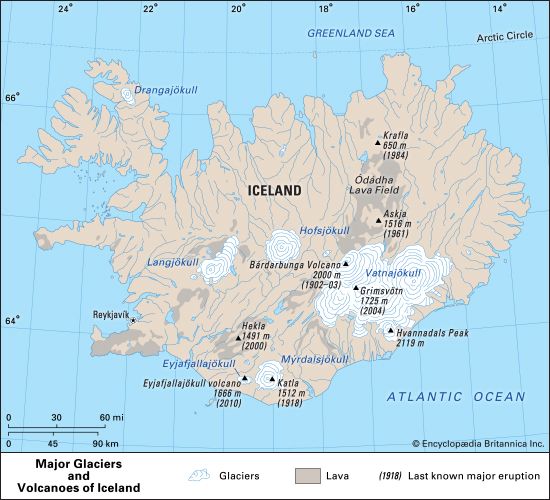
Iceland is home to approximately 200 volcanoes of various types, shaped by its position atop the Mid-Atlantic Ridge. While Eyjafjallajökull is famous for its 2010 air-travel disruption, other volcanoes exhibit different eruptive habits and landforms.9
Notable Icelandic Volcanoes
- Hekla: Known as Iceland’s most active and best-known volcano, Hekla is transitional between a fissure-fed plateau and a symmetrical stratovolcano10. Unlike the subglacial Eyjafjallajökull, Hekla erupts from a 3.4-mile-long fissure. Its eruptions often begin with an explosive ash phase followed by lava fountaining or flows.2
- Katla: Located only 15.5 miles east of Eyjafjallajökull, Katla is also a subglacial volcano beneath the Mýrdalsjökull glacier. Historically, eruptions of the two have sometimes occurred simultaneously. Katla is highly active and, like Eyjafjallajökull, produces explosive steam and ash clouds when magma vaporizes the overlying ice. Its 1918 eruption was particularly notable for producing massive lahars that expanded the southern coastline.1011
Comparison Summary
Feature
Eyjafjallajökull
Hekla
Katla
Primary Type
Subglacial
Fissure/Stratovolcano
Subglacial
Eruption Style
Explosive (phreatomagmatic)
Explosive/Effusive
Explosive (subglacial)
Key Characteristic
2010 ash plume disruption
Long fissure (Heklugjá)
Frequent, massive mudflows
While Eyjafjallajökull and Katla share the subglacial environment that drives explosive, ice-melting eruptions, Hekla’s morphology is defined by its unique fissure system, making it a distinct geological feature in the same volcanic zone.8211
Sources
- Eyjafjallajökull — Encyclopædia Britannica
- Eyjafjallajökull volcano — Encyclopædia Britannica
- iceberg - Impacts on ice sheets and sea level — Encyclopædia Britannica
- Arctic - Other glacier groups — Encyclopædia Britannica
- glacier - Mass balance of mountain glaciers — Encyclopædia Britannica
- Global warming - Ocean circulation changes — Encyclopædia Britannica
- Vatnajökull — Encyclopædia Britannica
- Katla — Encyclopædia Britannica
- Iceland - Land — Encyclopædia Britannica
- volcano - Determinants of size and shape — Encyclopædia Britannica
- Hekla — Encyclopædia Britannica
Published on · 3 min read