Helium Dating
Helium dating is a method of age determination based on the accumulation of helium produced by the radioactive decay of uranium-235, uranium-238, and…
How has helium dating contributed to our understanding of prehistoric life and Earth’s history?
Helium dating is a method of age determination based on the accumulation of helium produced by the radioactive decay of uranium-235, uranium-238, and thorium-232. By measuring the ratio of helium to these parent isotopes, scientists can estimate the age of minerals, rocks, and even fossils.
Historically, this method provided the foundation for early geologic time scales. However, it faces significant challenges because helium is a gas that can easily escape from rock, often leading to age estimates that are too low. Thermal events can also disrupt the helium clock, making it less reliable than other radiometric methods for older materials.1
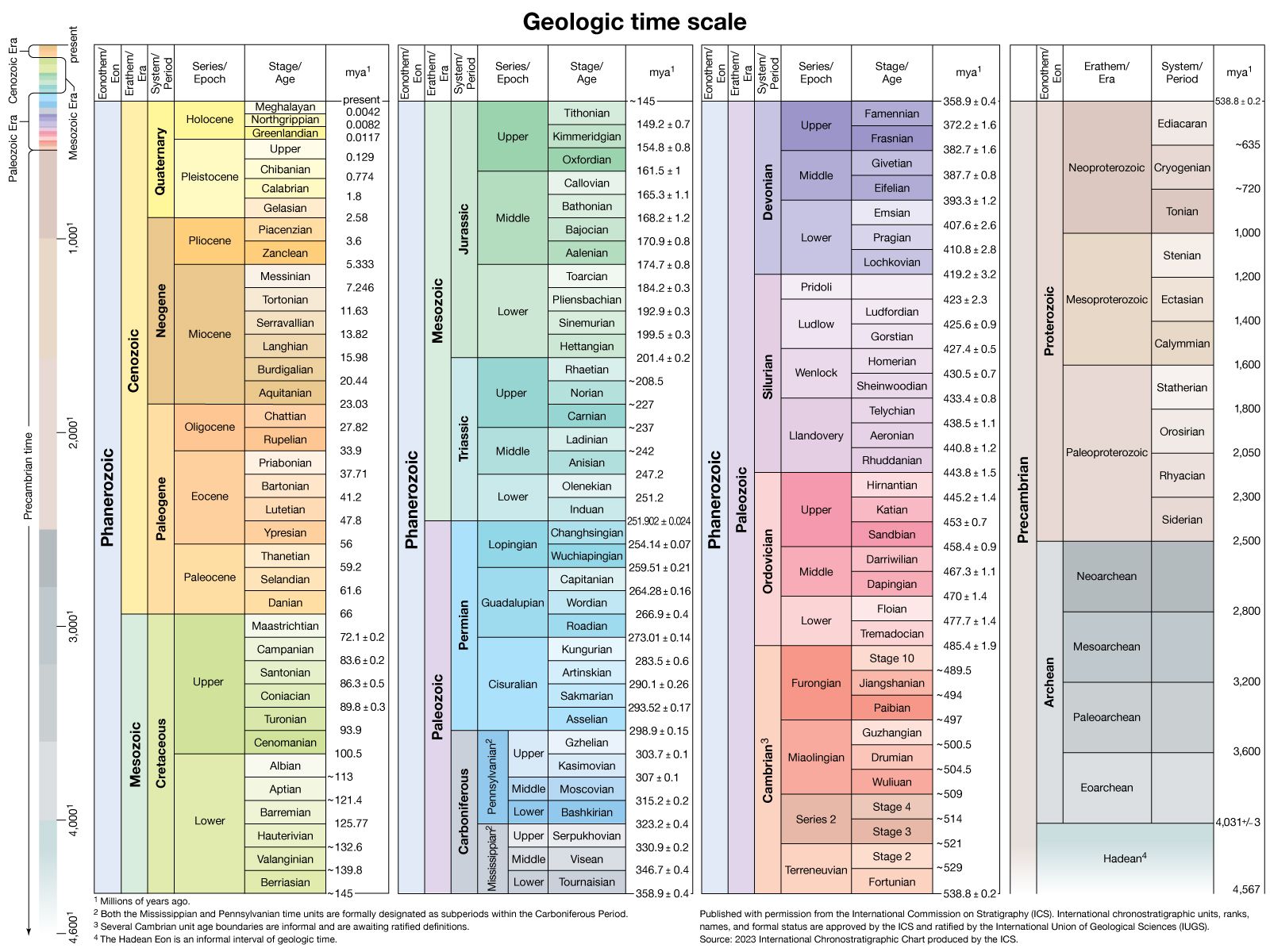
Despite these limitations, the technique remains valuable for studying Earth’s history. It is particularly promising for dating rocks and minerals from the late Cenozoic and Pleistocene, as these younger samples are less likely to have experienced complex thermal histories that would cause helium loss. This potential allows researchers to better understand relatively recent geologic events.1
What is the relationship between helium dating and radioactive decay?
Helium dating is a method of age determination that relies on the accumulation of helium produced through the radioactive decay of specific parent isotopes, namely uranium-235, uranium-238, and thorium-232.1
The relationship between these processes is defined by the following mechanisms:
- Alpha Decay: During the radioactive decay of these heavy elements, the nucleus ejects an alpha particle, which is identical to the nucleus of a helium-4 atom.156
- Accumulation: As these parent isotopes decay over time, the resulting helium atoms become trapped within the crystal structure of minerals or rocks.1
- Geologic Clock: Because the rate of radioactive decay is constant for a given isotope, the ratio of the accumulated helium to the remaining parent isotopes serves as a measure of geologic time.1
While this method was historically significant for establishing early geologic time scales, it is limited by the fact that helium is a gas that can easily escape from rock, often resulting in underestimated ages.1
How has the development of helium dating techniques evolved over time?
The evolution of helium dating techniques reflects a transition from early foundational geochronology to more specialized, modern applications.
Early Development and Limitations
Historically, helium dating was a primary method for establishing geologic time scales before the widespread adoption of mass spectrometry in isotopic geochronology. Early techniques often relied on the “alpha-helium radioactive clock,” which measured alpha-particle emission and total helium content to estimate the age of minerals and rocks.1
However, these early methods faced significant reliability challenges. Because helium is a gas, it can easily escape from rock structures, particularly when subjected to thermal events that might not affect other radioactive clocks. This tendency often led to underestimated ages, limiting the method’s precision for older geologic materials.1
Modern Perspectives and Future Utility
The development of more sophisticated analytical tools has refined how researchers approach helium dating:
- Uranium–Thorium–Helium Dating: By measuring the parent isotopes (uranium-235, uranium-238, and thorium-232) alongside helium, scientists can achieve more accurate results than by relying on helium content alone.1
- Focus on Younger Materials: Researchers now recognize that helium dating is particularly useful for late Cenozoic and Pleistocene rocks. These younger samples have not experienced the complex thermal histories of older rocks, making them more likely to have retained their helium.1
- Broadened Scope: The technique has expanded beyond rocks and minerals to include the dating of fossils. The significant volume of helium produced in certain rocks may even allow for the dating of materials as young as a few tens of thousands of years old.1
How does helium dating help in reconstructing ancient environments and climates?
Helium dating serves as a tool for reconstructing Earth’s history by measuring the accumulation of helium within minerals and rocks, which results from the radioactive decay of uranium-235, uranium-238, and thorium-232.1
While the method is primarily used for age determination, its utility in understanding ancient environments and climates is linked to its ability to date materials from the recent geologic past, specifically the late Cenozoic and Pleistocene epochs. Because these younger samples have not been subjected to the complex thermal histories or deep burial that often reset older isotopic clocks, they are more likely to retain their helium, providing reliable chronological markers for environmental changes during these periods.1
Furthermore, because helium dating can be applied to fossils as well as rocks, it allows researchers to place biological and environmental evidence within a precise temporal framework. By establishing these timelines, scientists can better interpret the global changes that occurred during Earth’s recent history, contributing to a broader understanding of past climate dynamics.12
Sources
- helium dating — Encyclopædia Britannica
- dating - Origin of radioactive elements used — Encyclopædia Britannica
- geology - Historical geology and stratigraphy — Encyclopædia Britannica
- mass spectrometry - Geochronology and geochemistry — Encyclopædia Britannica
- atom - Radioactive decay — Encyclopædia Britannica
- radioactivity - Alpha decay — Encyclopædia Britannica
- helium — Encyclopædia Britannica
- dating - Technical advances — Encyclopædia Britannica
- dating - Multiple ages for a single rock: the thermal effect — Encyclopædia Britannica
Published on · 4 min read