Henbane
Henbane (Hyoscyamus niger) is a highly toxic member of the Solanaceae family that has been utilized in both formal medicine and folk practices for centuries.
How has henbane been used historically in medicine and folklore?
Henbane (Hyoscyamus niger) is a highly toxic member of the Solanaceae family that has been utilized in both formal medicine and folk practices for centuries.
Historically and in modern pharmaceuticals, the plant is valued as a source of three potent alkaloids: atropine, hyoscyamine, and scopolamine. These compounds are extracted and purified for their medicinal properties, though the plant itself remains dangerous.123
In the context of folklore and traditional herbalism, henbane has been used in various ways, including as an ingredient in illicit smoking mixtures and, in some regions like India, as a beverage. However, it is critical to recognize that henbane is a powerful poison; ingestion of the plant can be fatal, and its use outside of controlled medical settings poses severe health risks. Due to its toxicity, any historical or traditional use must be viewed with extreme caution regarding safety and ethical health standards.21
Are there any modern medicinal uses for henbane or its derivatives?
Yes, henbane (Hyoscyamus niger) is a source of three potent alkaloids—atropine, hyoscyamine, and scopolamine—that are purified for use in modern pharmaceuticals.1
Medicinal Applications of Derivatives
While the plant itself is highly toxic, its extracted derivatives are utilized in clinical settings:
- Atropine: Used to dilate the pupil for eye examinations, reduce secretions before surgery, and treat certain types of bowel distress. It also serves as an antidote for organophosphate nerve agent poisoning.5
- Scopolamine: Primarily used as an effective remedy for motion sickness. It is also employed to dry up secretions and dilate the bronchi during anesthesia, as well as to dilate pupils during ophthalmological procedures.6
- Hyoscyamine: Found in henbane and other nightshades, it is used similarly to atropine in medical practice.24
Due to the nonselective nature and potential adverse effects of these natural alkaloids, modern medicine has also developed synthetic and semisynthetic substitutes, such as dicyclomine and oxybutynin, which offer more targeted therapeutic actions.5
What are the distinctive physical characteristics of the henbane plant?
The henbane plant (Hyoscyamus niger) is a highly toxic, fetid-smelling herb belonging to the Solanaceae family. Its physical characteristics include:
- Stems and Leaves: The plant features large, alternately arranged leaves with irregular lobes. Both the stems and leaves are covered in sticky glandular hairs (trichomes), and the entire plant emits a powerful, nauseous odor.24
- Root System: It possesses a branching taproot, which is thick and fleshy in the biennial form.2
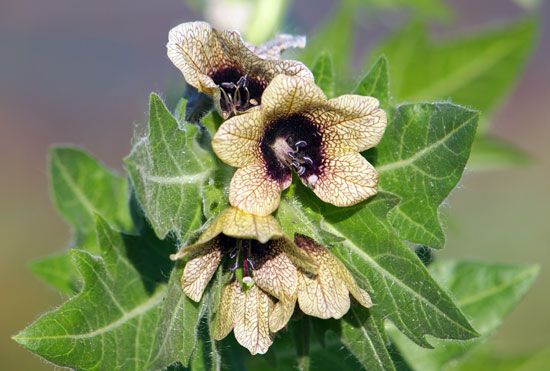
- Flowers: The showy, funnel-shaped flowers consist of five cream to dark yellow petals, characterized by distinct purple veins and dark centers.2
- Fruit and Seeds: The fruit is a capsule containing numerous small black seeds.2
- Growth Forms: There are two distinct forms:
What is henbane and where does it naturally grow?
Henbane (Hyoscyamus niger) is a highly toxic plant belonging to the nightshade family (Solanaceae). It is characterized by its fetid odor, sticky glandular hairs, and funnel-shaped, yellowish-brown flowers with purple veins.24
The plant is native to Eurasia but has become naturalized throughout much of the world. It exists in both annual and biennial forms, often found growing in disturbed soils. While it contains medicinal alkaloids such as atropine, hyoscyamine, and scopolamine that are extracted for pharmaceutical use, the plant itself is dangerous and can be fatal if ingested.24
Sources
- hyoscyamine — Encyclopædia Britannica
- Henbane — Encyclopædia Britannica
- Egyptian henbane — Merriam-Webster
- henbane — Merriam-Webster
- atropine — Encyclopædia Britannica
- scopolamine — Encyclopædia Britannica
- hyoscyamine — Merriam-Webster
- alkaloid — Encyclopædia Britannica
Published on · 3 min read