Herring Gull
The herring gull (Larus argentatus) is the most common gull found in the Northern Hemisphere, particularly across the Atlantic region. These birds are…
What is herring gull?
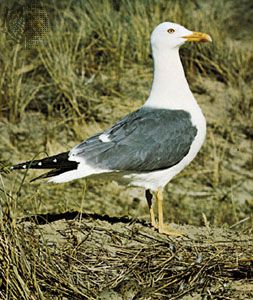
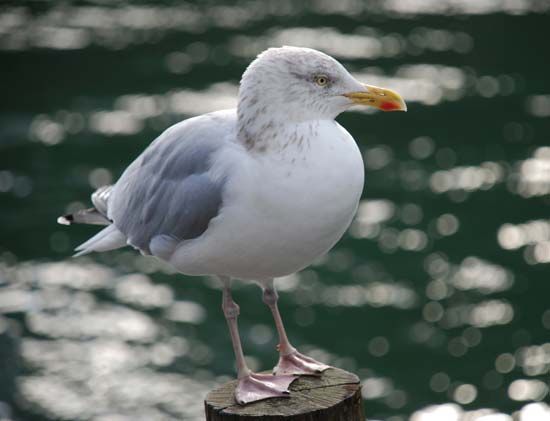
The herring gull (Larus argentatus) is the most common gull found in the Northern Hemisphere, particularly across the Atlantic region. These birds are characterized by a gray mantle, flesh-coloured legs and feet, and wing tips that are spotted with black and white.12
As adaptable scavengers, herring gulls are known for their opportunistic feeding habits, which include consuming garbage, sewage, fish, mollusks, and occasionally even small mammals like moles or rabbits. They are also known to steal food from other birds and humans.12
Herring gulls inhabit subarctic and temperate regions, where they typically nest in colonies on rocky coasts or dunes. During the breeding season, they engage in elaborate social displays to establish territories and form pair bonds. While they were once rare due to the millinery trade, they have made a significant population recovery thanks to legal protections and the availability of food at waste sites.32
How do herring gulls communicate with each other during the breeding season?
During the breeding season, herring gulls utilize an elaborate repertoire of vocalizations and physical postures to establish territories, attract mates, and defend their brood. Communication is essential for maintaining social order within their colonies.2
Aggressive and Territorial Displays
To defend their nesting territories, gulls employ several distinct displays:
- Oblique with long call: The bird stretches its neck forward and upward with wings slightly extended, emitting a loud, long-drawn call with its bill wide open.
- Upright threat: A silent posture where the head is raised, the bill is angled downward, and the wings are held stiffly away from the body.
- Choking: Both members of a pair may stand with legs bent, breasts lowered, and heads pointed down, rhythmically jerking their heads while uttering a deep call to intimidate intruders.
- Pecking the ground: Birds may peck at or tear out vegetation to signal aggression.2
Courtship and Pair Bonding
Communication also serves to reduce aggression and foster pair bonds:
- Facing away: Birds turn their heads to the side to signal a reduction in aggressive feelings.
- Head tossing and begging: Females approach males with a horizontal body posture, often head tossing and uttering liquid calls. This behavior is also used by both sexes to initiate copulation.
- Courtship feeding: Males may regurgitate food for females, a behavior that reinforces the pair bond.2
Parental and Alarm Communication
Parents and chicks rely on specific signals for survival:
- Alarm calls: A specific call alerts the colony to danger, prompting defensive behaviors like mobbing.
- Chick feeding: Chicks peck at a red spot on the adult’s bill to induce regurgitation.
- Recognition: Incubating birds can identify their returning mates by call, even amidst the noise of a crowded colony.2
What are some other common species of gulls found in North America?
North America is home to a diverse array of gull species, many of which exhibit unique behaviors and habitats. Beyond the familiar herring gull, common species include:
- Ring-billed gull: Frequently found on inland lakes, these gulls are known for gathering in large flocks to feed in plowed fields. They are characterized by a yellow bill featuring a distinct black ring near the tip.34
- California gull: This species breeds inland and winters along the Pacific coast. It is famously associated with early Mormon settlers in the Salt Lake City region, where it helped protect crops from grasshopper infestations.3
- Bonaparte’s gull: A unique North American species that builds its nests in trees. It features a black head and bill, a gray mantle, and pinkish to reddish legs.3
- Laughing gull: Named for its strident, laughing call, this medium-sized gull has a black head and red bill. It breeds from Maine to South America and is the only gull that breeds in both the Caribbean and the North Atlantic.3
- Franklin’s gull: This species breeds in large colonies within the inland marshes of North America and migrates to the Pacific coast of South America for the winter.3
Why did the herring gull population decline in the early 20th century?
The decline of gull populations in North America during the late 19th and early 20th centuries was primarily driven by human exploitation. During the latter half of the 19th century, these birds were heavily hunted to supply the feather trade, as their plumage became a popular fashion accessory for decorating women’s hats. This intense raiding of breeding colonies brought several species to the brink of extirpation.5
Additionally, the eggs of gulls and other charadriiform birds were frequently harvested for food on a massive scale, often without regard for the long-term sustainability of the colonies. These practices were eventually curtailed due to a shift in public opinion and the advocacy efforts of newly formed Audubon societies, which successfully campaigned for the protection of these species.5
Sources
- herring gull — Encyclopædia Britannica
- Charadriiform - Gulls (suborder Lari) — Encyclopædia Britannica
- Gull — Encyclopædia Britannica
- ring-billed gull — Merriam-Webster
- Charadriiform - Importance to humans — Encyclopædia Britannica
- Pelecaniform - Importance to humans — Encyclopædia Britannica
Published on · 4 min read