Gull
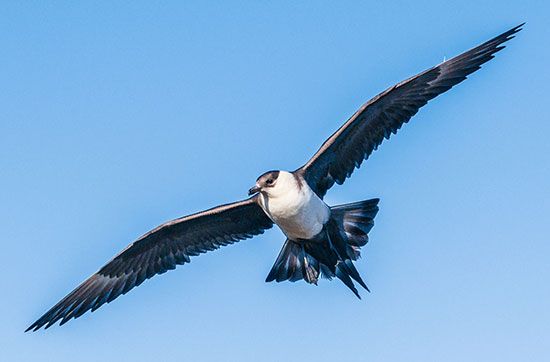
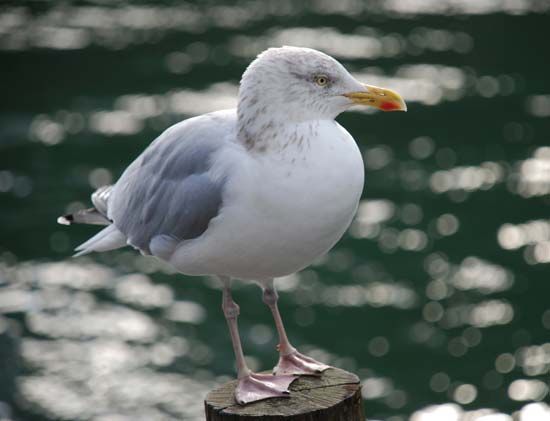
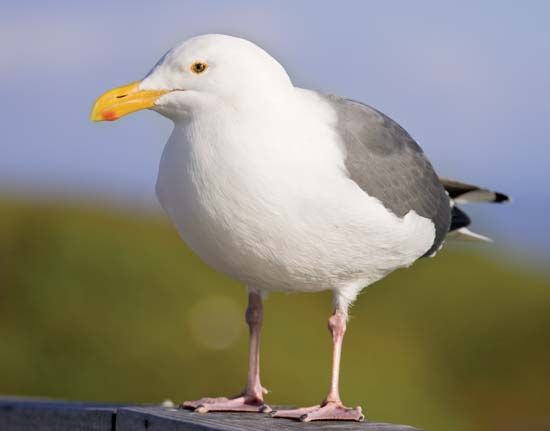
Gulls are heavily built, web-footed seabirds belonging to the family Laridae. Their physical characteristics are defined by several key features:
What are the distinguishing physical characteristics of gulls?
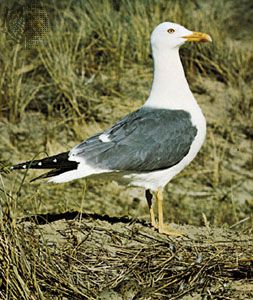
Gulls are heavily built, web-footed seabirds belonging to the family Laridae. Their physical characteristics are defined by several key features:
- Plumage: Adult gulls typically display solid patterns of white, gray, black, or sooty brown. During the breeding season, the head may be pure white, black, gray, or brown, while in winter, it often becomes streaked or smudgy.12
- Bills and Legs: Gulls possess strong, somewhat hooked bills, which are often brightly colored in red or yellow and may feature a spot of color in some species. Their legs are also frequently brightly colored.12
- Wings: They are characterized by long, pointed wings that are adapted for efficient flight, featuring low wing loadings and slow wing beat rates.23
- Feet: As web-footed birds, they have front toes that are fully webbed, which aids in their aquatic lifestyle.12
- Size: They range in size from small to large, with lengths typically between 20 and 76 cm (8 to 30 inches).2
How do gulls reproduce, and what is their nesting behavior like?
Gulls are primarily colonial ground nesters that exhibit complex social and reproductive behaviors. As spring approaches, they return to traditional breeding colonies, where established pairs defend specific territories through aggressive displays, such as the “oblique with long call” or “choking” postures.41
Courtship and Nesting
Before mating, younger, unpaired birds gather in groups called “clubs.” Courtship involves specific behaviors, including “head tossing,” vocalizations, and “courtship feeding,” where the male regurgitates food for the female. Once a pair is formed, they establish a territory and construct a nest—often a hollow or “scrape” in the ground lined with straw and moss. While most gulls are ground nesters, some species, such as Bonaparte’s gull, build nests in trees, and others, like the kittiwake, nest on narrow cliff ledges ](https://www.britannica.com/animal/kittiwake), nest on narrow cliff ledges.41
Incubation and Brood Defense
Females typically lay three eggs at two-day intervals. Both parents share incubation duties, often relieving each other every few hours. Parents are highly protective, using mobbing tactics to distract or repel predators. Once hatched, chicks are brooded for about three days and fed by their parents, who regurgitate food that the chicks access by pecking at a colored spot on the adult’s bill.4
How widespread are gulls, and in what habitats can they be found?
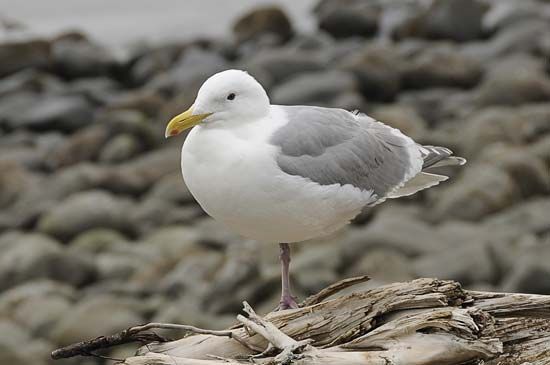
Gulls are highly widespread and adaptable birds, with more than 40 species found globally. They are most abundant as breeders in the Northern Hemisphere, particularly in temperate to Arctic regions, where approximately 30 species reside.1
Gulls are remarkably versatile in their habitat selection, occupying a diverse range of environments:
- Coastal and Marine: Many species are found along seacoasts, beaches, and sandbars, which serve as essential areas for roosting and feeding. Some species, such as the glaucous gull, inhabit northern seas, while others are found across the Atlantic Ocean and Indian Ocean1.14
- Inland Waters and Wetlands: Numerous gulls frequent inland lakes, ponds, and marshes. For example, the ring-billed gull is common on North American inland lakes, and Franklin’s gull breeds in inland marshes.1
- Terrestrial and Human-Modified Landscapes: Gulls are frequently seen in agricultural areas, such as plowed fields, where they forage for worms and grubs. They are also well-known for their presence in human-dominated environments, often scavenging for food at garbage dumps, near ships, and even in urban or recreational areas.1
- Extreme Environments: Their adaptability extends to unique locations, such as the Galapagos Islands, the waterless deserts of Chile, and even Antarcticaless deserts of Chile, and even Antarctica.14
What are the different species of gulls, and how do they differ from each other?
There are more than 40 species of gulls, which are members of the family Laridae. While many authorities group them under the broad genus Larus, they exhibit significant diversity in appearance, behavior, and habitat.1
Distinguishing Characteristics
Gulls are generally identified by variations in their size, wing patterns, and the colors of their bills and legs. Adult plumage is typically gray or white, though head markings change seasonally; during the breeding season, heads may be pure white, gray, brown, or black, while they often become streaked or smudgy in winter. Additionally, many gulls undergo age-related color changes, appearing deep gray or brown in their first year and becoming increasingly white as they mature.14
Notable Species Variations
Species are often distinguished by their unique traits and adaptations:
- Size: The great black-backed gull is the largest species, with a wingspan of 1.6 meters (63 inches), while the little gull is the smallest, with a wingspan of about 60 cm (24 inches).1
- Physical Features: The swallow-tailed gull and Sabine’s gull are unique for their forked tails.1
- Nesting Habits: While most are ground nesters, Bonaparte’s gull builds nests in trees, and kittiwakes are specialized to nest on narrow cliff ledges.17
- Behavioral Traits: The laughing gull is known for its strident, laughing call, and the California gull is famous for its historical role in protecting early Mormon crops from grasshoppers.1
Sources
- Gull — Encyclopædia Britannica
- Charadriiform - Annotated classification — Encyclopædia Britannica
- Falconiform - Plumage and molt — Encyclopædia Britannica
- Charadriiform - Gulls (suborder Lari) — Encyclopædia Britannica
- Charadriiform - Adaptations for flight — Encyclopædia Britannica
- Plumage — Encyclopædia Britannica
- coloration - Age-related changes — Encyclopædia Britannica
- Bird - Molting — Encyclopædia Britannica
Published on · 4 min read