Hippopotamus
The hippopotamus (Hippopotamus amphibius) is a massive, amphibious mammal characterized by a bulky body, stumpy legs, an enormous head, and a short tail.…
What are the physical characteristics and size of a hippopotamus?
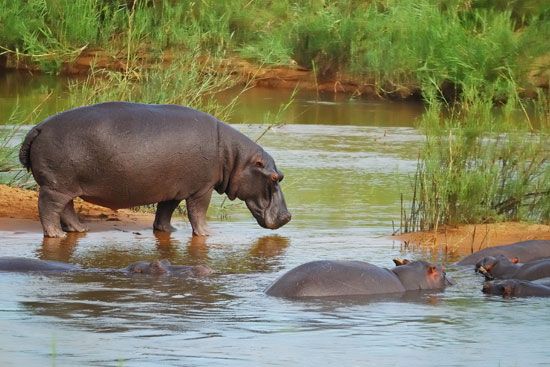
The hippopotamus (Hippopotamus amphibius) is a massive, amphibious mammal characterized by a bulky body, stumpy legs, an enormous head, and a short tail. Often considered the second-largest land animal after the elephant, it is comparable in size to the rhinoceros.12
Physical Characteristics
- Skin: Nearly hairless and grayish brown with pinkish underparts. It is approximately 5 cm (2 inches) thick on the flanks.1
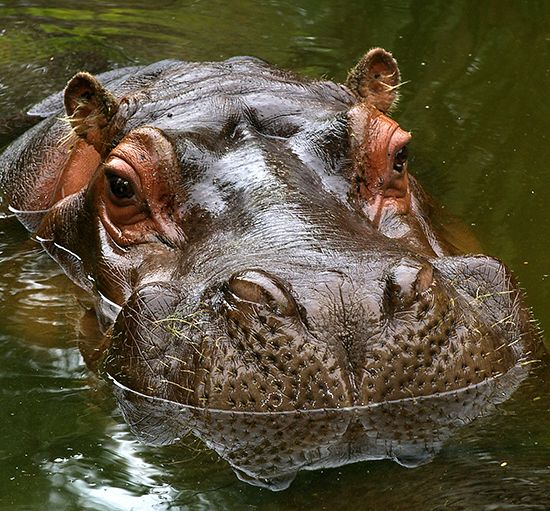
- Adaptations: The eyes, ears, and nostrils are positioned high on the head, allowing the animal to remain submerged while breathing and observing its surroundings.1
- Mouth: The mouth can reach half a meter in width and gape 150°, revealing sharp lower canines that may exceed 30 cm (12 inches).1
- Secretions: Lacking sweat glands, hippos secrete an oily, reddish-pink substance that acts as a natural sunblock.1
Size and Weight
Males are significantly larger than females, weighing roughly 30 percent more.21
- Males: Typically measure 3.5 meters (11.5 feet) long, stand 1.5 meters (5 feet) tall, and weigh between 1,600 and 3,200 kg (2–3.5 tons).21
- Females: Average between 1,300 and 2,350 kg (1.5–2.5 tons).2
Where do hippopotamuses live, and what type of habitat do they prefer?
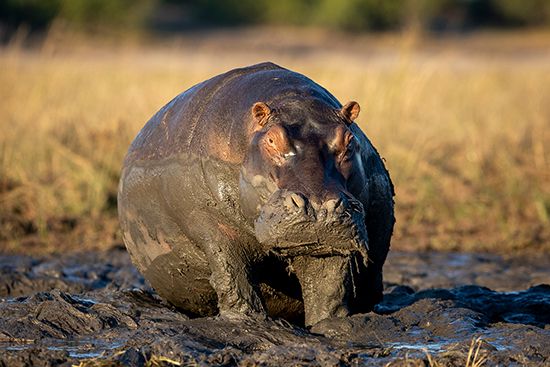
Hippopotamuses (Hippopotamus amphibius) are native to the African continent, where they currently inhabit regions across eastern, central, and parts of southern Africa.2
Preferred Habitat
Hippos are amphibious animals that require specific environmental conditions to survive:
- Aquatic Environments: They favor shallow rivers, lakes, and swamps that allow them to remain partially submerged, a behavior known as “rafting.” These water bodies serve as essential “day living spaces” where they sleep and stay cool, as they do not sweat and lose water rapidly through their skin.2
- Proximity to Grasslands: Their habitat must be near grasslands, as they are nocturnal grazers. At night, they follow familiar paths up to 10 km (6 miles) inland to feed on vegetation for several hours.2
- Space Requirements: Because they are gregarious, they require pools large enough to accommodate their social groups. During the dry season, these areas can become quite crowded, with as many as 150 individuals sharing a single pool.2
How fast can a hippopotamus run, and why is this surprising given their size?
Despite their massive size, hippopotamuses are surprisingly fast runners, capable of reaching speeds of up to 30 kilometers per hour (19 miles per hour) on land.3
This capability is considered surprising because of the animal’s immense physical build. Weighing up to 3,200 kg (3.5 tons), the hippo is the only living artiodactyl large enough to require heavy, pillar-like limbs simply to support its own body weight. While most animals of such significant mass are typically slower, the hippo’s ability to achieve these speeds is a testament to its powerful physical capabilities, which it often utilizes when defending its territory or feeling threatened.34
Are there different species of hippopotamuses, and if so, how do they differ?
Yes, there are two distinct living species within the family Hippopotamidae: the common hippopotamus (Hippopotamus amphibius) and the pygmy hippopotamus (Choeropsis liberiensis, also known as Hexaprotodon liberiensis).62
These two species differ significantly in size, behavior, and physical characteristics:
- Size and Build: The common hippopotamus is a massive animal, with males weighing up to 3,200 kg (3.5 tons). In contrast, the pygmy hippopotamus is much smaller, reaching a weight of only about 270 kg (600 pounds), roughly the size of a domestic pig.62
- Aquatic Habits: While the common hippo is highly aquatic and gregarious, spending its days “rafting” in large groups in rivers and lakes, the pygmy hippo is less aquatic and less gregarious. It is typically found alone or in very small groups in lowland tropical forests and swamps.62
- Physical Features: The pygmy hippo has a rounder head with eyes set to the sides, whereas the common hippo has eyes, ears, and nostrils positioned high on its head to facilitate remaining submerged. Additionally, the pygmy hippo has less webbing between its toes and possesses only one pair of lower incisor teeth.6
Sources
- How much does a hippopotamus weigh? — Encyclopædia Britannica
- hippopotamus — Encyclopædia Britannica
- Why are hippos dangerous? — Encyclopædia Britannica
- 9 of the World’s Deadliest Mammals - Hippopotamuses ( Hippopotamus amphibius ) — Encyclopædia Britannica
- artiodactyl - Locomotion — Encyclopædia Britannica
- pygmy hippopotamus — Merriam-Webster
Published on · 3 min read