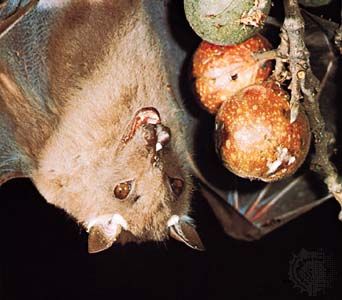
Jamaican Fruit Bat
The primary predators of the Jamaican fruit bat are opossums.
What are the main predators of Jamaican fruit bats?
The primary predators of the Jamaican fruit bat are opossums.
When a Jamaican fruit bat is captured by a predator, it emits distress calls that serve to summon other members of its colony to its defense. Beyond this specific interaction, the species relies on its ability to navigate and forage in the dark using echolocation and its keen sense of smell to locate ripe fruit, which helps it maintain its role in seed dispersal within tropical forest ecosystems.1
How do Jamaican fruit bats interact with human populations and agriculture?
The Jamaican fruit bat (Artibeus jamaicensis) interacts with human populations and agriculture primarily through its feeding habits and roosting behaviors.
Agricultural Impact
These bats are known to feed on a variety of cultivated fruits, including bananas, papayas, and guavas. Because they forage in large numbers, they have been reported to damage fruit crops. To mitigate these losses, farmers sometimes protect crops like bananas and figs by harvesting them early or by using protective netting.15
Human Interactions
In tropical regions, large colonies of these bats may inhabit houses and public buildings, where they are often noticed due to their noise, the accumulation of guano, and their distinct odor. While they are sometimes viewed unfavorably in Western culture, they are regarded as symbols of good luck and happiness in parts of the Orient.5
Ecological Contribution
Despite their status as agricultural pests, Jamaican fruit bats provide a significant benefit to the environment. By consuming fruit and dispersing seeds across tropical forests, they play a vital role in forest regeneration.13
What is the lifespan of a Jamaican fruit bat in the wild versus in captivity?
In the wild, the life expectancy of the Jamaican fruit bat (Artibeus jamaicensis) is relatively short, rarely exceeding two or three years.1
Information regarding the specific lifespan of this species in captivity is not provided in the current knowledge base. While some tropical bat species are known to live for more than 10 years, and certain temperate species can live for over 20 or even 30 years, longevity data for most tropical bats remains limited.7
How do Jamaican fruit bats reproduce and care for their young?
The reproduction of the Jamaican fruit bat (Artibeus jamaicensis) is uniquely adapted to its environment and food availability.
Reproductive Strategy
- Mating System: Males form harems and actively defend their roost sites, while other males typically roost in nearby foliage.1
- Postpartum Estrus: Females are capable of reproducing immediately after giving birth, a phenomenon known as postpartum estrus.1
- Gestation: The gestation period is highly flexible, ranging from as little as four weeks to several months. This duration is closely linked to the seasonal availability of fruit, allowing the species to time births with peak food abundance.1
- Births: Females typically give birth to a single offspring. These births are synchronized within the population, leading to one or two distinct birth peaks annually.1
Care for Young
While specific details on maternal care are limited, it is common among many bat species for pregnant females to occupy specialized nursery roosts. In these settings, females remain with their young until they reach independence.8
Sources
- Jamaican fruit bat — Encyclopædia Britannica
- bat - Anatomical specializations — Encyclopædia Britannica
- bat - Importance to humans — Encyclopædia Britannica
- fringe-lipped bat — Encyclopædia Britannica
- Hitching a ride — Encyclopædia Britannica
- fruit bat — Encyclopædia Britannica
- bat - Life cycle — Encyclopædia Britannica
- bat - Social interactions — Encyclopædia Britannica
Published on · 2 min read