Honey Ant
The provided search results do not contain specific information regarding the mechanism or criteria by which honey ant colonies select which individual…
How do honey ant colonies select which workers will become repletes?
The provided search results do not contain specific information regarding the mechanism or criteria by which honey ant colonies select which individual workers will become repletes.
While it is known that repletes are a specialized worker caste that serves as a living food storage system—distending their abdomens to store honeydew when food is plentiful—the specific process of selection remains unaddressed in the available documentation. In broader biological contexts, caste differentiation in social insects is often influenced by diet, hormones, or environmental factors, but these general principles are not explicitly linked to the selection of honey ant repletes in the provided text.123
In which regions of the world can honey ants be found?
The provided search results do not specify the exact global regions where honey ants are found. While the documents identify several genera of honey ants—including Melophorus, Leptomyrmex, Plagiolepis, Camponotus, Myrmecocystus, and Prenolepis—they do not provide a geographic distribution for these specific groups.1
More generally, the provided text notes that while some ant species are widely distributed or found in specific environments like the tropics of Africa and Asia, it does not explicitly map the habitats of the various honey ant genera to these or other regions.4
What are honey ants, and how are they different from other ant species?
Honey ants are not a single taxonomic group but rather a collection of various ant species that have independently evolved a specialized method for food storage. Unlike typical ant species that rely on external caches or communal foraging, honey ants utilize a unique caste of workers known as repletes.13
The Role of Repletes
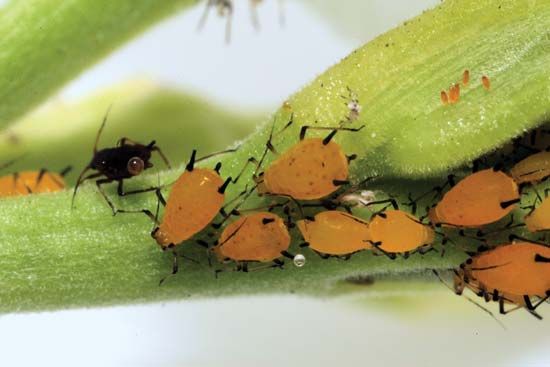
The primary distinction between honey ants and other species lies in this physiological adaptation. When food is abundant, repletes are fed honeydew—a sugary byproduct gathered from aphids and scale insects—until their abdomens become significantly distended.13
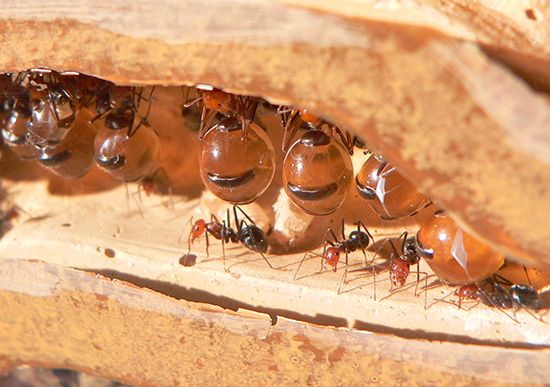
Once engorged, these ants become immobile and hang from the ceilings of underground chambers, effectively serving as living storage vessels for months. When the colony faces a food shortage, the repletes regurgitate the stored honeydew upon stimulation by other workers. This specialized division of labor allows the colony to survive periods of scarcity that might otherwise threaten its existence.13
How do honey ants store food in their bodies, and why do they do this?
Honey ants store food by utilizing a specialized caste of worker ants known as repletes. When food sources are abundant, these workers are fed honeydew—a sugary liquid byproduct gathered from aphids and scale insects—which is stored within their crop, or “honey stomach”. As they ingest this liquid, their abdomens become significantly distended, sometimes reaching many times their normal size.16
Once engorged, these repletes hang from the ceilings of underground chambers, effectively serving as living storage vessels for months. They do this to ensure the survival of the ant colony during periods of food scarcity. When the colony requires nourishment, the repletes are stimulated by other workers to regurgitate the stored honeydew, providing a vital resource when external food is unavailable.1
Sources
- honey ant — Encyclopædia Britannica
- Hymenoptera - Division of labor — Encyclopædia Britannica
- Caste — Encyclopædia Britannica
- ant - Natural history — Encyclopædia Britannica
- Hymenoptera - Social forms — Encyclopædia Britannica
- Hymenoptera - Internal structure — Encyclopædia Britannica
- ant - Food — Encyclopædia Britannica
Published on · 2 min read