Mantis
Mantids belong to the order Mantodea, which comprises approximately 2,000 species of predatory insects. While they are distinct from the unrelated gladiator…
What are the different species of mantids and where are they found around the world?
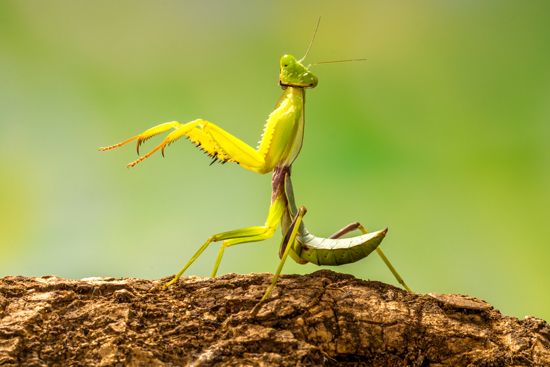
Mantids belong to the order Mantodea, which comprises approximately 2,000 species of predatory insects. While they are distinct from the unrelated gladiator bugs (order Mantophasmatodea), both groups are known for their predatory behavior.12
Distribution and Diversity
The majority of mantid species are found in tropical or subtropical regions worldwide. Their distribution includes:1
- Europe: Representative genera include Mantis (such as the widespread M. religiosa), Ameles, Iris, and Empusa.1
- North America: Native genera include Stagmomantis (e.g., the Carolina mantis, S. carolina), Litaneutria (the agile ground mantis, L. minor), Thesprotia, and Oligonicella. Several non-native species, such as the Chinese mantis (T. aridifolia sinensis) and the Mediterranean mantis (Iris oratoria), have also been introduced to the continent.1
- Asia: The Chinese mantis is native to many parts of eastern Asia.1
Mantids are primarily ambush predators that utilize camouflage to resemble their surroundings, such as foliage, twigs, or flowers. They are highly regarded as beneficial insects due to their consumption of garden pests.1
What are the stages of a mantid’s life cycle?
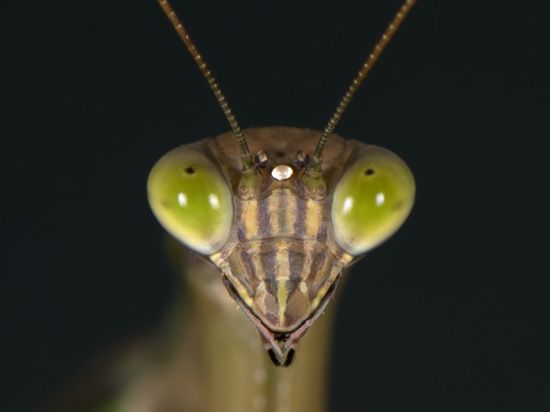
Mantids undergo a process known as incomplete metamorphosis, which consists of three primary stages: egg, nymph, and adult.34
The Life Cycle Stages
- Egg: Females lay eggs in clusters, typically ranging from fewer than 10 to more than 300. These are deposited in a protective, cocoon-like capsule called an ootheca, which is formed from a quick-drying, viscous liquid. These cases are usually attached to vegetation, though some species may place them on rocks or bury them in desert sand.4
- Nymph: Upon hatching, the young mantids emerge as nymphs. These nymphs lack wings but otherwise closely resemble the adults in form. As they feed and grow, they must undergo a series of molts (ecdyses) to shed their growth-restricting exoskeletons. During these stages, the nymphs gradually develop toward their adult form.54
- Adult: After the final molt, the mantid reaches adulthood. At this stage, the insect possesses fully functional wings (in most species) and reproductive organs. The adult mantid is then capable of mating and continuing the cycle.54
How have mantids been portrayed in various cultures and mythologies?
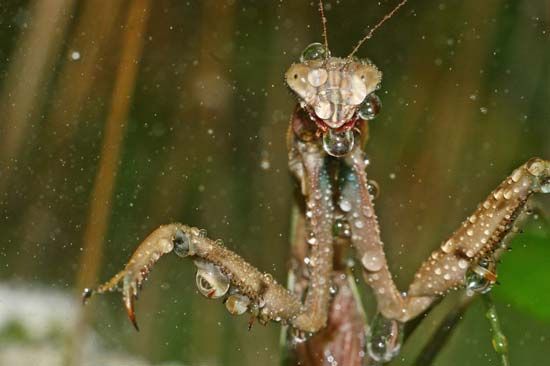
The name “mantis” originates from the ancient Greek word mantis, meaning “diviner” or “prophet,” reflecting the insect’s characteristic posture of holding its front legs outstretched as if in prayer or supplication.17
Cultural and Folk Associations
The mantis has inspired a wide range of cultural interpretations, often oscillating between themes of piety and superstition:
- Piety: Many common names for the insect, such as the “praying mantis” and the scientific name Mantis religiosa, emphasize a perceived religious devotion. This is echoed in various languages, including the German Gottesanbeterin (“God-worshipper”), the French prie-Dieu (“pray-to-God”), and the West Indian “god-horse”.1
- Superstition: Folk traditions have historically attributed more ominous qualities to the insect. Superstitions have suggested that the mantis’s brown saliva could cause human blindness and that consuming one could be fatal to horses or mules. Consequently, the insect has also been referred to as the “devil’s horse” or “mule killer”.1
While their appearance suggests a meditative or prayerful state, their nature as ferocious carnivores has led some to suggest that “preying” is a more accurate descriptor than “praying”.1
How do mantids reproduce and what is unique about their mating behavior?
Mantids reproduce through a process that often involves significant sexual dimorphism, where females are notably larger and stronger than males. To initiate mating, females release pheromones to attract potential mates.49
A unique and widely recognized aspect of mantid mating behavior is sexual cannibalism, where the female consumes the male during or after copulation. This behavior is not universal across all species, but when it occurs, it provides the female with essential nutrients and energy required for egg production. Because the female may lay hundreds of eggs, this nutritional investment can significantly benefit her reproductive success.1049
Males have evolved strategies to mitigate the risk of being eaten. For instance, the male giant Asian mantis (Hierodula membranacea) attempts to avoid attack by leaping onto the female’s back from a distance and positioning himself at an angle that makes it difficult for her to strike. Interestingly, even if a male is decapitated during the encounter, he is often still capable of mating because his abdominal nerves continue to control the necessary movements.104
Sources
- mantis — Encyclopædia Britannica
- gladiator bug — Encyclopædia Britannica
- heteropteran - Nymphs — Encyclopædia Britannica
- mantispid — Encyclopædia Britannica
- insect - Types of metamorphosis — Encyclopædia Britannica
- Orthoptera - Growth and life span — Encyclopædia Britannica
- praying mantis — Merriam-Webster
- mantis — Merriam-Webster
- Why Do Some Animals Eat Their Mates After Sex? — Encyclopædia Britannica
- 6 Animals That Eat Their Mates — Encyclopædia Britannica
- Orthoptera - General features — Encyclopædia Britannica
- Reproductive behaviour - Crustaceans — Encyclopædia Britannica
Published on · 4 min read