Hongshui River
Sorry, the Britannica knowledge base does not contain information regarding the specific annual water flow volume of the Hongshui River.
What is the annual water flow of the Hongshui River, and how does it vary seasonally?
Sorry, the Britannica knowledge base does not contain information regarding the specific annual water flow volume of the Hongshui River.
Regarding seasonal variations, the Hongshui River is part of the Xi River system, which experiences significant fluctuations in water levels throughout the year. The system’s rate of flow more than doubles during the summer season, primarily due to monsoon rains that can lead to torrential flooding. Conversely, the river reaches its lowest levels during the dry winter period. While water level fluctuations can vary by as much as 80 feet (25 metres) at Wuzhou, these variations are generally smaller in the lower course and the delta.
How does the Hongshui River fit into China’s larger river system and water management plans?
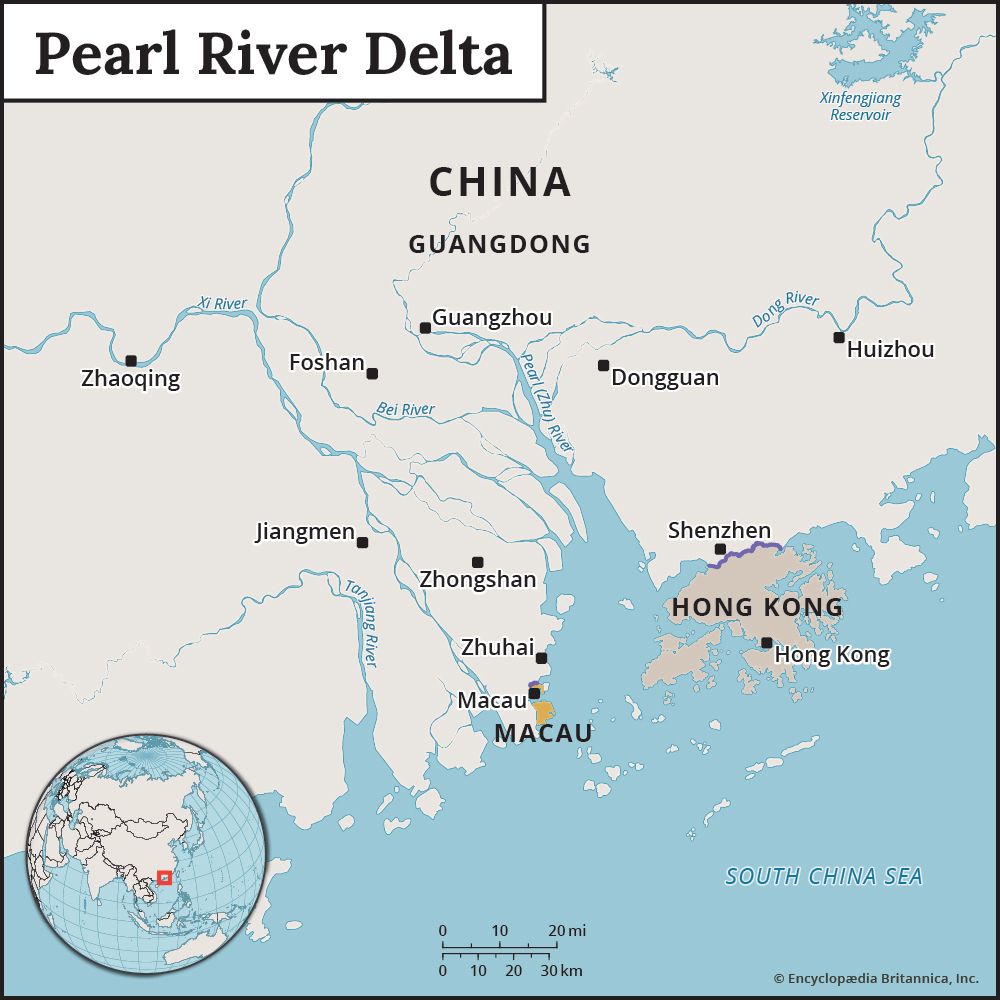
The Hongshui River is a vital component of the Xi River system, which serves as the primary waterway of southern China. Rising in the highlands of Yunnan province, the river flows through Guizhou and Guangxi before joining other tributaries to form the Xi River, which eventually empties into the South China Sea via the Pearl River Delta.12
Regarding water management, the river system faces significant challenges due to its mountainous, karst-heavy landscape and extreme seasonal flow fluctuations driven by monsoon rains. While the region utilizes an intricate network of flood dikes to protect low-lying areas, the river’s natural state—characterized by deep gorges, rapids, and high-velocity seasonal flooding—limits its role as a fully integrated commercial waterway. Navigation is often restricted to shallow-draft vessels, and many sections remain unnavigable, necessitating reliance on other routes for regional commerce. Unlike the Bian Canal, which was engineered specifically for flood control and irrigation, the Hongshui remains largely defined by its natural topography.123
What role does the Hongshui River play in local transportation and commerce?
The Hongshui River plays a limited but geographically significant role in the transportation and commerce of southwestern China. Because the river flows through a rugged, mountainous landscape characterized by deep gorges and rocky rapids, much of its upper course is virtually unnavigable. Consequently, it does not function as a major, integrated commercial artery like the lower reaches of the Xi River system.
However, the river remains important in the following ways:
- Regional Connectivity: Despite the challenges posed by its topography, the valley of the Hongshui and its tributaries serve as the primary routes for travel and trade into Guizhou province from the south.
- Local Navigation: In the lower sections of the river—specifically below Laibin and along the Liu River as far as Liuzhou—the water is navigable by shallow-draft junks.
- Commercial Hubs: As the river enters the hillier regions of Guangxi, it becomes a more active artery of commerce, supporting river towns such as Gongchuan and Qianjiang that facilitate local trade.
How does the Hongshui River contribute to China’s hydroelectric power generation?
The Hongshui River is a significant contributor to China’s hydroelectric power generation, particularly within the country’s southwestern region where mountainous terrain and extensive river networks provide substantial energy potential.5
The river’s capacity is highlighted by the Longtan Dam, a major gravity dam completed in 2009. With an installed capacity of 6,426 megawatts, it ranks among the world’s largest hydroelectric facilities.16
Like many hydroelectric projects in China, the Hongshui River’s power generation is subject to seasonal variations. Because the region experiences considerable fluctuations in rainfall, power stations often face reduced capacity during winter months, while summer flooding can occasionally interfere with production. Despite these challenges, the development of such multipurpose dams remains a central strategy for managing water resources, supporting industrial growth, and meeting the rapidly increasing energy demands of the region.56
Sources
- Hongshui River — Encyclopædia Britannica
- Xi River system — Encyclopædia Britannica
- Bian Canal — Encyclopædia Britannica
- Yu River — Encyclopædia Britannica
- China - Hydroelectric potential — Encyclopædia Britannica
- world’s largest dams — Encyclopædia Britannica
- dam — Encyclopædia Britannica
Published on · 3 min read