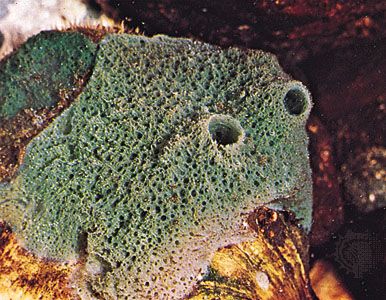
Horny Sponge
A horny sponge is any sponge belonging to the orders Dictyoceratida and Dendroceratida within the class Demospongiae. Unlike other sponges that contain…
What is horny sponge?
A horny sponge is any sponge belonging to the orders Dictyoceratida and Dendroceratida within the class Demospongiae. Unlike other sponges that contain siliceous or calcareous elements, horny sponges possess a skeleton composed exclusively of fibrous organic materials.1
The primary structural component of these sponges is spongin, a unique scleroprotein that forms a flexible, netlike fiber network. Members of the order Dictyoceratida, such as the well-known commercial bath sponges (Hippospongia and Spongia), are often characterized by their large, irregular shapes and this fibrous skeletal structure. Because they lack hard mineral spicules, these sponges are soft and pliable, making them historically valuable for bathing and cleaning purposes. In their natural marine environment, they serve as a food source for various organisms, including sea slugs, starfish, and certain fish.12
How are commercial bath sponges harvested?
Commercial bath sponges are harvested using several methods depending on the depth of the water. In shallow areas, they are typically collected by hooking or harpooning, while in deeper waters, they are gathered through skin diving or deepwater fishing techniques.6
Once harvested, the living sponge—which is a mass of cells and fibers—must be thoroughly cleaned to remove all living cells. Only after this process is complete does the sponge reveal the soft, elastic spongin skeletal framework that is familiar as the sponge of commerce.6
These sponges are found in various regions, including the eastern Mediterranean, the West Indies, and off the coasts of Florida and the Florida Keys. Because sponges have the ability to regenerate lost parts, they can also be cultivated from small fragments to support sustainable harvesting.6
What are the differences between spongin and spicules?
The primary difference between spongin and spicules lies in their composition and the structural properties they provide to a sponge.
Spicules
Spicules are mineral-based skeletal units that provide rigid support and protection. They are classified based on their composition:8
- Calcareous spicules: Composed of calcium carbonate (such as calcite or aragonite), these are characteristic of the class Calcarea.9
- Siliceous spicules: Made essentially of silicic acid, these are found in the classes Demospongiae and Hexactinellida.9
Spicules exhibit a vast array of shapes, ranging from simple rods (monaxons) to complex, star-shaped structures (asters) or multi-rayed forms (triacts and tetracts). They may be scattered throughout the sponge or united into continuous networks to form a hard, sometimes glass-like skeleton.98
Spongin
Spongin is a fibrous, organic material composed of scleroproteins, which are similar to the keratin found in human skin, hair, and nails.3
- Function: It provides flexibility and elasticity to the sponge skeleton.5
- Structure: In many sponges, spongin acts as a cement to bind spicules together into meshes or bundles. In the order Keratosa, which includes commercial bath sponges, spongin fibers constitute the entire skeleton, resulting in a soft, pliable texture devoid of hard mineral elements.5
How do sponges feed and filter water?
Sponges are primarily filter feeders that rely on a sophisticated water-current system to obtain nutrients and oxygen. Because they lack specialized organs, this system of canals and chambers is essential for circulating water throughout their bodies to facilitate feeding, respiration, waste removal, and reproduction.1213
The Water-Current System
The movement of water is driven by the continuous beating of flagella located on specialized cells called choanocytes. This movement creates pressure that draws water into the sponge through small pores, moves it through incurrent canals into choanocyte chambers, and eventually expels it through larger openings called oscula. This process is highly efficient; the flow is regulated by the contraction and expansion of these pores and oscula, ensuring that expelled water does not contaminate the incoming supply.12
Feeding and Digestion
Sponges capture suspended food particles—such as bacteria, microorganisms, and organic debris—using their choanocytes. Once captured, these particles are transferred to amoebocytes (thesocytes) for distribution throughout the sponge. Digestion occurs intracellularly within both choanocytes and thesocytes. While most species filter-feed, some, such as cladorhizid sponges, are carnivorous and capture prey directly.12
Sources
- horny sponge — Encyclopædia Britannica
- sponge - Size range and diversity of structure and colour — Encyclopædia Britannica
- spongin — Merriam-Webster
- sponge - Habitats — Encyclopædia Britannica
- Spongiidae — Merriam-Webster
- sponge - Importance — Encyclopædia Britannica
- sponge - Sexual reproduction — Encyclopædia Britannica
- sponge - Skeleton — Encyclopædia Britannica
- sponge - Mineral skeletons — Encyclopædia Britannica
- sponge - Biochemical aspects — Encyclopædia Britannica
- sponge - Other types — Encyclopædia Britannica
- sponge - Feeding and digestion — Encyclopædia Britannica
- sponge - Form and function — Encyclopædia Britannica
Published on · 3 min read