Horseradish
It is a common misconception that there are multiple distinct varieties of horseradish; however, the term "horseradish" refers specifically to a single…
What are some common varieties of horseradish, and how do they differ?
It is a common misconception that there are multiple distinct varieties of horseradish; however, the term “horseradish” refers specifically to a single species of hardy perennial plant known as Armoracia rusticana.12
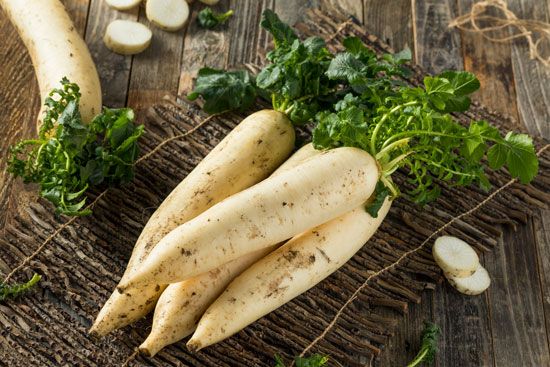
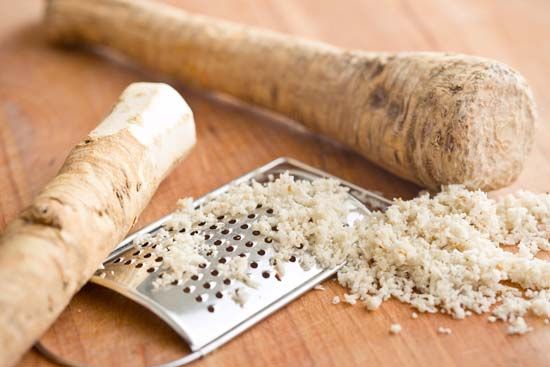
While there are many different types of radishes—such as the daikon—these are separate plants belonging to the same Brassicaceae family. Horseradish is characterized by its large, fleshy white root, which is processed into a pungent condiment. Its sharp, spicy flavor is produced through the same biochemical process as other members of the mustard family: when the plant’s cells are damaged, an enzyme called myrosinase breaks down compounds called glucosinolates into pungent isothiocyanates.341
Because horseradish is a single species, differences in flavor intensity are generally attributed to growing conditions—such as soil moisture, temperature, and harvest timing—rather than varietal differences.3
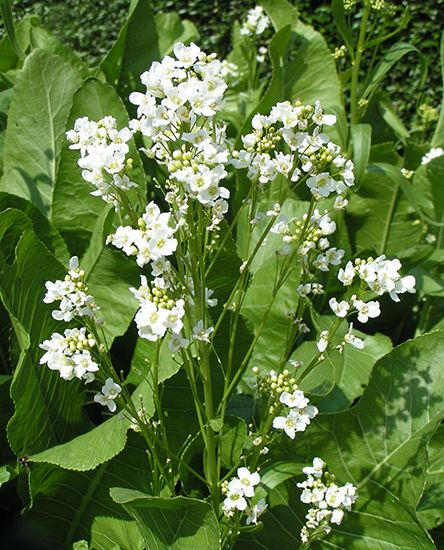
What parts of the horseradish plant are used, and how are they processed?
The primary part of the horseradish plant (Armoracia rusticana) used for culinary purposes is its large, fleshy white root. This root is highly valued for its pungent flavor and is commonly processed into a condiment or table relish.15
The cultivation and preparation process involves several steps:
- Propagation: In the spring, cultivators plant pieces of pencil-sized roots into the soil at a slight angle, covering the upper ends with 1–2 cm of earth.1
- Maintenance: To ensure a high-quality harvest, growers remove all but the terminal shoots to prevent the formation of multiple crowns. Additionally, side roots are rubbed off to minimize branching and crooked growth.1
- Harvesting and Processing: After one growing season, the roots are harvested, washed, and trimmed for sale. Once prepared, the roots are ground up to create the final condiment.15
It is important to distinguish this plant from the “horseradish tree” (Moringa oleifera), which is an entirely different species. While the horseradish tree also possesses a root with a similar flavor, it is cultivated in the tropics for its edible, elongated fruit and its seeds, which yield ben oil.2
How does horseradish compare to other pungent roots like wasabi or ginger?
Horseradish (Armoracia rusticana) and wasabi (Eutrema japonicum) are both members of the Brassicaceae family, which explains their shared pungent profile. When their cells are damaged—through cutting, biting, or grating—an enzyme called myrosinase converts glucosinolates into volatile isothiocyanates. These compounds stimulate sensory receptors in the nose and mouth, creating a sharp, nasal-clearing sensation distinct from the heat of chili peppers, which rely on capsaicin.
Because true wasabi is difficult to cultivate and expensive, horseradish is frequently used as a substitute in Western restaurants, often dyed green to mimic the appearance of the authentic rhizome. While both provide a similar “kick,” true wasabi is prized for a more complex, nuanced flavor that dissipates quickly, whereas horseradish is generally more aggressive and persistent.
Regarding ginger, it is a distinct plant that does not belong to the Brassicaceae family. Its pungency is derived from different chemical compounds, resulting in a warming heat that is fundamentally different from the sharp, sinus-clearing sensation of horseradish and wasabi.
How is horseradish cultivated, and in which regions is it commonly grown?
Horseradish (Armoracia rusticana) is a hardy perennial plant native to Mediterranean lands. Today, it is widely cultivated throughout the world’s temperate zones, where it thrives in cool, moist environments.1
Cultivation Practices
To propagate horseradish, cultivators follow a specific process during the spring:
- Planting: Pieces of pencil-sized roots are placed into the soil at a slight angle. The upper ends are covered with 1–2 cm (0.4–0.8 inch) of earth.1
- Maintenance: Growers remove all but the terminal shoots to prevent the plant from forming multiple crowns. Additionally, side roots are rubbed off to minimize branching and ensure the root grows straight.1
- Harvesting: The roots are typically harvested after one growing season. Once pulled from the ground, they are washed and trimmed for commercial use.1
While it is a valued crop, the plant can also become a troublesome weed in certain cool, moist regions. It is important not to confuse this plant with the “horseradish tree” (Moringa oleifera), which is a separate species grown primarily in the tropics.12
Sources
- Horseradish — Encyclopædia Britannica
- horseradish — Merriam-Webster
- Why do radishes taste spicy? — Encyclopædia Britannica
- Radish — Encyclopædia Britannica
- list of vegetables — Encyclopædia Britannica
- horseradish tree — Merriam-Webster
- wasabi — Encyclopædia Britannica
Published on · 3 min read