House Mouse
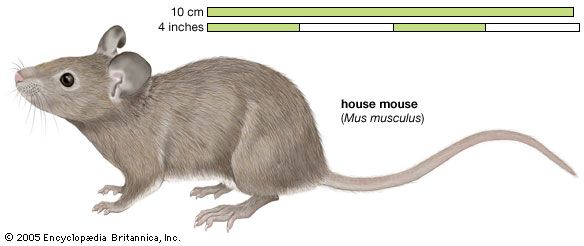
The house mouse (Mus musculus) is a small, slender rodent characterized by a body length of 6 to 11 cm (2.4 to 4.3 inches) and a tail that is typically equal…
What are the physical characteristics and size of a house mouse?
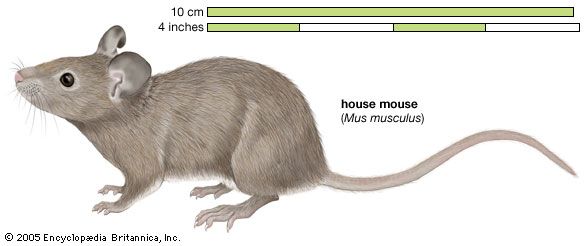
The house mouse (Mus musculus) is a small, slender rodent characterized by a body length of 6 to 11 cm (2.4 to 4.3 inches) and a tail that is typically equal in length to its body. These animals generally weigh between 12 and 30 grams (0.4 to 1.1 ounces).1
Physically, the house mouse possesses several distinct features:
- Head and Limbs: They have a blunt or tapered muzzle, thin whiskers, narrow hind feet with small, sharp claws, and prominent, thinly furred ears that appear nearly naked.12
- Tail and Fur: The tail is long, slender, and scantily haired. While the fur on the rest of the body is short and soft, coloration varies by population: native populations typically have tawny-brown upperparts with white bellies, whereas introduced feral populations often feature dark, grayish-brown upperparts that pale to gray on the sides.1
- Sensory Traits: The animal is known for having a distinctive, strong, musky odor.1

What kind of habitats do house mice prefer, and how do they adapt to human environments?
House mice are highly adaptable rodents that thrive in diverse environments, ranging from natural grasslands and shrubby deserts to human-made structures. While their ancestral origin is likely the grasslands of the northern Indian subcontinent, they have successfully spread worldwide through their close association with humans.1
Habitat Preferences
In temperate regions, house mice are flexible, living both outdoors and indoors. Outdoor populations inhabit grasslands, fallow fields, croplands, and coastal dunes. However, they avoid forests. In tropical Asia, where other related species occupy natural habitats, house mice are restricted to living exclusively in buildings.1
Adaptation to Human Environments
House mice have evolved specific traits that allow them to exploit human-dominated landscapes:
- Behavioral Flexibility: They are agile climbers, jumpers, and swimmers, enabling them to navigate various structures. They readily move into buildings or new fields when their current habitat is disturbed, such as during plowing or harvesting.1
- Nesting and Diet: They are essentially omnivorous and will construct nests in any protected indoor space, often leading to property damage and food contamination.1
- Reproductive Success: Their ability to breed throughout the year in indoor environments, combined with a rapid gestation period of 19 to 21 days, allows populations to grow quickly.1
How do house mice reproduce and what is their lifespan?
House mice are highly prolific breeders, with their reproductive patterns influenced by their environment. Indoor populations are capable of breeding throughout the year, whereas outdoor populations in temperate latitudes typically breed from early spring until late fall.1
Key aspects of their reproduction include:
- Gestation: The gestation period lasts between 19 and 21 days.1
- Litter Frequency: Females can produce up to 14 litters per year, though 5 to 10 is more common.13
- Litter Size: A typical litter consists of 5 or 6 young, although some litters can contain as many as 12 offspring.1
Regarding their lifespan, there is a significant difference between captive and wild populations. While laboratory mice can live for as long as three years, the lifespan of free-living house mice is considerably shorter.1
How have house mice been used in scientific research?
House mice (Mus musculus) are the most commonly used animal models in scientific and medical research. Their utility stems from several key biological and practical factors:45
- Genetic Similarity: Mice share a strong genetic resemblance to humans, which allows scientists to use them as models to study human diseases, gene functions, and potential therapies.64
- Short Life Cycles: With a lifespan of only two to three years in laboratory settings, mice enable researchers to observe the progression of diseases and the effects of treatments over an entire lifespan or across multiple generations in a relatively short period.65
- Ease of Handling: Their small size and manageable nature make them practical for laboratory environments.4
Advanced Research Applications
Scientists have developed specialized mouse models to investigate complex biological questions:
- Genetically Modified Mice: Through techniques involving embryonic stem cells, researchers create knockout mice (with specific genes deactivated) and transgenic mice (with inserted genetic material). These models are essential for understanding hereditary diseases and testing gene therapies.41
- Preclinical Studies: Mice are frequently used to investigate the safety and efficacy of new drugs before they proceed to human trials.4
Ethical Considerations
The use of mice in research is subject to strict oversight, such as the Animal Welfare Act in the United States, which mandates humane treatment and the minimization of pain and distress. While supporters argue that these models are critical for medical progress, the practice remains controversial. Ethical debates often center on the moral implications of animal testing and the necessity of adhering to the “three Rs” principle: replacement (using alternatives like computer modeling), reduction (using fewer animals), and refinement (improving welfare and pain management).64
Sources
- house mouse — Encyclopædia Britannica
- mouse — Encyclopædia Britannica
- rodent - Natural history — Encyclopædia Britannica
- Why are mice used in medical research? — Encyclopædia Britannica
- Animal testing — Encyclopædia Britannica
- stem cell - Mouse embryonic stem cells — Encyclopædia Britannica
Published on · 4 min read