Horse
The horse has played a unique and transformative role in human history, serving as a partner in labor, transportation, and warfare since its domestication…
What role have horses played in human history, from transportation to warfare?
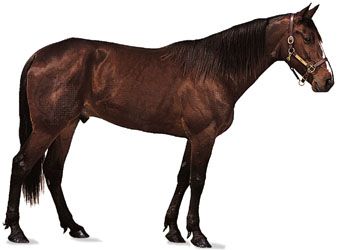
The horse has played a unique and transformative role in human history, serving as a partner in labor, transportation, and warfare since its domestication approximately 6,000 years ago.1
Warfare and Political Power
Horses revolutionized combat, beginning with the use of light, two-wheeled chariots in the 2nd millennium BCE, which provided a decisive tactical advantage. By the 9th and 8th centuries BCE, the development of effective horsemanship allowed for the rise of cavalry, enabling mobile raiding and striking power that foot soldiers struggled to counter. In medieval Europe, the “great horse” or destrier was essential to the feudal system, carrying armored knights into battle. Similarly, in the Americas, the introduction of the horse during the Columbian Exchange fundamentally altered the political landscape, allowing groups like the Comanche and Sioux to expand their power and improve hunting efficiency.2345
Transportation and Labor
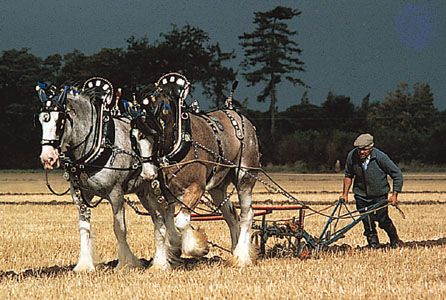
While horses were historically expensive to maintain, they eventually became vital for conveying passengers and hauling goods. Their utility as draft animals was initially limited by inefficient harness technology, which often constricted the animal’s breathing. Over time, however, horses became central to agriculture and transport, eventually providing a new source of traction in the Americas that made plowing and wheeled transport feasible.1675
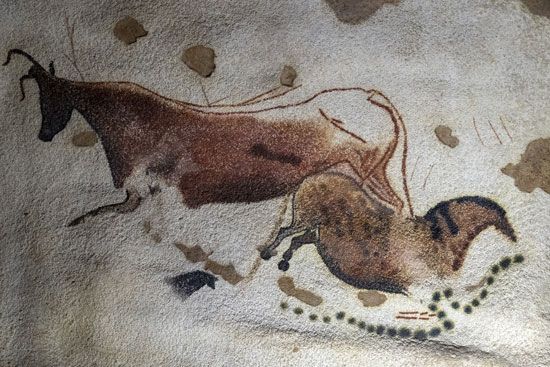
How have horses evolved over time, and what were their prehistoric ancestors like?
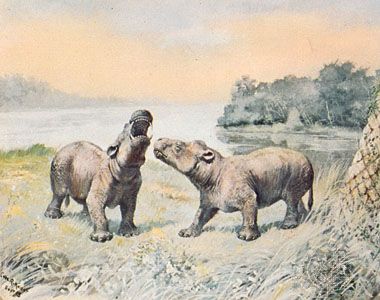
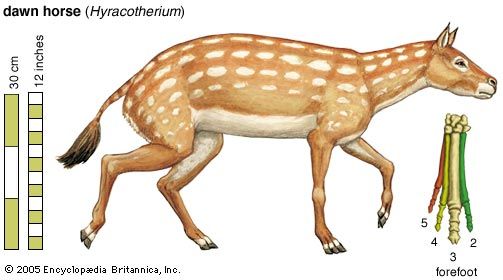
The evolutionary history of the horse is one of the most well-documented lineages in paleontology. It began in the early Eocene Epoch (about 56 million to 33.9 million years ago) with a small, forest-dwelling ancestor known as Hyracotherium, often called Eohippus or the “dawn horse.”89
Prehistoric Ancestors
Hyracotherium was diminutive, standing only 16 to 20 inches high, with an arched back and raised hindquarters. Unlike modern horses, it had padded feet with four functional toes on the forefeet and three on the hind feet. Its teeth were adapted for browsing on leaves rather than grazing on grass, and it possessed a smaller, less complex brain.109
Key Evolutionary Trends
Over millions of years, the horse family (Equidae) underwent significant transformations, primarily in North America, to adapt to changing environments—specifically the spread of grasslands during the Miocene Epoch. Major trends included:89
- Size and Anatomy: A gradual increase in overall body size and the lengthening of limbs for efficient running in open country.9
- Limb Specialization: A reduction in the number of toes, eventually leading to the single-hoofed foot of the modern genus Equus. This was accompanied by the fusion of lower leg bones and the loss of footpads.89
- Dentition: The development of high-crowned, ridged teeth (hypsodonty) reinforced with cement, which allowed horses to grind down the abrasive, siliceous content of grasses.89
- Brain Development: An increase in the size and complexity of the brain.9
The genus Equus emerged during the Pliocene Epoch about 4 to 4.5 million years ago. While Equus flourished globally, it went extinct in the Americas about 10,000 to 8,000 years ago, only to be reintroduced by Spanish explorers in the 16th century.9
How do horses sleep, and how much rest do they need?
Horses possess a unique ability to sleep both standing up and lying down, a behavior adapted for survival against predators.
Standing Sleep
Horses primarily doze while standing, which allows them to remain alert and ready to flee if threatened. This is made possible by the “stay apparatus,” a specialized system of tendons, ligaments, and muscles that locks the major joints in their legs, enabling them to relax without collapsing.1213
Deep Sleep and REM
For REM (rapid eye movement) sleep, which is essential for memory consolidation and overall health, horses must lie down. Because getting up from the ground takes time and effort, they only lie down for short, intermittent periods throughout the day. In total, horses require about one to three hours of this deep sleep daily. During these sessions, they often rely on a companion to stand nearby and act as a lookout for potential threats.1213
How do horses communicate with each other and with humans?
Horses communicate through a combination of sensory perception, memory, and physical cues. While they do not use language in the human sense, they possess a highly developed nervous system that allows them to interpret and respond to their environment and human handlers.14
Communication with Humans
Communication between a horse and a rider is established through “aids,” which the horse learns to associate with specific movements through repetition and memory.1516
- Natural Aids: These include the rider’s voice, the movement of their weight, and the use of hands (via reins and the bit) and legs. A consistent tone of voice is particularly effective for teaching desired reactions.1416
- Artificial Aids: Tools such as whips, spurs, and specialized equipment like martingales or nosebands are used to reinforce commands or provide precision. Horses do not distinguish between natural and artificial aids; they respond to the physical pressure and cues provided.16
- Reinforcement: Because horses associate events that occur nearly simultaneously, rewards—such as a pat on the neck or a friendly tone—must be immediate to be effective.16
Interspecies and Social Interaction
Horses rely on acute senses to navigate their social world and detect threats. They are highly observant and can sense a human’s emotional state, such as fear or nervousness, often reacting by disregarding or disobeying the rider. Their communication is deeply rooted in instinct and habit, allowing them to interpret subtle signals from others of their species and their environment.1416
Sources
- military technology - The horse — Encyclopædia Britannica
- horse - General features — Encyclopædia Britannica
- military technology - The war-horse — Encyclopædia Britannica
- Domestication - Domestication of animals — Encyclopædia Britannica
- Columbian Exchange - Animals — Encyclopædia Britannica
- the Steppe - Horsepowered warfare — Encyclopædia Britannica
- military technology - Land transportation — Encyclopædia Britannica
- perissodactyl - Horses — Encyclopædia Britannica
- Eohippus — Encyclopædia Britannica
- horse - Evolution of the horse — Encyclopædia Britannica
- perissodactyl - Annotated classification — Encyclopædia Britannica
- How do horses sleep? — Encyclopædia Britannica
- Why Do Horses Sleep Standing Up? — Encyclopædia Britannica
- horse - Behaviour — Encyclopædia Britannica
- horsemanship - Training and equipment — Encyclopædia Britannica
- horse - Senses — Encyclopædia Britannica
- horsemanship - Aids — Encyclopædia Britannica
Published on · 4 min read