How Big Is the Giant Squid?
The giant squid (Architeuthis) is a massive cephalopod that has long been the subject of legend. While much of our historical knowledge was based on…
How Big Is the Giant Squid?
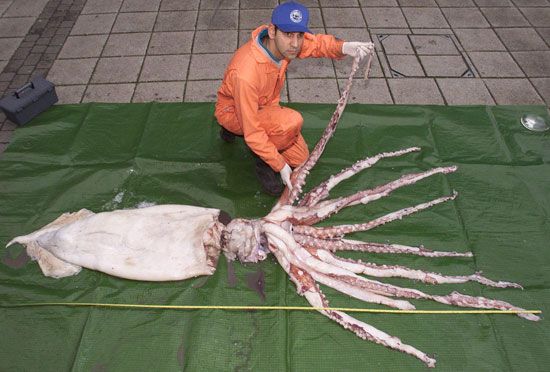
The giant squid (Architeuthis) is a massive cephalopod that has long been the subject of legend. While much of our historical knowledge was based on washed-up carcasses, the largest documented specimen measured approximately 13 meters (43 feet) in length, including its tentacles, with a wet weight potentially reaching up to a ton (907 kg or 2,000 pounds).1
It is important to note that the giant squid is often compared to the colossal squid (Mesonychoteuthis hamiltoni). While the giant squid may reach greater lengths, the colossal squid is considered heavier and more robust. Some researchers suggest the colossal squid could reach lengths of up to 14 meters (46 feet), though this remains a subject of scientific debate. Despite advancements in deep-sea observation, including the first video footage of a living giant squid in 2012, no living specimen as large as the 13-meter record has been documented.1
How does the colossal squid differ from the giant squid?
While both the giant squid (Architeuthis) and the colossal squid (Mesonychoteuthis hamiltoni) are considered the world’s largest invertebrates, they differ significantly in their physical build and habitat.
Physical Differences
- Size and Weight: The colossal squid is heavier and more robust than the giant squid. While the giant squid may reach greater total lengths—with documented specimens measuring up to 13 meters (43 feet)—the colossal squid has a larger body mass, often weighing more than 500 kg (1,100 pounds). Some researchers estimate the colossal squid could reach lengths of up to 14 meters (46 feet), though this remains a subject of scientific debate.
- Anatomy: The colossal squid is equipped with hooks on its arms and tentacles to capture prey, whereas the giant squid relies on suckers and sucker rings.
- Eyes: Both species possess massive eyes, which are among the largest in the animal kingdom, allowing them to detect predators like the sperm whale at great distances.
Habitat and Range
- Giant Squid: Inhabits deep regions of temperate to subtropical marine waters globally.
- Colossal Squid: Primarily found in the cold, deep waters of the Southern Ocean, typically south of the Antarctic Convergence.
What do giant squids eat in the deep ocean?
The giant squid is a carnivorous predator that inhabits deep regions of the ocean. To capture its prey, it utilizes two long, slender tentacles equipped with suckers and toothed, horny rings.56
Its diet primarily consists of:
- Fishes: Various species of deep-sea fish.6
- Crustaceans: A staple food source for many cephalopods.6
- Other Cephalopods: Giant squids are known to prey upon other squid species.6
While the giant squid is a formidable hunter, it also serves as a food source for larger predators, most notably the sperm whale. Evidence of these interactions is frequently found in the form of sucker-shaped scars on the hides of sperm whales and the presence of giant-squid beaks within their stomachs.3
How do scientists study animals that live so deep underwater?
Scientists employ a variety of sophisticated methods and technologies to study deep-sea animals, as direct access to these environments is often difficult or dangerous for humans.78
Direct Observation and Imaging
Since World War II, advancements in technology have revolutionized our ability to observe marine life in its natural habitat.8
- Submersibles: These specialized craft allow researchers to descend to great depths to observe and document organisms directly.8
- Remotely Operated Vehicles (ROVs): These uncrewed, remote-controlled vehicles are essential for inspecting and photographing deep-sea environments, such as the wreck of the Titanic or the natural habitats of elusive species like the giant squid.71
- Underwater Cameras and Television: These tools provide continuous visual data, allowing scientists to monitor events and behaviors in real time.8
Sampling and Collection
To analyze the biology and ecology of deep-sea species, scientists use specialized equipment to collect specimens:
- Nets and Trawls: Researchers use plankton nets and midwater trawls to capture organisms. Midwater trawls are designed to move at speeds that prevent active, fast-swimming animals from escaping.9
- Quantitative Samplers: Devices like the Clark-Bumpus sampler allow scientists to take uncontaminated samples from specific depths while measuring the volume of water filtered.9
Acoustic and Remote Sensing
Because electromagnetic radiation does not penetrate deep water, scientists rely on acoustic signals to study marine life.109
- Acoustic Tracking: Many organisms can be tracked by the sounds they produce. Additionally, biologists use acoustics to chart the distribution and behavior of fish populations and plankton, which often appear as acoustic-scattering layers.9
- Satellite Sensing: Satellites are used to monitor surface life-forms and ocean color, which provides large-scale data on biological activity and suspended materials in the upper layers of the ocean.9
We could dive deeper into how these technologies have specifically helped researchers understand the life cycles of elusive deep-sea cephalopods.
Sources
- How Big Is the Giant Squid? — Encyclopædia Britannica
- colossal squid: Top Questions — Encyclopædia Britannica
- giant squid — Encyclopædia Britannica
- colossal squid — Encyclopædia Britannica
- squid — Encyclopædia Britannica
- mollusk - Habitats, feeding habits, and associations — Encyclopædia Britannica
- undersea exploration - Exploration of the seafloor and the Earth’s crust — Encyclopædia Britannica
- ROV — Merriam-Webster
- Marine biology — Encyclopædia Britannica
- undersea exploration - Collection of biological samples — Encyclopædia Britannica
- undersea exploration - Primary objectives and accomplishments — Encyclopædia Britannica
Published on · 4 min read