Howler Monkey
Howler monkeys (genus Alouatta) are a group of tropical American monkeys known for their loud, resonant vocalizations, which are produced by an enlarged…
What are some of the different species of howler monkeys, and how do they vary?
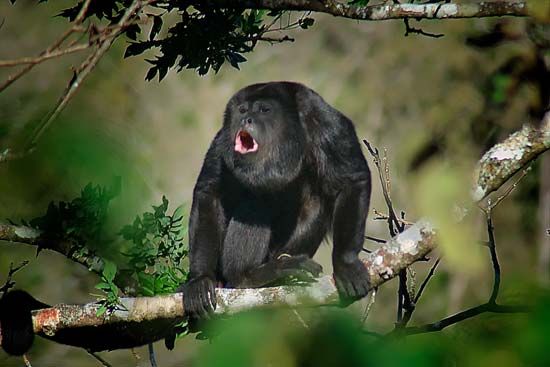
Howler monkeys (genus Alouatta) are a group of tropical American monkeys known for their loud, resonant vocalizations, which are produced by an enlarged hyoid bone in the throat. While they share common physical traits—such as a hunched appearance, bearded faces, and thick, prehensile tails—they vary in color and conservation status.1
Specific species include:
- Colombian red howler (A. seniculus): This species has the widest distribution of all howlers and is currently listed as a species of least concern, though it faces threats from hunting.1
- Maranhão red-handed howler monkey (A. ululata): Found in the Atlantic coastal forests of Brazil, this species is critically endangered due to habitat loss and hunting, with a very small remaining population.1
- Yucatán black howler monkey (A. pigra): Native to parts of Mexico, Belize, and Guatemala, this species is considered an endangered species due to significant population declines caused by disease, hunting, and habitat destruction.1
Howler monkeys are generally slow-moving, arboreal folivores that live in territorial groups. Because they are difficult to maintain in captivity, conservation efforts prioritize protecting their natural habitats.1
What are the distinguishing physical characteristics of howler monkeys?
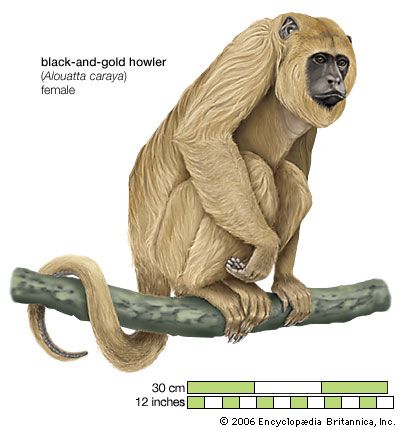
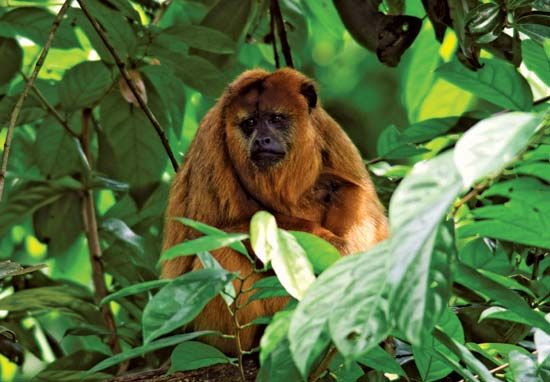
Howler monkeys (genus Alouatta) are the largest New World monkeys, characterized by a stout build and a distinctively hunched appearance. Their physical traits are specialized for their arboreal lifestyle and their famous vocalizations.1
Key physical characteristics include:
- Vocal Anatomy: They possess an enlarged hyoid bone in the throat that functions as a large, shell-like resonator. This is connected to a large throat, protruding jaws, and a high, sloping face, all of which facilitate their powerful, far-reaching howls.1
- Size and Build: They typically reach lengths of 40–70 cm (16–28 inches), excluding their long, thick tails.1
- Tail: They have a thickly furred prehensile tail that measures 50–75 cm (20–30 inches). The underside of the tail tip is naked, providing an enhanced grip for navigating the canopy.1
- Fur: Their hair is long and thick, appearing in shades of black, brown, or red depending on the specific species.1
- Facial Features: They are bearded monkeys with a facial structure adapted to accommodate their specialized vocal apparatus.1
How do male and female howler monkeys differ in size and appearance?
In many animal species, sexual dimorphism refers to the differences in size, shape, color, or structure between males and females. While the provided search results explain the general concept of sexual dimorphism and provide examples such as baboons and sea lions, they do not contain specific information regarding the physical differences between male and female howler monkeys.
Because the Britannica knowledge base does not currently provide specific details on the sexual dimorphism of howler monkeys, I cannot accurately describe how they differ in size or appearance.
What are the main threats to howler monkey populations, and what conservation efforts are in place to protect them?
Howler monkey populations face significant survival challenges, primarily driven by human activity. The most pressing threats include:
- Habitat Loss: The destruction of forests, which these arboreal animals rely on for food and shelter, is a primary driver of population decline.1
- Hunting: In various regions, howler monkeys are hunted for their meat, which has severely impacted specific populations.1
- Disease: Outbreaks have contributed to the sharp decline of certain species, such as the Yucatán black howler monkey.1
Because howler monkeys are notoriously difficult to maintain in captivity, conservationists prioritize strategies that focus on habitat protection rather than captive breeding programs. These efforts are critical for species like the Maranhão red-handed howler monkey, which has been classified as critically endangered since 1996 due to the combined pressures of hunting and environmental degradation.1
Sources
- howler monkey — Encyclopædia Britannica
- monkey - Old World monkeys versus New World monkeys — Encyclopædia Britannica
- howler monkey — Merriam-Webster
- Sexual dimorphism — Encyclopædia Britannica
Published on · 3 min read