Hudson Canyon
The Hudson Canyon is a massive submarine canyon located in the Atlantic Ocean, specifically incised into the continental slope and outer shelf off the coast…
What is the Hudson Canyon and where is it located in the Atlantic Ocean?
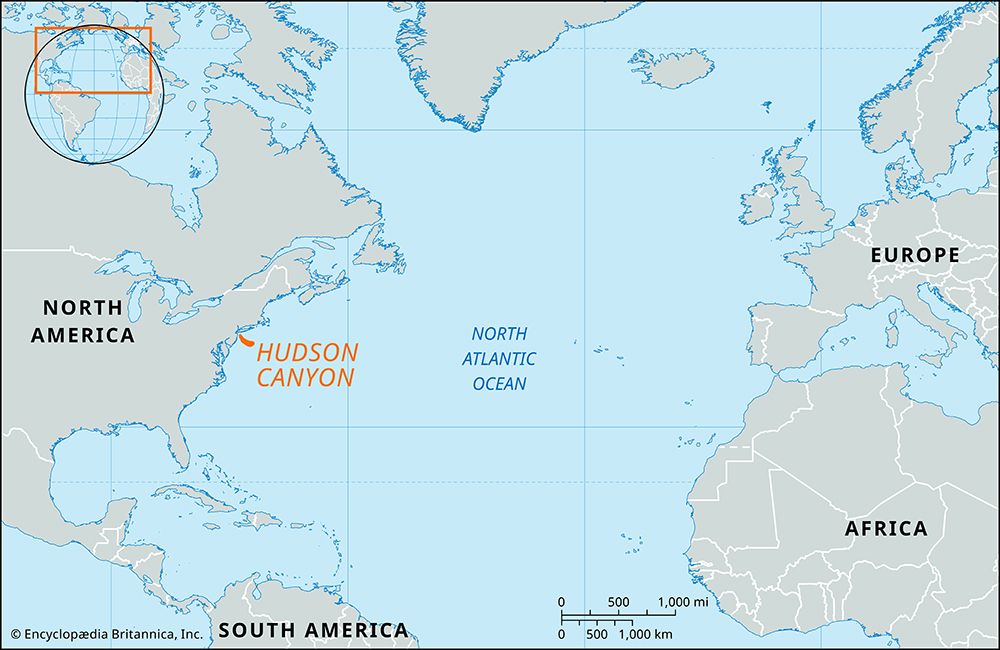
The Hudson Canyon is a massive submarine canyon located in the Atlantic Ocean, specifically incised into the continental slope and outer shelf off the coast of New York Harbor, United States.1
The canyon begins at the edge of the continental shelf, where it connects to the Hudson Channel—a shallow shelf channel extending from the mouth of the Hudson River. The canyon itself stretches approximately 58 miles (93 km) in length, reaching depths of about 7,000 feet (2,100 meters) at the base of the continental slope. In its most prominent sections, the canyon features steep, V-shaped walls that rise as high as 4,000 feet (1,200 meters). Beyond the canyon, the Hudson Fan Valley continues across the continental rise, serving as a conduit for sediment distribution across the Hudson Fan.1
How was the Hudson Canyon formed and what are its main geological features?
The Hudson Canyon was formed by the action of turbidity currents—dense, sediment-laden slurries that flow down the continental slope to the deep seafloor. These currents act as powerful erosional agents, carving deep channels into the shelf and slope over time. The canyon serves as a primary conduit, funneling land-derived sediment from the Hudson River and the continental shelf out to the continental rise and the abyssal seafloor.12
Its main geological features include:
- V-shaped Profile: In areas where it is most topographically distinct, the canyon features steep, V-shaped walls reaching heights of 4,000 feet (1,200 meters).1
- Dimensions: The canyon proper spans approximately 58 miles (93 km) in length, reaching depths of about 7,000 feet (2,100 meters) at the base of the continental slope.1
- Hudson Fan Valley: Beyond the canyon, the feature transitions into the Hudson Fan Valley, which extends at least 230 miles (370 km) across the continental rise to distribute sediment across the Hudson Fan.1
How does the Hudson Canyon compare to other submarine canyons around the world?
The Hudson Canyon is a prominent example of a submarine canyon, a class of steep-sided valleys that cut into continental slopes and continental rises worldwide.15
When compared to other submarine canyons, the Hudson Canyon exhibits several notable characteristics:
- Scale and Dimensions: While some submarine canyons, such as the Zemchung Canyon or Monterey Canyon, rival the scale of the Grand Canyon, the Hudson Canyon is relatively modest in length at 58 miles (93 km). In contrast, some of the largest submarine canyons exceed 320 km (200 miles) in length.165
- Geological Context: Unlike canyons formed solely by tectonic activity, the Hudson Canyon is closely associated with a present-day river system, the Hudson River1. Its head was likely carved during the Pleistocene Epoch when lower sea levels allowed rivers to reach the outer shelf.6
- Sediment Transport: Like many Atlantic canyons, it acts as a vital conduit for sediment. However, its associated fan valley is particularly deep, with walls reaching 1,800 feet (550 meters) far down the fan, which is considered abnormally high compared to most other fan valleys.1
What is the depth and length of the Hudson Canyon?
The Hudson Canyon is a significant submarine feature with the following dimensions:
- Length: The canyon proper is approximately 58 miles (93 km) long, while the associated fan valley extends at least 230 miles (370 km) further across the continental rise.1
- Depth: The canyon reaches a depth of about 7,000 feet (2,100 meters) at the base of the continental slope, where it transitions into the fan valley. Additionally, the canyon’s V-shaped walls reach heights of up to 4,000 feet (1,200 meters) in areas where it is most topographically distinct.1
Sources
- Hudson Canyon — Encyclopædia Britannica
- submarine fan — Encyclopædia Britannica
- Hudson River — Encyclopædia Britannica
- Hudsonian orogeny — Encyclopædia Britannica
- submarine canyon — Encyclopædia Britannica
- canyon — Encyclopædia Britannica
Published on · 3 min read