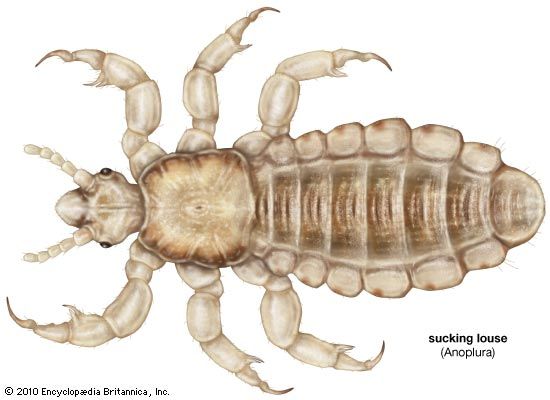
Human Louse
There are three primary types of lice that infest humans, all of which are sucking lice that feed on blood.
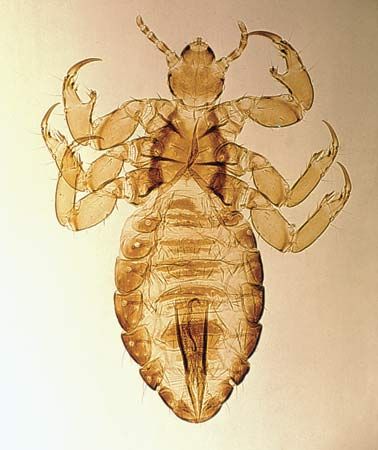
What are the different types of human lice and how do they differ?
There are three primary types of lice that infest humans, all of which are sucking lice that feed on blood.12
Head and Body Lice
Both the head louse (Pediculus humanus capitis) and the body louse (P. humanus humanus) are subspecies of the human louse.1
- Head Lice: These are smaller and tougher than body lice. They attach to the hair or scalp using claws on their legs and are primarily transmitted through direct contact.1
- Body Lice: These are larger than head lice and range in color from white to brown. Unlike head lice, they live in the seams of clothing rather than on the body itself, though they are not dependent on clothing for survival. They are sensitive to heat and can be eliminated through standard laundry procedures.1
Pubic Lice
The pubic louse (Phthirus pubis) is a distinct species from the human louse. It typically infests the coarse hair of the pubic region.2
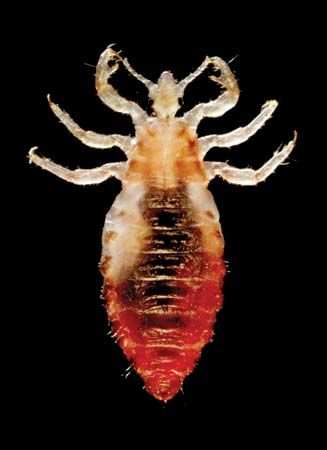
What role do human lice play in disease transmission, if any?
Human lice play a significant role in the transmission of several serious infectious diseases. The body louse (Pediculus humanus humanus) is the primary vector for epidemic typhus, a disease caused by the bacterium Rickettsia prowazekii.13
When a body louse feeds on an infected person, the bacteria invade the insect’s gut and are subsequently excreted in its feces. Humans typically contract the disease not from the bite itself, but by scratching the bite area, which rubs the infected feces into the skin or an open wound. Additionally, contaminated clothing can harbor infected louse feces, which may become airborne as dust and spread the infection to others.3
Beyond epidemic typhus, the human louse is also a known carrier of trench fever and relapsing fever. Furthermore, heavy infestations of any type of louse can cause intense skin irritation; the resulting scratching can break the skin barrier, potentially leading to secondary bacterial infections.14
What are the most effective treatments for human lice infestations?
Effective treatment for human lice depends on the type of infestation and the louse’s biological characteristics.
Head Lice
The most straightforward approach to managing head lice involves maintaining consistent hygiene of the hair and scalp, supplemented by the frequent use of a fine-tooth comb to physically remove the insects. While insecticidal shampoos have been widely used for control, their effectiveness has diminished in many regions because head lice have developed resistance to many common insecticides, leading to a global resurgence of the parasite.14
Body Lice
Because the body louse is highly sensitive to heat, it cannot survive high temperatures. Consequently, standard laundry procedures—such as washing clothing in hot water and drying at high heat—are highly effective at killing both the lice and their eggs, which are typically laid in the seams of undergarments.1
It is important to note that because lice thrive in conditions of overcrowding and poor hygiene, environmental cleanliness remains a fundamental component of preventing and controlling infestations.4
How have human lice evolved alongside humans throughout history?
Human lice have evolved in close association with their hosts, a phenomenon often referred to as host specificity or host restriction. Because lice are highly dependent on the specific environment of their host—such as body heat, skin secretions, and hair diameter—they have diverged and evolved alongside the lineages of their hosts over time.61
Genetic and evolutionary evidence reveals that human lice are most closely related to those found on our closest primate relatives. Specifically, the louse most nearly related to the human body louse is that of the chimpanzee, while the human pubic louse is most closely related to the louse of the gorilla.6
While this evolutionary history is generally stable, it can be obscured by secondary infestation, where a louse species successfully establishes itself on a new, unrelated host. Such events, which may occur through direct contact or environmental transfer, can lead to new evolutionary trajectories that mask the original host-parasite relationship.61
Sources
- human louse — Encyclopædia Britannica
- List of insects - lice (order Phthiraptera) — Encyclopædia Britannica
- typhus — Encyclopædia Britannica
- louse — Encyclopædia Britannica
- sexually transmitted disease — Encyclopædia Britannica
- louse - Evolution and paleontology — Encyclopædia Britannica
- louse - Ecology — Encyclopædia Britannica
Published on · 3 min read