Eciton Army Ant
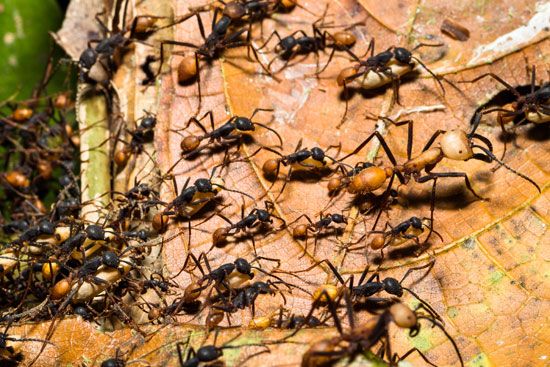
The Eciton army ant (Eciton burchellii) is a species of aggressive, nomadic ant native to the forests of Central and South America. As a keystone species…
What is Eciton army ant?
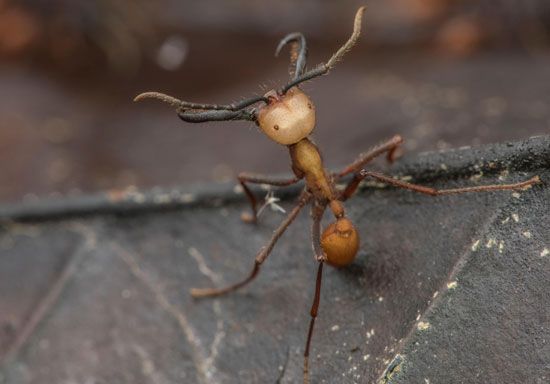
The Eciton army ant (Eciton burchellii) is a species of aggressive, nomadic ant native to the forests of Central and South America. As a keystone species, they play a critical role in maintaining biodiversity within their ecosystems.1
Unlike most ants, these social insects do not build permanent nests. Instead, they form temporary living structures called bivouacs using their own bodies. Colonies are massive, ranging from 100,000 to 2 million individuals, and follow a nomadic lifestyle, frequently moving to new hunting grounds. They communicate primarily through touch and pheromones, which they use to coordinate raids on prey, including various invertebrates and small vertebrates.1
Because over 300 animal species depend on them for food or survival, the extinction of these ants would have devastating effects on forest communities. Currently, they face threats from deforestation and habitat fragmentation, making conservation efforts vital.1
How do Eciton army ants build living bridges with their bodies?
Eciton army ants build living bridges by using the claws on their front legs to physically link their bodies together. This remarkable cooperative behavior allows the colony to navigate uneven terrain and overcome obstacles while on the move.1
This same structural strategy is also employed to create bivouacs, which are temporary, cylindrical nests formed by the worker ants to protect the queen and the colony’s immature members. By interlocking their bodies, the ants create a stable, living architecture that can be quickly assembled or disassembled as the colony travels through its forest habitat.1
What are some other examples of keystone species in nature?
A keystone species is an organism that exerts a disproportionately large influence on its environment relative to its abundance, often maintaining the structure and biodiversity of its community. Here are several notable examples:3
- Sea Otters (Enhydra lutris): These marine mammals are classic keystone predators. By consuming sea urchins, they prevent the urchins from overgrazing giant kelp forests. This “trophic cascade” allows the kelp to thrive, which in turn provides essential habitat for numerous other marine species.4
- Starfish (Pisaster ochraceus): In rocky intertidal zones, this predatory starfish controls populations of the mussel Mytilus californianus. Without the starfish, mussels can outcompete other species, leading to a significant loss of local biodiversity.3
- Beavers (Castor): Often called “ecosystem engineers,” beavers build dams that create ponds and wetlands. These structures provide critical habitats for fish, waterfowl, and other aquatic organisms, significantly increasing the environmental complexity and health of the local area.5
- Wolves (Canis lupus): As apex predators, wolves regulate the populations of large herbivores like deer and elk. By limiting these populations and influencing their movement, wolves help prevent overgrazing, which protects vegetation and supports broader ecosystem health.6
- Fig Trees (Ficus): In some tropical forests, certain fig species act as keystone food resources. Because they bear fruit year-round, they provide a vital lifeline for many birds and mammals during seasons when other food sources are scarce.3
How do rove beetles use mimicry to live among army ants?
Certain species of rove beetles, such as Ecitophya simulans, have evolved sophisticated methods to infiltrate and live among Eciton army ants. These beetles utilize a combination of physical, chemical, and behavioral mimicry to remain undetected by the colony members.7
By mimicking the appearance and behavior of the ants, these beetles can move through the colony without triggering an aggressive response. Furthermore, they employ chemical secretions to pacify their hosts, which often induces the ants to accept and even feed them. This form of social parasitism allows the beetles to exploit the colony’s resources, including food and larvae, while living safely within the protection of the ant horde.178
Sources
- Eciton army ant — Encyclopædia Britannica
- ant - Notable ant behaviors — Encyclopædia Britannica
- apex predator — Encyclopædia Britannica
- keystone species — Encyclopædia Britannica
- Why do beavers build dams? — Encyclopædia Britannica
- Otters, Algae, and Plants, Oh My - “Otters, Algae, and Plants, Oh My” transcript — Encyclopædia Britannica
- rove beetle — Encyclopædia Britannica
- Hymenoptera - Social parasitism — Encyclopædia Britannica
- Chemoreception - Pheromones — Encyclopædia Britannica
- Coleoptera - Size range and diversity of structure — Encyclopædia Britannica
Published on · 3 min read