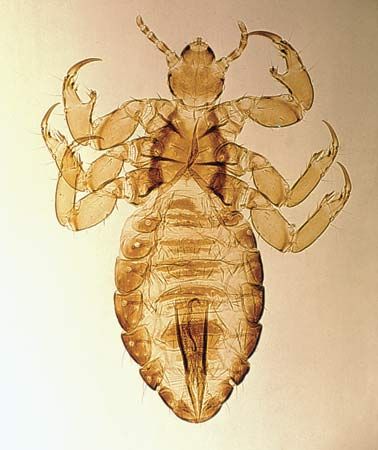
Louse
Lice reproduce primarily through sexual reproduction, though some species can reproduce via unfertilized eggs, a process known as parthenogenesis. Females…
How do lice reproduce and what is their life cycle like?
Lice reproduce primarily through sexual reproduction, though some species can reproduce via unfertilized eggs, a process known as parthenogenesis. Females are typically larger than males and often outnumber them on a host.1
The life cycle of a louse is characterized by simple metamorphosis, consisting of the egg, nymph, and adult stages.1
- Eggs: Often called nits, eggs are laid singly or in clumps and are usually cemented to hair or feathers. The human body louse, however, deposits its eggs in clothing seams.123
- Hatching: When ready to emerge, the nymph sucks in air to build internal pressure, which forces off the egg cap (operculum). Some species use a specialized structure called a hatching organ to assist in this process.1
- Nymphs: The emergent nymph resembles a smaller, uncolored version of the adult. Nymphs undergo three molts, with each stage (instar) becoming progressively larger and more adult-like.1
- Development: The duration of these stages varies by species and temperature; for example, the human louse egg stage lasts six to 14 days, with the nymphal stages taking an additional eight to 16 days.1
How do lice spread from one host to another?
Lice are primarily transmitted from one host to another through direct contact.2
- Head lice: These parasites, which attach themselves to the hair or scalp, pass between hosts when individuals come into direct physical contact with one another.2
- Body lice: Similar to head lice, body lice are transferred through direct contact. While they live in the seams of clothing, they are not dependent on the clothing itself for survival, but rather on the host.2
- Pubic lice: Often associated with the infestation known as pediculosis pubis, these lice (the crab louse, Phthirus pubis) typically infest the pubic region and are commonly spread through sexual contact.7
Because lice are generally host-specific and spend their entire life cycle on the host (with the exception of the body louse, which resides in clothing), they rely on close proximity or physical interaction to move to a new environment.21
What health issues can lice infestations cause in humans and animals?
Lice infestations can lead to a variety of health issues in both humans and animals, ranging from localized irritation to the transmission of serious systemic diseases.
Health Impacts on Humans
The most common effect of a lice infestation is intense skin irritation caused by the insects feeding on blood and tissue fluids. This irritation often leads to persistent scratching, which can break the skin and result in secondary bacterial infections.89
More severely, certain species—specifically the human louse—act as vectors for dangerous infectious diseases, including:
Health Impacts on Animals
In domestic animals, lice infestations cause significant discomfort and physical damage. Common issues include:
- Skin and Coat Damage: Animals may suffer from intense irritation, leading to rubbing that damages hides, wool, or feathers.8
- Reduced Productivity: Heavy infestations can negatively impact the health of livestock, often resulting in reduced meat and egg production.8
- Disease Transmission: Some lice serve as intermediate hosts for parasites, such as the dog louse, which can transmit the dog tapeworm. Additionally, certain rat lice are known to transmit murine typhus among rodent populations.8
How many species of lice exist, and what are the major groups?
Lice are classified within the order Phthiraptera, which comprises small, wingless, and dorso-ventrally flattened insects that live as permanent ectoparasites on birds and mammals. While the exact total number of species is difficult to pinpoint, the suborders Amblycera and Ischnocera alone contain approximately 2,900 described species. When including the other groups, the total number of known species is significantly higher.1112
These insects are categorized into four distinct suborders based primarily on their mouthparts and feeding habits:11
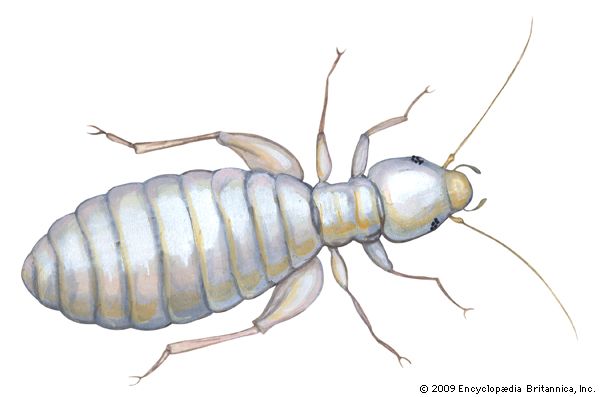
- Amblycera (chewing or biting lice): These possess mandibulate (chewing) mouthparts and are parasites of both birds and mammals.11
- Ischnocera (chewing lice): Also possessing mandibulate mouthparts, this group is primarily parasitic on birds, though some species infest mammals.11
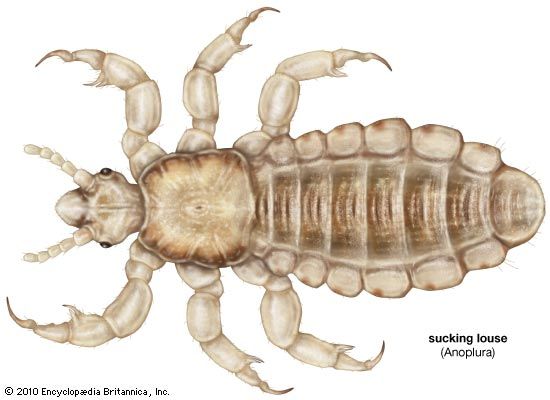
- Anoplura (sucking lice): This group consists of about 500 species characterized by piercing mouthparts adapted for feeding exclusively on blood.1113
- Rhynchophthirina: A very small group containing only two known species, Haematomyzus elephantis (found on elephants) and H. hopkinsi (found on warthogs), which feature modified mandibles at the end of a long proboscis.11
Sources
- louse - Life cycle — Encyclopædia Britannica
- human louse — Encyclopædia Britannica
- nit — Merriam-Webster
- heteropteran - Nymphs — Encyclopædia Britannica
- louse - General features — Encyclopædia Britannica
- nitro — Merriam-Webster
- sexually transmitted disease — Encyclopædia Britannica
- louse — Encyclopædia Britannica
- sucking louse — Encyclopædia Britannica
- skin disease - Skin infections and infestations — Encyclopædia Britannica
- chewing louse — Encyclopædia Britannica
- louse - Annotated classification — Encyclopædia Britannica
- louse - Ecology — Encyclopædia Britannica
Published on · 3 min read