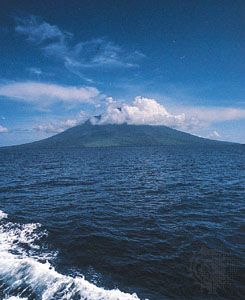
Huon Peninsula
The Huon Peninsula is a prominent peninsula extending from northeastern Papua New Guinea into the southwestern Pacific Ocean. It is bounded by the Bismarck…
What is Huon Peninsula?
The Huon Peninsula is a prominent peninsula extending from northeastern Papua New Guinea into the southwestern Pacific Ocean. It is bounded by the Bismarck Sea, the Solomon Sea, the Huon Gulf, and the Markham River1.1
The region is characterized by rugged, densely forested terrain, with mountain ranges rising over 13,000 feet (4,000 metres). Geologically, the peninsula is internationally significant for its spectacular suite of coastal terraces, which were formed by rapid tectonic uplift during the Pleistocene Epoch. These terraces provide a vital record of ancient sea-level changes.12
Historically, the area is notable for early human settlement, with archaeological evidence near Bobongara dating back approximately 40,000 years. In more recent history, it was occupied by Japanese forces in 1942 and recaptured by the Allies in 1943. Additionally, the nearby Huon Gulf is renowned for its distinct art and architecture, particularly its carved wooden figures and elaborate bowls.13
How do coral terraces help scientists track ancient sea levels?
Coral terraces serve as essential tools for scientists to reconstruct ancient sea levels, particularly in regions experiencing steady tectonic uplift, such as the Huon Peninsula in Papua New Guinea.2
These terraces help track sea-level history through the following processes:
- Exposure of Shorelines: In areas undergoing tectonic uplift, ancient shorelines and their associated coral reefs are pushed above modern sea level. This preserves them from being submerged and lost, as has happened to many other Pleistocene coastal environments.2
- Radiometric Dating: Because these terraces contain fossilized reef complexes, scientists can use radiometric dating to determine the precise age of the corals. This allows researchers to correlate specific terrace elevations with known periods of high sea level.2
- Chronological Mapping: By analyzing the ages and elevations of a suite of terraces, scientists can map the fluctuations of the sea over tens of thousands of years. For example, studies have indicated that high sea-level intervals occurred roughly every 20,000 years, providing a vital record that links coastal changes to the broader history of glaciation.2
What makes the Huon Peninsula a significant site for studying early human migration?
The Huon Peninsula is a significant site for studying early human migration primarily due to the archaeological discoveries made near the town of Bobongara on its east coast.
Excavations in this area have uncovered stone tools and evidence of human habitation dating back approximately 40,000 years. These findings represent some of the earliest known evidence of human settlement in Oceania, providing critical insights into the timeline and patterns of prehistoric migration across the Pacific Ocean and the surrounding region.1
What are some unique characteristics of art from the Huon Gulf region?
Art from the Huon Gulf region is primarily defined by the influential Tami style, which is characterized by a distinct, massive aesthetic.
Figural Sculpture
Representations of the human figure in this region are noted for their blocky, almost cubist forms. Key features include:
- Structure: Figures are typically standing or kneeling with a rectangular head set directly into the torso.
- Geometry: The human form is dominated by rectilinear lines, with three horizontal axes at the shoulders, hips, and feet.
- Facial Details: Faces are triangular with closely set, circular eyes positioned beneath a low forehead. A unique characteristic is the presence of triangular shapes incised or painted at the sides of the face, with their apexes pointing toward the center.
Decorative Arts and Objects
Beyond figural carvings, the region is famous for its functional yet highly stylized objects:
- Bowls: Large, shallow, oval wooden bowls are a hallmark of the area. These often feature a human face carved at one end, with the bowl itself representing an elaborate headdress, or they are shaped like birds, fish, or other animals.
- Surface Design: Designs on these objects are typically incised and filled with lime to create a striking contrast against a black background.
- Versatility: Stylized animal motifs—including crocodiles, turtles, lizards, and fish—frequently appear on secular items such as canoe prows, paddles, headrests, and lime spatulas.
Sources
- Huon Peninsula — Encyclopædia Britannica
- Pleistocene Epoch - Coastal environments and sea-level changes — Encyclopædia Britannica
- Oceanic art and architecture - The Huon Gulf — Encyclopædia Britannica
- geochronology - Coral growth — Encyclopædia Britannica
- coral reef - Winds , currents, temperature, and salinity — Encyclopædia Britannica
- Tertiary Period - Correlation of Tertiary strata — Encyclopædia Britannica
- lagoon - The effect of time — Encyclopædia Britannica
- coral reef - Origin and development of reefs — Encyclopædia Britannica
- Tami style — Encyclopædia Britannica
Published on · 3 min read