Tertiary Period
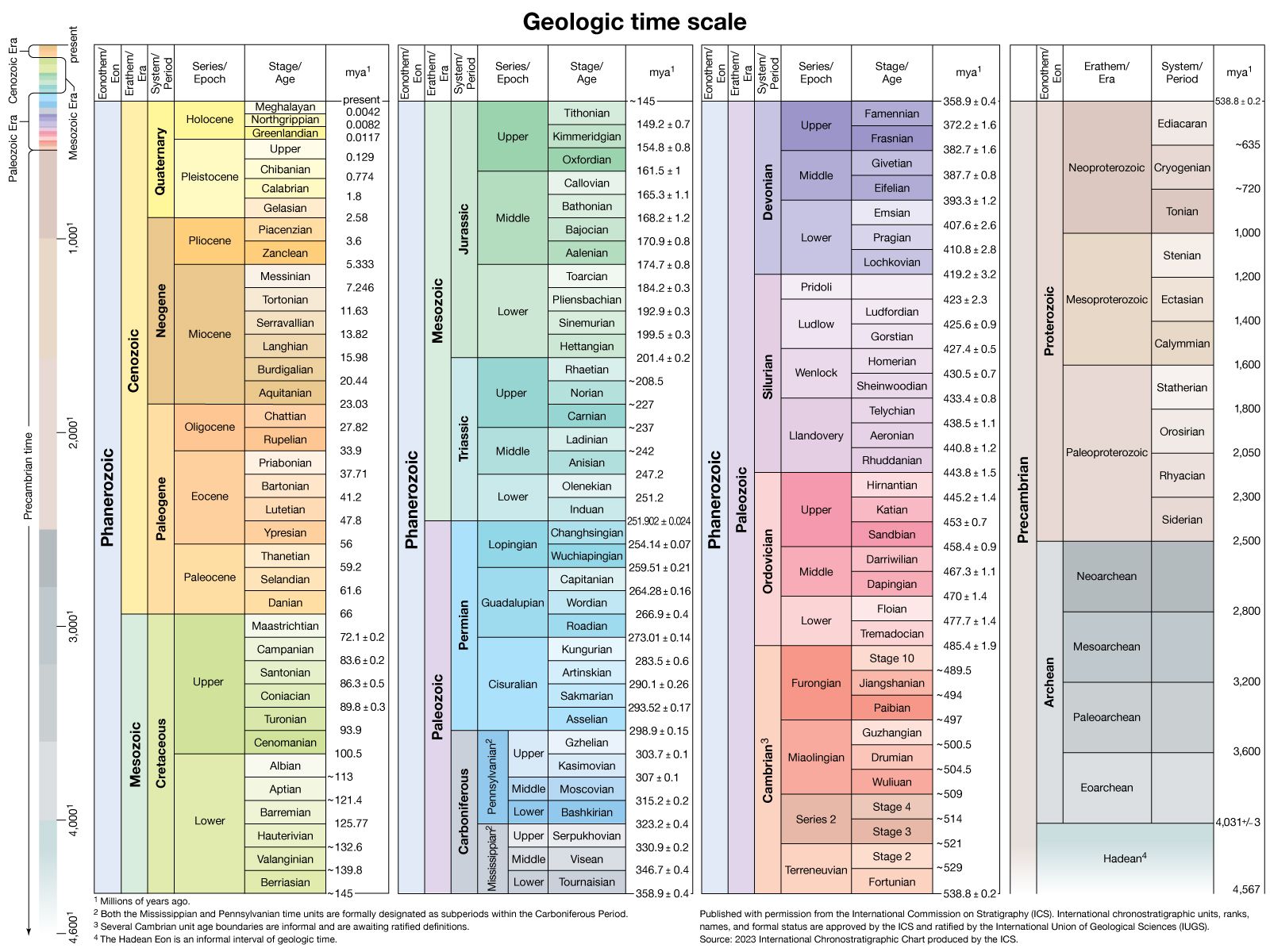
It is important to clarify that the Tertiary Period is no longer an official interval of geologic time. In 2008, the International Commission on Stratigraphy…
How is the Tertiary Period divided into smaller epochs, and what are their names?
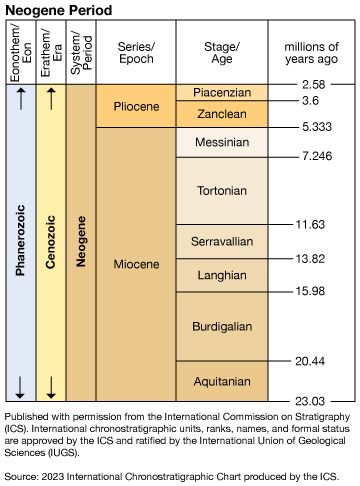
It is important to clarify that the Tertiary Period is no longer an official interval of geologic time. In 2008, the International Commission on Stratigraphy officially replaced it with two distinct periods: the Paleogene Period and the Neogene Period.12
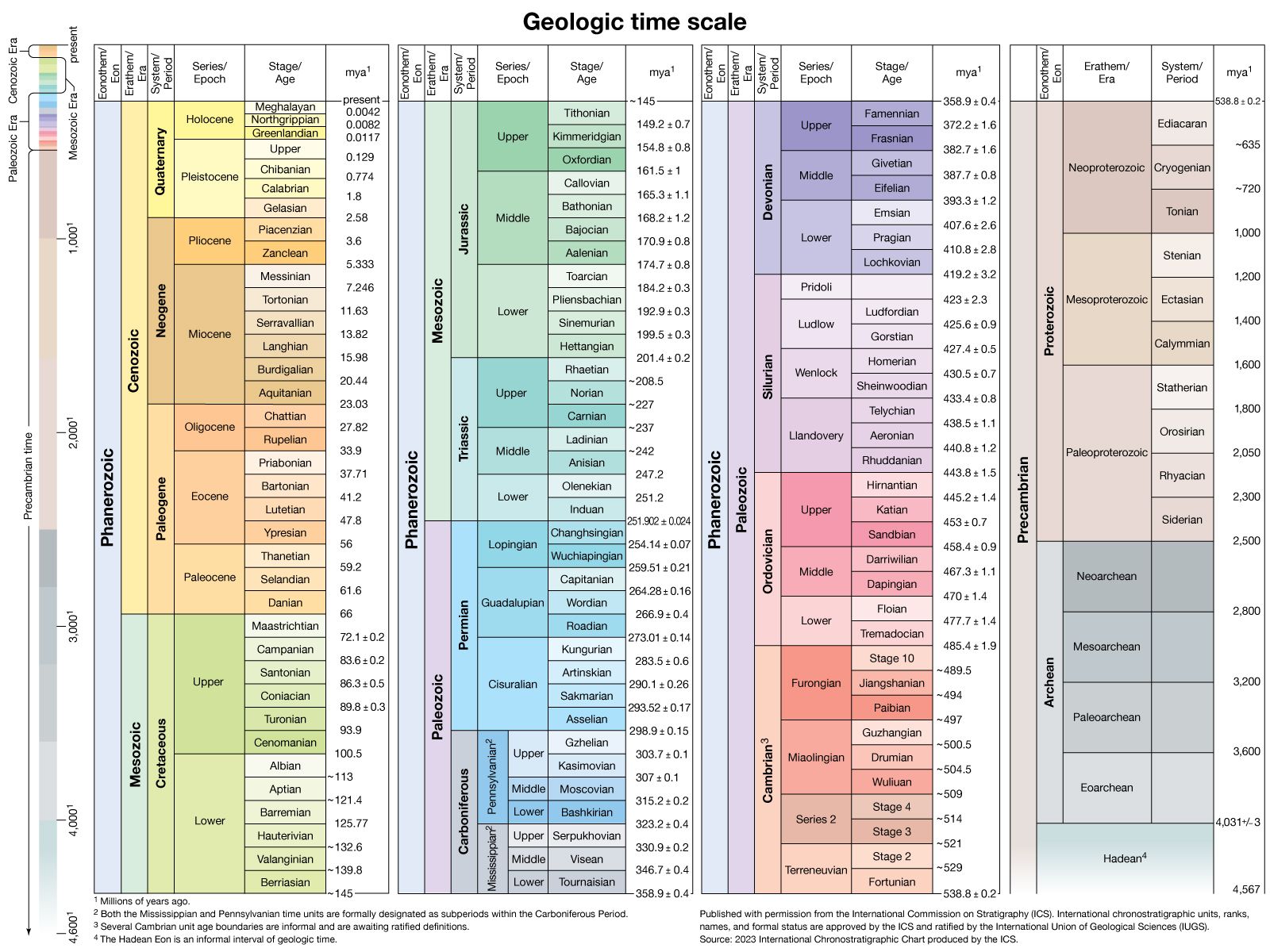
Historically, the Tertiary was divided into five principal epochs, which remain the standard subdivisions for the time interval spanning approximately 66 million to 2.6 million years ago. From oldest to youngest, these epochs are:2
- Paleocene: 66 million to 55.8 million years ago.2
- Eocene: 55.8 million to 33.9 million years ago.2
- Oligocene: 33.9 million to 23 million years ago.2
- Miocene: 23 million to 5.3 million years ago.2
- Pliocene: 5.3 million to 2.6 million years ago.2
The Paleocene, Eocene, and Oligocene epochs now constitute the Paleogene Period, while the Miocene and Pliocene epochs comprise the Neogene Period.1
What major mountain ranges formed during the Tertiary Period?
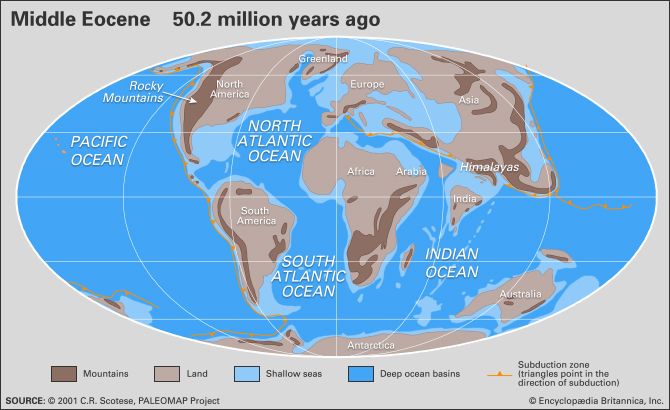
The Tertiary Period (now divided into the Paleogene and Neogene periods) was a time of intense tectonic activity, resulting in the formation and significant uplift of several major mountain ranges worldwide.34
Major Mountain Ranges and Orogenies
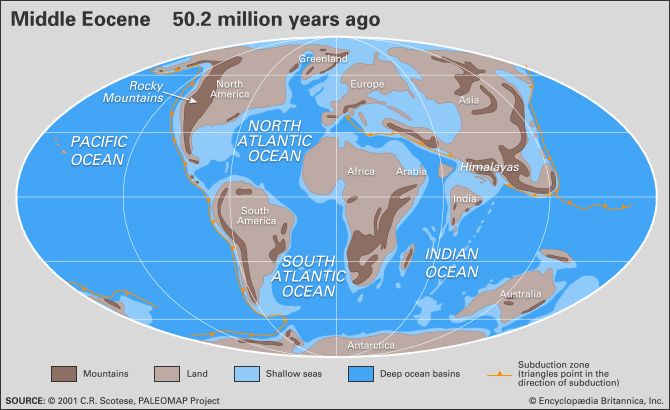
- The Himalayas: The collision of the Indian subcontinent with the Eurasian Plate, which began approximately 40 to 50 million years ago, initiated the formation of the Himalayas. Mountain building intensified during the Miocene, and the range reached its current staggering heights during the Pleistocene.35
- The Alps: The Alpine orogeny was a major mountain-building event that began in the late Eocene and Oligocene. It was responsible for the elevation of the Alps and the uplifting of plateaus across the Balkan Peninsula, Corsica, and Sardinia.36
- The Andes: While mountain-building processes in the Andes began earlier, significant uplift occurred throughout the Neogene due to the subduction of the Nazca Plate beneath the South American continent. A notable period of rapid uplift occurred approximately 25 million years ago.378
- The Rocky Mountains: The Laramide orogeny during the Paleocene and Eocene produced the initial upthrusting of the Rocky Mountains. These mountains underwent renewed uplift near the Pliocene-Pleistocene boundary.3
- Other Ranges: The Pyrenees experienced major uplift in the late Eocene, while the Southern Alps of New Zealand began their major tectonic rise about 24 million years ago.3
How did the climate change throughout the Tertiary Period?
The climate of the Tertiary Period (now divided into the Paleogene and Neogene periods) was characterized by a long-term transition from extreme warmth to a cooler, “icehouse” state. This climatic evolution was driven primarily by tectonic forces, which altered continental positions, ocean bathymetry, and circulation patterns, alongside fluctuations in atmospheric carbon dioxide concentrations.111213
Early Tertiary Warmth
The early Cenozoic was marked by global warmth, with tropical and subtropical conditions extending to high latitudes. The peak of this warmth occurred during the Paleocene-Eocene Thermal Maximum (PETM) about 56 million years ago, when global temperatures rose by more than 5 °C (9 °F) in a few thousand years. Following the PETM, temperatures declined briefly before rising again during the Eocene Optimum.1114
The Cooling Trend
A steady global cooling trend began in the middle to late Eocene, accelerating significantly across the Eocene-Oligocene boundary (about 34 million years ago). This shift was largely caused by the opening of the Drake Passage, which isolated Antarctica within a cold polar sea and disrupted global oceanic circulation. Consequently, continental-scale glaciation developed in Antarctica during the Oligocene.111413
Neogene Cooling and Glaciation
While the late Oligocene and early Miocene were relatively warm, cooling resumed 15 million years ago, leading to the expansion of the Antarctic ice sheet. The cooling trend accelerated into the Pliocene, culminating in the onset of Northern Hemisphere glaciation approximately 3.2 million years ago. This final transition was driven by tectonic events, including the uplift of the Andes and the Tibetan Plateau, which fundamentally altered atmospheric and oceanic circulation patterns.11
What were the major geological events that took place during the Tertiary Period?
The Tertiary Period was a time of profound geological transformation, driven primarily by the movement of tectonic plates, which reshaped the Earth’s surface, oceanic circulation, and climate.133
Major Tectonic and Geological Events
- Continental Rifting and Separation: The Tertiary saw the continued fragmentation of continents. Notably, the rifting and separation of Eurasia from North America occurred along a line between Scandinavia and Greenland. Additionally, the separation of Australia from Antarctica, beginning about 58 million years ago, initiated limited circum-Antarctic circulation, which isolated Antarctica and set the stage for its eventual glaciation.1516
- Orogenesis (Mountain Building): The period was defined by intense mountain-building activity:
- Himalayan Uplift: The collision of the Indian subcontinent with the Asian continent, which began approximately 40 million years ago, initiated the formation of the Himalayas and the subsequent uplift of the Plateau of Tibet.1517
- Alpine Orogeny: The Alpine orogeny began in the late Eocene and Oligocene, leading to the formation of the Alps and the Pyrenees.15
- Cordilleran Activity: The Laramide orogeny produced the upthrusting of the Rocky Mountains, which underwent renewed uplift near the Pliocene-Pleistocene boundary.15
- Volcanism: Massive volcanic events occurred, such as the eruption of the Deccan Traps in India near the Cretaceous-Tertiary boundary and extensive explosive volcanism in the North Atlantic region around 55 million years ago. The circum-Pacific “Ring of Fire” remained a site of significant seismic and volcanic activity throughout the period.15
- Closure of Seaways: The closing of the Tethys seaway and the eventual formation of the Isthmus of Panama (completed near the end of the Tertiary) fundamentally altered global ocean circulation, contributing to significant climatic cooling and the intensification of ice ages.1316
Sources
- A Journey Through Time Since the Precambrian - Paleogene Period: 66 million to 23 million years ago, and Neogene Period: 23 million to 2.6 million years ago — Encyclopædia Britannica
- Tertiary Period — Encyclopædia Britannica
- Tertiary Period - Volcanism and orogenesis — Encyclopædia Britannica
- Alpine orogeny — Encyclopædia Britannica
- Asia - Chronological summary — Encyclopædia Britannica
- Himalayas - Geologic history — Encyclopædia Britannica
- Andes Mountains: Top Questions — Encyclopædia Britannica
- Andean Geosyncline — Encyclopædia Britannica
- mountain - Tectonic processes that produce high elevations — Encyclopædia Britannica
- plate tectonics - Mountains by subduction — Encyclopædia Britannica
- Climate change - Cenozoic climates — Encyclopædia Britannica
- Paleocene-Eocene Thermal Maximum — Encyclopædia Britannica
- Tertiary Period - Paleoclimate — Encyclopædia Britannica
- Climate change - Phanerozoic climates — Encyclopædia Britannica
- paleoceanography — Encyclopædia Britannica
- Earth sciences - The theory of plate tectonics — Encyclopædia Britannica
- mountain - The Himalayan chain — Encyclopædia Britannica
- Isthmus of Panama — Encyclopædia Britannica
- Panama, Isthmus of — Merriam-Webster
Published on · 5 min read