Iberian Peninsula
The Moorish conquest and the subsequent Reconquista fundamentally reshaped the Iberian Peninsula over several centuries.
How did the Moorish conquest and subsequent Reconquista affect the Iberian Peninsula?
The Moorish conquest and the subsequent Reconquista fundamentally reshaped the Iberian Peninsula over several centuries.
The Moorish Impact
Beginning in 711, the Muslim conquest introduced a period of significant cultural and economic development. Under Al-Andalus, the region experienced a golden age characterized by advancements in agriculture, irrigation, and urban life. Cities like Córdoba and Sevilla became centers of science, architecture, and learning, fostering an environment where Christians, Muslims, and Jews intermingled.1
The Reconquista and Transformation
The Reconquista was a centuries-long series of campaigns by Christian kingdoms to reclaim territory. This process led to:
- Political Consolidation: The rise of kingdoms like Castile and Aragon and the development of early parliamentary institutions known as the Cortes.2
- Cultural Exchange: Despite the conflict, the peninsula remained a crossroads of thought. Institutions like the School of Translators in Toledo made Arabic knowledge available to the Christian West.3
- Religious Uniformity: Following the fall of Granada in 1492, the Catholic Monarchs emphasized religious homogeneity, leading to the Spanish Inquisition and the eventual expulsion of Moorish and Jewish populations.3
What countries are located on the Iberian Peninsula?
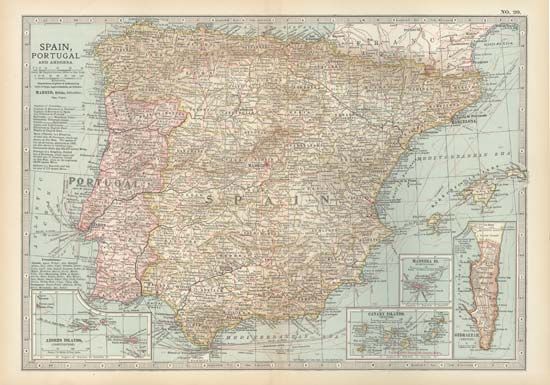
The Iberian Peninsula is primarily occupied by two sovereign countries: Spain and Portugal.67
While these two nations make up the vast majority of the peninsula’s territory, it is also home to:
- Andorra: A tiny principality located in the Pyrenees mountains on the border between Spain and France.8
- Gibraltar: A British Overseas Territory located at the southern tip of the peninsula.68
How did the geography of the Iberian Peninsula influence its history and culture?
The geography of the Iberian Peninsula has profoundly shaped its historical development and cultural identity by acting as both a barrier and a bridge.
Physical Barriers and Isolation
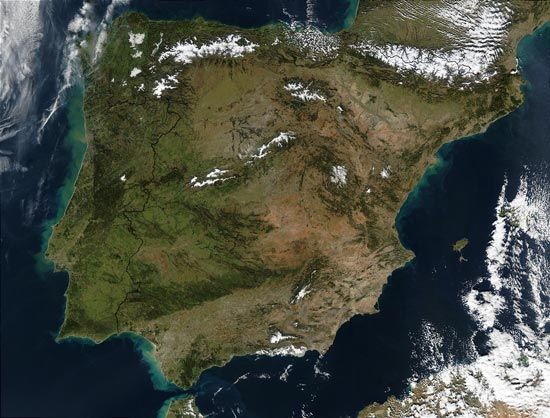
The Pyrenees mountain range creates a formidable land barrier in the northeast, effectively separating the peninsula from the rest of Europe. This isolation contributed to the development of distinct regional cultures, such as the Basques, and fostered a unique internal political evolution. Internally, the Meseta Central—a vast, high plateau—defined the peninsula’s interior, influencing settlement patterns and creating a continental climate that contrasts sharply with the maritime conditions of the coastal regions.691011
Maritime Influence and Expansion
Surrounded by the Atlantic Ocean and the Mediterranean Sea, the peninsula’s extensive coastline encouraged maritime activity. While inland populations traditionally prioritized the conquest of contiguous territory, coastal regions developed a strong seafaring tradition. The caravel, with its shallow draft, allowed Portuguese explorers to navigate complex river outlets and coastlines, facilitating the expansion of trade and exploration into the Atlantic and beyond.61213
Cultural Crossroads
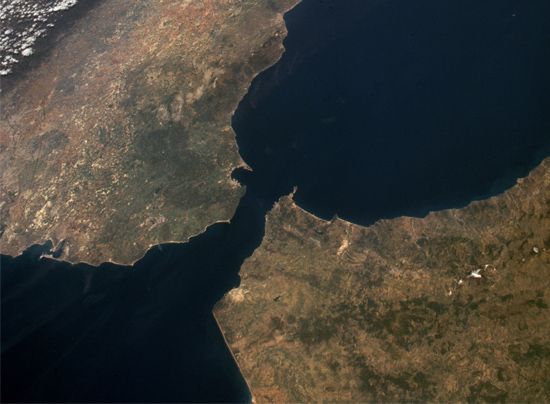
The peninsula’s proximity to North Africa, separated only by the narrow Strait of Gibraltar, made it a frequent site of cross-continental contact. The Muslim conquest and the subsequent Reconquista were driven by this geographic accessibility, leading to centuries of interaction between diverse ethnic and religious groups. This history of contact and eventual movement toward religious orthodoxy deeply influenced the social and political structures that the Iberian powers later exported to the Western Hemisphere.69
How has the Iberian Peninsula’s location between the Mediterranean Sea and Atlantic Ocean impacted its development?
The Iberian Peninsula occupies a unique geographic position between the Atlantic Ocean and the Mediterranean Sea, a location that has fundamentally dictated its economic and political trajectory.6
Maritime Strategy and Trade
The peninsula’s access to both bodies of water made it a critical hub for maritime commerce. The Strait of Gibraltar serves as the vital gateway between the two, historically functioning as a strategic chokepoint for trade routes. During the 15th century, the shift in global trade—often called the “Atlantic revolution”—saw the rise of Atlantic ports like Lisbon, which challenged the long-standing dominance of Mediterranean commercial centers. The development of the caravel allowed Portuguese explorers to leverage this Atlantic access to pioneer new maritime routes to Asia, effectively bypassing traditional Mediterranean intermediaries.1617181911
Cultural and Geopolitical Crossroads
The proximity to North Africa across the narrow strait facilitated centuries of intense interaction, including the 711 CE Muslim invasion that deeply influenced the region’s language, architecture, and intellectual heritage. Furthermore, the control of the Rock of Gibraltar has remained a point of strategic rivalry for centuries, reflecting the peninsula’s enduring importance as a bridge between continents and seas.6201621
Sources
- Reconquista — Encyclopædia Britannica
- Spain - Society, economy, and culture — Encyclopædia Britannica
- Spain - The conquest — Encyclopædia Britannica
- Spain - The ṭāʾifa s — Encyclopædia Britannica
- Andalusia - History of Andalusia — Encyclopædia Britannica
- Iberian Peninsula — Encyclopædia Britannica
- Spain - Land — Encyclopædia Britannica
- Portugal - Land of Portugal — Encyclopædia Britannica
- history of Latin America - Ethnic diversity and its results — Encyclopædia Britannica
- Western architecture - Iberia — Encyclopædia Britannica
- Caravel: Top Questions — Encyclopædia Britannica
- Spain - Relief — Encyclopædia Britannica
- Spain - Climate of Spain — Encyclopædia Britannica
- Spain - Soils — Encyclopædia Britannica
- history of Latin America - The overseas tradition — Encyclopædia Britannica
- Strait of Gibraltar — Encyclopædia Britannica
- Gibraltar - History — Encyclopædia Britannica
- Portugal - Cultural life — Encyclopædia Britannica
- history of Europe - Trade and the “Atlantic revolution” — Encyclopædia Britannica
- Mediterranean Sea - Transportation and tourism — Encyclopædia Britannica
- Spain - Cultural milieu — Encyclopædia Britannica
Published on · 4 min read