Icadyptes
Icadyptes is an extinct genus of giant penguin that lived approximately 37 million to 35 million years ago during the Eocene Epoch. Represented by the single…
What is Icadyptes?
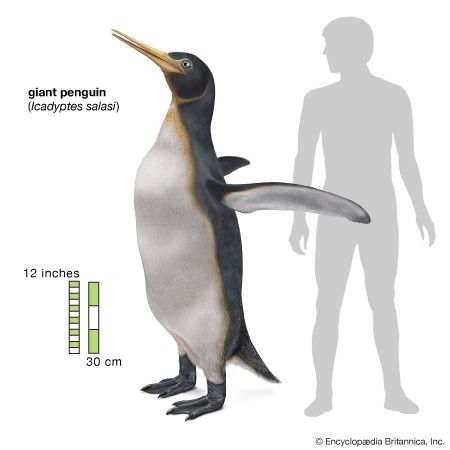
Icadyptes is an extinct genus of giant penguin that lived approximately 37 million to 35 million years ago during the Eocene Epoch. Represented by the single species I. salasi, this bird was remarkable for its size, reaching heights of about 1.5 metres (5 feet) and weighing between 50 and 80 kg (110 to 176 pounds).1
Unlike most penguins, Icadyptes inhabited low-latitude, tropical environments near the Equator along the coast of ancient South America. It possessed a distinctive 20-cm (8-inch) spear-shaped beak, which it likely used to catch fish in nutrient-rich waters. Its fossil remains, which include a remarkably complete wing skeleton, provide significant insights into the biology of ancient aquatic birds insights into the biology of ancient aquatic birds. The extinction of Icadyptes and other giant penguins is thought to be linked to increasing competition for resources from marine mammals, such as seals and small carnivorous whales.12
When and where did Icadyptes live?
Icadyptes lived approximately 37 million to 35 million years ago during the latter half of the Eocene Epoch.1
Geographically, this genus was unique among penguins for inhabiting low-latitude, tropical environments near the Equator. Fossil remains of Icadyptes have been recovered from marine rocks of the Otuma Formation in the Pisco Basin, located along the southern coast of ancient South America in modern-day Peru. This habitat was significantly warmer than the environments typically associated with modern penguins, as the Eocene climate was generally much warmer and lacked polar ice.1
What did Icadyptes look like?
Icadyptes was a physically imposing bird that stood approximately 1.5 metres (about 5 feet) tall, making it significantly larger than the modern Emperor penguin. It weighed between 50 and 80 kg (110 to 176 pounds), giving it a stature comparable to a small or medium-sized human.12
Key physical characteristics included:
- Beak: It possessed a long, 20-cm (8-inch) spear-shaped beak. This feature was powerfully built and resembled the beaks of living herons, likely serving as a tool to spear fish in tropical waters.1
- Skeleton: Its bones were notably solid, a common trait in diving birds. Interestingly, its wing structure was less paddle-like than that of modern penguins, offering researchers unique insights into the anatomy of ancient aquatic species.1
Overall, Icadyptes represented a giant form of the Sphenisciformes order, showcasing a body plan that thrived in the warmer, ice-free climates of the Eocene Epoch.12
How big was Icadyptes compared to modern penguins?
Icadyptes was significantly larger than any penguin species alive today. While the Emperor penguin—the largest living penguin—stands approximately 1.3 metres (about 4 feet) tall and weighs between 25 and 45 kg (55 to 100 pounds), Icadyptes reached a height of about 1.5 metres (5 feet) and weighed between 50 and 80 kg (110 to 176 pounds).1
This size difference highlights the trend of “mega penguins” during the Eocene Epoch, where many extinct species were much larger than their modern counterparts. While Icadyptes was massive, it was not the largest penguin ever discovered; for instance, the extinct Palaeeudyptes klekowskii is estimated to have reached up to 2 metres (6.6 feet) in height, and Kumimanu fordycei is considered the heaviest known penguin, weighing up to 160 kg (353 pounds).13
Sources
- Icadyptes — Encyclopædia Britannica
- penguin - Fossil record — Encyclopædia Britannica
- What Is a Mega Penguin? — Encyclopædia Britannica
- Climate change - Cenozoic climates — Encyclopædia Britannica
Published on · 2 min read