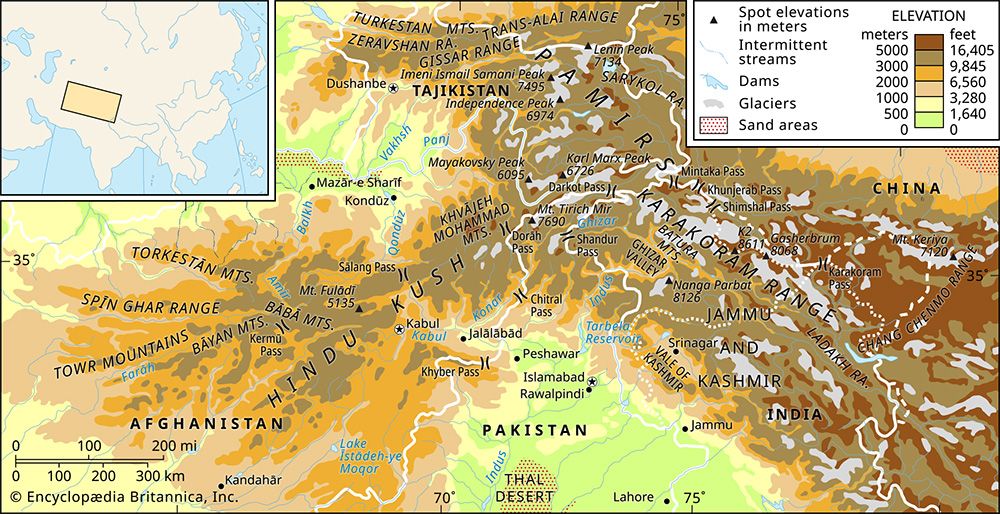
Imeni Ismail Samani Peak
Imeni Ismail Samani Peak is the highest mountain in Tajikistan and the Akademii Nauk Range, reaching an elevation of 24,590 feet (7,495 metres). Located in…
What is Imeni Ismail Samani Peak?
Imeni Ismail Samani Peak is the highest mountain in Tajikistan and the Akademii Nauk Range, reaching an elevation of 24,590 feet (7,495 metres). Located in the western Pamirs, this prominent peak was first successfully climbed by a Russian expedition in 1933.1
What are the Pamir Mountains known for?
The Pamirs are a vast highland region in Central Asia, primarily located in Tajikistan. They are known for several distinct characteristics:
- The Pamir Knot: The region serves as a central orogenic uplift from which major mountain ranges radiate, including the Hindu Kush, Karakoram Range, Kunlun Mountains, and Tien Shan.2
- Historical Significance: The region was traversed by branches of the Silk Road and served as a strategic buffer zone between the Russian and British empires during the 19th century.3
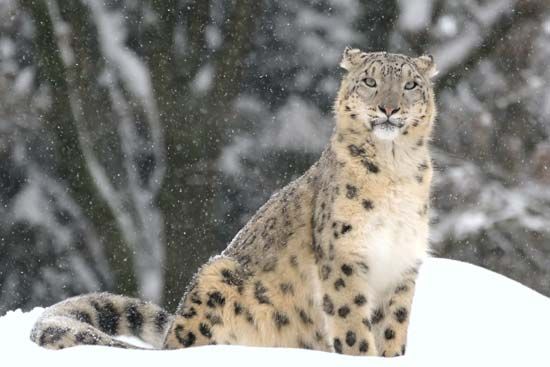
- Unique Ecosystems: The eastern Pamirs feature high, undulating grasslands and tablelands that support diverse wildlife, including the argali (Marco Polo) wild sheep and snow leopards. The western valleys, by contrast, are marked by deep river systems and regenerating vegetation.245
- Scientific Research: The region has been a focal point for studies in geology, glaciation, and high-altitude physiology, supported by long-standing meteorological and hydrological observatories.3
How do mountain climbers prepare for high-altitude peaks?
Preparing for high-altitude peaks requires a combination of physical conditioning, technical skill development, and careful physiological acclimatization.
Physical and Technical Preparation
Mountaineers must be competent in three core areas: hiking, rock climbing, and snow and ice technique. Mastery of these skills is typically gained through experience and practice at lower elevations, where climbers learn to handle ropes, place anchors, and use specialized gear like ice axes and crampons. Maintaining a steady, rhythmic pace is essential for endurance during long, arduous ascents.7
Acclimatization
The most critical challenge at high altitude is hypoxia, or oxygen deprivation. To adapt, climbers often follow the principle of “climb high, sleep low,” where they ascend to establish camps at higher elevations before returning to a lower camp to rest. This process allows the body to undergo acclimatization, which includes increasing ventilation, producing more hemoglobin and red blood cells, and developing more blood vessels to improve oxygen transport to tissues.89
Expedition Strategy
Climbers generally choose between two styles:
- Siege Climbing: A traditional, large-scale approach involving multiple camps and logistical support, often used for major expeditions.8
- Alpine Style: A lightweight, fast-paced approach used by small parties carrying all necessary provisions, which minimizes time spent in dangerous zones but still requires weeks of acclimatization at base camp.8
What is the significance of the Akademiya Nauk Range?
The Akademii Nauk Range is a significant mountain range located in the western Pamirs of central Tajikistan. Its primary significance lies in its extreme elevation and extensive glaciation.11
Key features include:
- Extreme Elevation: The range contains the highest peak in Tajikistan, Imeni Ismail Samani Peak, which reaches an altitude of 24,590 feet (7,495 metres). In total, the range features 24 peaks exceeding 19,700 feet (6,000 metres).11
- Glacial Coverage: The mountains are heavily glaciated, with permanent snowcaps covering an area of approximately 580 square miles (1,500 square km).11
- Geological Composition: The range extends north-south for about 68 miles (110 km) and is primarily composed of sedimentary and metamorphic rocks, with some granite formations.11
- Historical Naming: The range was named in 1927 to honor the Academy of Sciences of the Soviet Union.11
Sources
- Imeni Ismail Samani Peak — Encyclopædia Britannica
- Pamirs — Encyclopædia Britannica
- Pamirs - Climate — Encyclopædia Britannica
- Pamirs - Study and exploration — Encyclopædia Britannica
- Pamirs - Plant life — Encyclopædia Britannica
- Pamirs - Animal life — Encyclopædia Britannica
- Mount Everest - The human challenge — Encyclopædia Britannica
- human respiratory system - High altitudes — Encyclopædia Britannica
- Mount Everest - Routes and techniques — Encyclopædia Britannica
- mountaineering - Techniques — Encyclopædia Britannica
- Akademii Nauk Range — Encyclopædia Britannica
Published on · 3 min read