India Rubber Plant
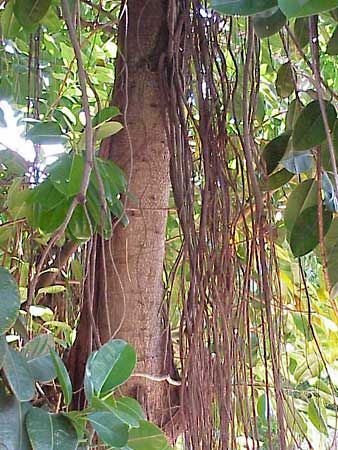
The India rubber plant (Ficus elastica) was historically a source of natural rubber, but it produced an inferior product compared to the rubber tree (Hevea…
How does the rubber produced from India rubber plants compare to synthetic rubber?
The India rubber plant (Ficus elastica) was historically a source of natural rubber, but it produced an inferior product compared to the rubber tree (Hevea brasiliensis), which became the primary source of natural rubber in the early 20th century.1
Natural rubber, derived from Hevea brasiliensis, consists almost exclusively of cis-1,4-polyisoprene. Its unique physical properties include high extensibility and “self-reinforcing” strength, as its molecules align into a crystalline arrangement when stretched. However, it is sensitive to temperature fluctuations and can be weakened by hydrocarbon oils or atmospheric oxygen.2
In contrast, synthetic rubber is produced through chemical processes using materials like petroleum or natural gas. While early synthetic attempts were often inferior, modern chemistry allows for the creation of “synthetic natural rubber” (cis-polyisoprene) that is virtually identical to the natural product. Other synthetic elastomers are engineered for specific advantages, such as superior oil or heat resistance, which natural rubber lacks. Today, synthetic and natural rubbers are often used in combination to balance their respective strengths and weaknesses.3452
What are some common uses of the India rubber plant besides rubber production?
The India rubber plant (Ficus elastica) is primarily valued today as an ornamental plant. Because it is durable and capable of thriving in less-than-ideal indoor conditions, it is widely cultivated as a popular indoor potted plant.17
Gardeners and interior decorators often choose from various cultivated varieties that offer aesthetic appeal through their foliage, such as:
- ‘Decora’: Known for having broader, darker green leaves.
- Variegated strains: These feature marbled patterns of gray, cream, and white, or green leaves accented with yellow or white margins.1
Beyond its role as a houseplant, the species is a member of the Moraceae family and shares the general characteristics of the Ficus genus, which are often used in landscaping and tropical gardening for their evergreen, waxy foliage.17
How is latex extracted from the India rubber plant and processed into rubber?
The India rubber plant (Ficus elastica) produces a milky sap known as latex that exudes from its trunk and stems when they are cut or injured. While this plant was historically used as a source of natural rubber, it was eventually replaced in the early 20th century by the rubber tree (Hevea brasiliensis), which is far more efficient for commercial production.
The process for extracting and refining rubber from latex-bearing trees generally involves the following steps:
- Tapping: The bark is scored with a knife to allow the latex to flow. In commercial operations, this involves a precise, slanted cut to maximize yield without killing the tree.
- Collection and Coagulation: The collected liquid is treated with an acid, such as formic acid, to cause the rubber particles to coagulate into solid crumbs or curds.
- Processing: The coagulated rubber is washed, dried, and either compacted into large blocks or pressed into thin sheets. These sheets are often dried over smoky wood fires, which provide natural fungicides to prevent mold.
- Vulcanization: To make the raw rubber durable and resistant to temperature changes, it is treated with sulfur and heat, a process known as vulcanization.
What is the scientific name of the India rubber plant and where is it native to?
The scientific name of the India rubber plant is Ficus elastica. It is native to Southeast Asia.1
Sources
- India rubber plant — Encyclopædia Britannica
- rubber - The rise of synthetic rubber — Encyclopædia Britannica
- rubber — Encyclopædia Britannica
- polyisoprene — Encyclopædia Britannica
- natural rubber — Merriam-Webster
- synthetic rubber — Merriam-Webster
- Ficus — Encyclopædia Britannica
- rubber - Tapping and coagulation — Encyclopædia Britannica
- rubber - Development of the natural rubber industry — Encyclopædia Britannica
- rubber plant — Merriam-Webster
Published on · 2 min read