Indian Pipe
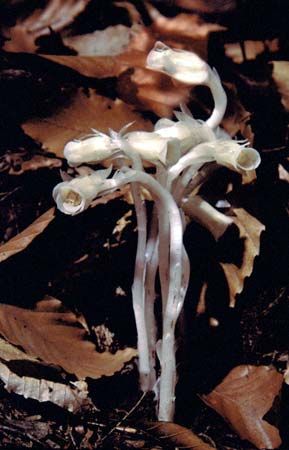
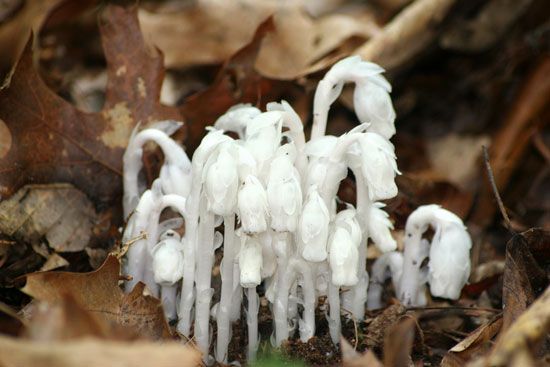
The Indian pipe (Monotropa uniflora), also known as the ghost plant, is a unique, nonphotosynthetic perennial herb belonging to the heath family (Ericaceae).
What is Indian pipe?
The Indian pipe (Monotropa uniflora), also known as the ghost plant, is a unique, nonphotosynthetic perennial herb belonging to the heath family (Ericaceae).12
Because it lacks chlorophyll, the plant cannot perform photosynthesis. Instead, it is mycoheterotrophic, meaning it survives by forming a symbiotic relationship with fungi that are connected to the roots of nearby trees, such as beeches and pines. Through this network, the Indian pipe acquires the nutrients it needs to survive.12
Physically, the plant is typically white or pinkish, growing 15–25 cm tall with leaves reduced to small scales. It features a single, drooping, bell-shaped flower at the tip of its stalk. Found in moist, shady regions across Asia and North America, the plant is considered rare and notably turns black once it dries out or matures.12
What is mycoheterotrophy?
Mycoheterotrophy is a biological relationship in which a plant obtains all or part of its nutrition from fungal networks rather than through photosynthesis. The term is derived from the Greek words for “fungus” (mykēs), “other” (heteros), and “nourishment” (trophē).4
How It Works
Mycoheterotrophs form a nonreciprocal relationship with fungi, leaching carbon-based nutrients without providing benefits in return. Most exploit mycorrhizal symbiosis, a tripartite arrangement where the mycoheterotroph acts as a “sink” for carbon that the fungi originally acquired from photosynthetic plants. In some cases, certain orchids derive nutrition directly from saprotrophic fungi that feed on decaying organic matter.54
Types of Mycoheterotrophs
- Obligate (Full) Mycoheterotrophs: These plants have lost the ability to photosynthesize and depend entirely on fungi for survival. They often lack chlorophyll and may appear white or non-green.4
- Partial Mycoheterotrophs (Mixotrophs): These plants use both photosynthesis and mycoheterotrophy, often switching methods based on environmental conditions.4
Why do some plants not need chlorophyll?
Plants that do not require chlorophyll are typically those that have lost the ability to perform photosynthesis and have instead adopted a mycoheterotrophic lifestyle. Because chlorophyll is the specific pigment used to capture light energy for the production of food, it is unnecessary for plants that obtain their nutrients from other sources.5
These plants, known as mycoheterotrophs, survive by forming symbiotic relationships with fungi. They leach carbon-based nutrients from these fungal networks, which often acquire the energy from nearby photosynthetic plants. This evolutionary transition from autotrophy (self-feeding) to mycoheterotrophy involves the loss of genes and the reprogramming of metabolism rather than the gain of new pathways.5
While some plants are “mixotrophs” and use both photosynthesis and fungal nutrition, “obligate” mycoheterotrophs—such as the Indian pipe—are entirely dependent on their fungal partners. Having abandoned the energy-intensive process of photosynthesis, these plants often lack green pigmentation, appearing instead in shades of white, purple, or brown.56
What are other examples of parasitic or nonphotosynthetic plants?
Plants that do not perform photosynthesis are generally categorized as either parasitic plants or mycoheterotrophs. While both may lack chlorophyll, they differ significantly in how they obtain nutrients.
Parasitic Plants
Parasitic plants obtain nutrients directly from a host plant using a specialized organ called a haustorium, which penetrates the host’s tissues to form a vascular connection.8
- Holoparasites: These are nonphotosynthetic and depend entirely on their host for all nutrition. Examples include dodder (Cuscuta), which appears as a tangled web of yellow or orange stems, and the genus Rafflesia, which lives endophytically within host vines and produces massive flowers.8910
- Hemiparasites: These retain some photosynthetic ability but rely on hosts for water and minerals. Some, like dwarf mistletoes, are obligate parasites that require a host to complete their life cycle.8
Mycoheterotrophs
Mycoheterotrophs are not considered true parasites because they do not use haustoria to harm a host plant directly. Instead, they form symbiotic associations with fungi to extract carbon-based nutrients.84
- Obligate Mycoheterotrophs: These species have lost the ability to photosynthesize entirely. A well-known example is the Indian pipe (Monotropa uniflora), which is often recognized by its distinct white, non-green appearance.4
Sources
- Indian pipe — Encyclopædia Britannica
- Indian pipe — Merriam-Webster
- ghost plant — Merriam-Webster
- mycoheterotroph: Top Questions — Encyclopædia Britannica
- mycoheterotroph — Encyclopædia Britannica
- plant - Definition of the kingdom — Encyclopædia Britannica
- plant - Specific variations in photosynthesis — Encyclopædia Britannica
- parasitic plant — Encyclopædia Britannica
- rafflesia — Encyclopædia Britannica
- dodder — Encyclopædia Britannica
Published on · 3 min read