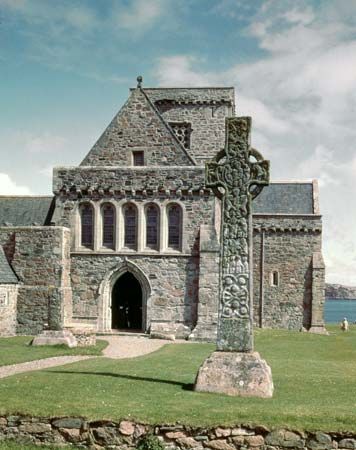
Iona
Iona holds profound historical significance as the cradle of Christianity in Scotland. In 563 CE, St. Columba arrived on the island from Ireland and…
What is the historical significance of Iona in Scottish and Christian history?
Iona holds profound historical significance as the cradle of Christianity in Scotland. In 563 CE, St. Columba arrived on the island from Ireland and established a monastery that served as the primary base for the Celtic Christianization of Scotland and northern England.123
The island’s influence extended far beyond its shores:
- Religious Hub: The monastery functioned as the “mother house” for the Celtic church, with its abbots serving as chief ecclesiastical authorities.2
- Cultural Legacy: Iona is believed to be the site where the Book of Kells, a masterpiece of the Hiberno-Saxon style, was begun in the late 8th century.4
- Royal Burial Ground: Due to its reputation as a holy place, Iona became the final resting place for numerous Scottish, Irish, and Norwegian kings.1
- Modern Revival: In 1938, the Iona Community was founded to restore the island’s ruined abbey and continue the spirit of Columba’s mission, emphasizing the integration of spiritual life and social justice.15
How did St. Columba contribute to the establishment of Iona as a religious center?
St. Columba established Iona as a preeminent religious center through several key actions:
- Strategic Foundation: In 563 CE, Columba and 12 disciples arrived on the island, utilizing it as a “springboard” for the Christianization of Scotland.24
- Ecclesiastical Authority: The monastery he founded became the “mother house” of the Celtic church. Its abbots held significant power, serving as the chief ecclesiastical rulers even over bishops.2
- Political Influence: Columba solidified Iona’s status by engaging with secular leadership. He provided formal benediction and inauguration to Aidan MacGabrain of Dunadd as king of Dalriada and participated in high-level political councils, such as the one at Druim Cetta, which defined the relationship between regional rulers.2
- Missionary Base: The community served as a vital base for spreading the gospel throughout Scotland and northern England, fostering a network of influence that extended to offshoots like Lindisfarne.24
How does Iona’s location in the Inner Hebrides affect transportation to and from the island?
Iona’s location in the Inner Hebrides necessitates travel by sea, as the island is separated from the larger island of Mull by the Sound of Iona, a channel approximately 0.7 miles (1.1 km) wide.1
Historically, the island was readily accessible by sea from Ireland, which facilitated St. Columba’s arrival in 563 CE via a currach—a small boat constructed with a wooden or wicker frame covered in tarred animal hides. Today, this maritime connection remains the primary means of transit for visitors and residents, linking the island to the broader Scottish transport network through its proximity to Mull.12
How has Iona’s relationship with the rest of Scotland evolved over the centuries?
Iona’s relationship with Scotland has evolved significantly from its origins as a remote missionary outpost to a central symbol of Scottish religious and national identity.
- Early Influence: In 563 CE, St. Columba used Iona as a base to Christianize Scotland, establishing the Celtic church and spreading influence throughout the mainland.1
- Political and Religious Shifts: During the Middle Ages, the island faced instability due to Norse invasions, leading to the transfer of relics to Ireland. By the 11th century, it was integrated into the Norse diocese of Man and the Isles, eventually falling under the archbishop of Trondheim until the Hebrides were ceded to Scotland in 1266.1
- Royal Significance: Despite centuries of conflict, Iona maintained its reputation as a sacred site, serving as the burial ground for Scottish, Irish, and Norwegian kings.1
- Modern Era: Following the Protestant Reformation, the monastery was suppressed and eventually passed to the Campbells of Argyll. In 1899, the site was gifted to the Church of Scotland, leading to the restoration of the abbey and the 1938 founding of the Iona Community, which continues to bridge theology and social life today.15
Sources
- Iona — Encyclopædia Britannica
- St. Columba — Encyclopædia Britannica
- Book of Kells — Encyclopædia Britannica
- Ireland - Irish monasticism — Encyclopædia Britannica
- Iona Community — Encyclopædia Britannica
- Inner Hebrides — Encyclopædia Britannica
Published on · 3 min read