Ionium-thorium Dating
The uranium-238 decay series is fundamental to ionium-thorium dating because it provides the continuous supply of the radioactive isotope thorium-230…
What is the significance of the uranium-238 decay series in ionium-thorium dating?
The uranium-238 decay series is fundamental to ionium-thorium dating because it provides the continuous supply of the radioactive isotope thorium-230, historically known as ionium.12
In the marine environment, uranium compounds are soluble, while thorium compounds are highly insoluble. As uranium-238 decays through its series, it produces thorium-230, which is rapidly precipitated out of seawater and incorporated into marine sediments. Because thorium-230 has a half-life of approximately 80,000 years, it acts as a radioactive clock for dating sediments up to 400,000 years old.134
The significance of this decay relationship lies in disequilibrium dating: since the parent uranium remains in the water while the daughter thorium is removed, the sediment starts with a specific concentration of thorium-230 that subsequently decays over time. By measuring the remaining amount of this isotope—or its ratio relative to thorium-232—researchers can determine the age of the sediment layer.12
How is ionium-thorium dating used in studying ocean sediments and marine geology?
Ionium-thorium dating is a vital method in marine geology used to establish the age of marine sediments by measuring the concentrations of specific thorium isotopes.
The technique relies on the chemical properties of uranium and thorium in seawater. While uranium compounds are soluble, thorium isotopes—specifically thorium-230, historically known as ionium—are highly insoluble. As uranium decays in the ocean, the resulting thorium-230 is rapidly precipitated and incorporated into seafloor sediments. Because thorium-230 has a half-life of approximately 80,000 years, it serves as a radioactive clock, allowing scientists to date sediments up to 400,000 years old.1
To ensure accuracy, researchers often measure the ratio of ionium to thorium-232. This approach accounts for variations in sedimentation rates by assuming the two isotopes are precipitated in a constant proportion. The validity of this method depends on several key assumptions:
- The ratio of thorium-230 to thorium-232 in seawater remains constant over time.
- No chemical fractionation occurs during precipitation.
- Sediments are free of significant detrital material containing these nuclides.
- Thorium isotopes do not migrate within the sediment after deposition.1
How does ionium-thorium dating compare to carbon-14 dating in terms of accuracy and applicable time ranges?
Ionium-thorium dating and carbon-14 dating serve different purposes in geochronology, primarily distinguished by their applicable time ranges and the materials they analyze.
Applicable Time Ranges
- Ionium-Thorium Dating: This method is effective for dating marine sediments up to approximately 400,000 years old. Its utility is derived from the half-life of thorium-230 (ionium), which is about 80,000 years.1
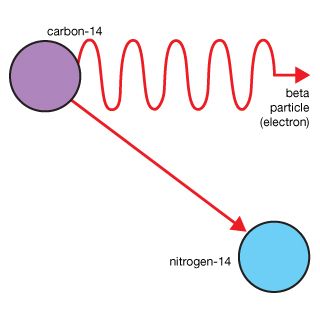
- Carbon-14 Dating: This technique is used for dating organic materials, typically covering a range from 500 to 60,000 years old. It relies on the decay of carbon-14, which has a half-life of 5,730 years.78
Accuracy and Methodology
The accuracy of both methods depends on specific environmental conditions and the absence of contamination:
- Ionium-Thorium: Accuracy relies on the assumption that thorium-230 and thorium-232 are precipitated in a constant proportion and that no chemical fractionation or post-depositional migration occurs within the sediment. It is a form of disequilibrium dating, measuring the decay of isotopes rather than the accumulation of daughter products from a parent in a closed system.19
- Carbon-14: Accuracy is influenced by temporal fluctuations in atmospheric carbon-14 levels, which are corrected using calibration curves derived from dendrochronology and other established records. While highly versatile for archaeology and late-glacial studies, it is susceptible to contamination from modern carbon, which can significantly skew results in older samples.8
How was ionium-thorium dating first developed and by whom?
The provided search results do not contain information regarding the specific individuals who first developed ionium-thorium dating or the historical circumstances of its initial development. While the sources explain the scientific principles and the transition from radioactive counting to mass spectrometry, they do not attribute the discovery to a specific person or timeline of origin.12
Sources
- ionium-thorium dating — Encyclopædia Britannica
- protactinium-231–thorium-230 dating — Encyclopædia Britannica
- dating - Origin of radioactive elements used — Encyclopædia Britannica
- atom - Radioactive decay — Encyclopædia Britannica
- geology - Isotopic geochemistry — Encyclopædia Britannica
- dating - The isochron method — Encyclopædia Britannica
- dating - Principles of isotopic dating — Encyclopædia Britannica
- carbon-14 dating — Encyclopædia Britannica
- dating - Carbon-14 dating and other cosmogenic methods — Encyclopædia Britannica
- dating - Uranium-series disequilibrium dating — Encyclopædia Britannica
Published on · 3 min read