Irukandji Jellyfish
The Irukandji jellyfish refers to any of at least 16 species of box jellyfish (class Cubozoa) characterized by their small size, transparency, and highly…
What is an Irukandji jellyfish?
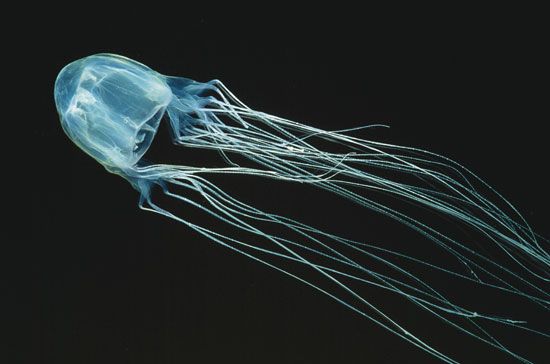
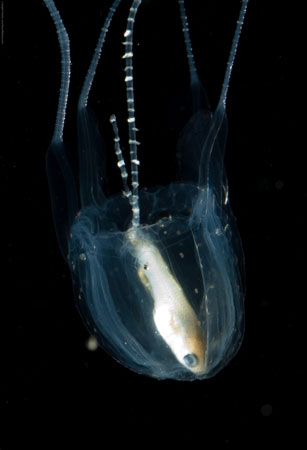
The Irukandji jellyfish refers to any of at least 16 species of box jellyfish (class Cubozoa) characterized by their small size, transparency, and highly potent venom. These planktonic creatures typically possess a box-shaped bell measuring 1–3.5 cm (0.4–1.4 inches) in diameter, with a single tentacle extending from each of the four corners.1
They are primarily found in the warm coastal waters of northern Australia, though various species inhabit tropical regions across the Indian and Pacific oceans. The species most commonly associated with the name is Carukia barnesi.1
Stings from these jellyfish can cause Irukandji syndrome, a painful and potentially life-threatening condition. Symptoms—which may include severe muscle cramps, vomiting, hypertension, and a sense of impending doom—typically appear about 30 minutes after the initial, often mild, sting. In severe cases, the syndrome can lead to heart failure or pulmonary edema.1
Where are Irukandji jellyfish found?
Irukandji jellyfish are primarily found in the warm coastal waters of northern Australia, particularly within the Coral Sea along the coast of Queensland. While they are most commonly associated with these Australian regions, various species inhabit tropical waters across the Indian and Pacific oceans, as well as the Caribbean Sea and parts of the Atlantic and South China Sea.1
Specific distribution details include:
- Australia: Species such as Carukia barnesi and Malo kingi are found near coral reef habitats along the Queensland coast. Other species, like C. shinju and M. maxima, are located along the northern coast of Western Australia. Occasionally, specimens are found as far south as Sydney and Melbourne.1
- Global: Various species of the genus Alatina are found in diverse locations, including Hawaii, Guam, Puerto Rico, and Florida.1
Why are Irukandji jellyfish considered dangerous?
Irukandji jellyfish are considered dangerous primarily because they deliver a highly potent venom through nematocysts—tiny, poison-filled barbed hooks located on their tentacles—which can cause a severe and potentially life-threatening condition known as Irukandji syndrome.1
The danger of this syndrome stems from its systemic impact on the human body. Symptoms typically begin about 30 minutes after a sting, which itself is often mild and may leave no visible mark. The resulting clinical presentation can include:1
- Severe physical distress: Intense muscle cramps, abdominal and back pain, and persistent vomiting.1
- Cardiovascular complications: Significant hypertension and, in severe cases, [heart failure].1
- Neurological and psychological effects: Agitation and a profound, characteristic sense of impending doom.1
- Critical health risks: Potential for pulmonary edema and cerebral [hemorrhaging].1
While the sting is often initially deceptive due to its lack of immediate pain, the subsequent envenomation can lead to fatal outcomes if not managed medically. The potency of the venom is particularly high in mature individuals, and while Carukia barnesi is the species most commonly associated with these effects, several other species are suspected of causing similar, dangerous reactions.1
How can someone recognize or identify an Irukandji jellyfish?
Identifying an Irukandji jellyfish in the wild is extremely difficult because they are nearly transparent and very small, making them nearly invisible in the water.
To recognize these box jellyfish, you would need to look for the following physical characteristics:
- Bell Shape and Size: They possess a boxlike, transparent bell that measures only 1–3.5 cm (0.4–1.4 inches) in diameter. Some species, such as M. maxima, may reach up to 5 cm (about 2 inches).1
- Tentacles: A single tentacle protrudes from each of the four corners of the bell. These tentacles are highly retractable, capable of shrinking to 3 cm (about 1.2 inches) or extending up to 1.2 meters (3.9 feet).1
- Distinguishing Features: While many species look similar, the Malo kingi (or common kingslayer) can be identified by the presence of rings of tissue that encircle each of its tentacles, a feature that distinguishes it from other box jellyfish.1
Because they are planktonic and driven by ocean currents, they are most frequently encountered in coastal waters during warmer months. Given their size and transparency, it is best to rely on local beach safety warnings rather than visual identification.1
Sources
- Irukandji jellyfish — Encyclopædia Britannica
- box jellyfish — Encyclopædia Britannica
Published on · 3 min read