Ivory-billed Woodpecker
The ivory-billed woodpecker (Campephilus principalis) was historically found in Cuba and the southern United States. These birds required large, isolated…
Where was the ivory-billed woodpecker’s natural habitat, and what led to its decline?
The ivory-billed woodpecker (Campephilus principalis) was historically found in Cuba and the southern United States. These birds required large, isolated areas of virgin forest to thrive, where they subsisted on insects found in deadwood.12
The species’ decline was primarily driven by the logging of these old-growth forests. Because the birds depended on specific, undisturbed forest environments for their survival, the destruction of their habitat led to a catastrophic population collapse. While the species was long believed to be extinct, there have been unconfirmed sightings and a 2005 report of the bird in eastern Arkansas. A subspecies, the Cuban ivory-billed woodpecker, is believed to be extinct, with its last official sighting occurring in the late 1980s.12
Are there any similar woodpecker species that are often mistaken for the ivory-billed woodpecker?
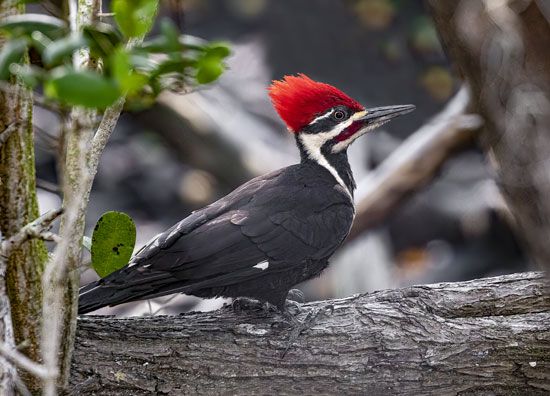
The pileated woodpecker (Dryocopus pileatus) is the species most frequently mistaken for the ivory-billed woodpecker. Because both birds are large, share similar black-and-white plumage, and possess prominent red crests, they are often confused by casual observers.451
However, there are distinct differences between the two:
- Size: The ivory-billed woodpecker is slightly larger, reaching about 45 cm (18 inches) in length, while the pileated woodpecker typically measures between 40 and 47 cm (15.5 to 18.25 inches).521
- Appearance: The pileated woodpecker is known for its bold white stripes on the face and neck and a red crest. While the male ivory-billed woodpecker also features a red crest, its overall coloration and specific markings differ from the pileated species.415
- Status: The pileated woodpecker is a common, nonmigratory species with a population of over two million birds, whereas the ivory-billed woodpecker is critically endangered and widely believed to be extinct.51
How does the ivory-billed woodpecker compare in size to other North American woodpecker species?
The ivory-billed woodpecker (Campephilus principalis) was one of the largest woodpeckers in the world, measuring approximately 45 cm (18 inches) in length. Among North American species, it was surpassed in size only by the imperial woodpecker (C. imperialis) of Mexico, which is considered the largest woodpecker globally.123
In comparison to other common North American woodpeckers, the ivory-billed woodpecker was notably larger:
- Pileated woodpecker: Currently the largest living woodpecker in North America, it reaches lengths of 40–47 cm (15.5–18.25 inches). While its size range overlaps with the ivory-billed woodpecker, the latter was historically considered larger.23
- Hairy woodpecker: A much smaller species, typically measuring 20–25 cm (8–9.8 inches).2
- Acorn woodpecker and Red-headed woodpecker: These species are significantly smaller, generally ranging between 19 and 23 cm (7.5–9 inches).2
- Downy woodpecker: One of the smallest North American species, measuring only about 15 cm (6 inches).2
What are the distinctive physical characteristics of the ivory-billed woodpecker?
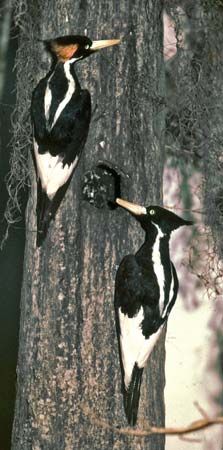
The ivory-billed woodpecker (Campephilus principalis) is a large, distinctive bird characterized by several key physical traits:
- Size: It is a very large woodpecker, measuring approximately 45 cm (18 inches) in length.13
- Plumage: The bird features a striking black-and-white color pattern.12
- Crest: Both sexes possess a flaring crest, which is notably red in the male.12
- Bill: A defining feature is its long, whitish bill, which distinguishes it from many other woodpecker species.1
As a highly specialized member of the family Picidae, the ivory-billed woodpecker shares the structural adaptations common to its order, such as a sturdy, chisel-tipped bill and a long, distensible tongue used for extracting insects from deadwood. These physical characteristics, combined with its impressive size, made it one of the most iconic and sought-after birds in North American ornithology.35
Sources
- Ivory-billed woodpecker — Encyclopædia Britannica
- Woodpecker — Encyclopædia Britannica
- Pileated woodpecker — Encyclopædia Britannica
- Pileated woodpecker: Top Questions — Encyclopædia Britannica
- Piciform - Form and function — Encyclopædia Britannica
- ivory-billed woodpecker — Merriam-Webster
Published on · 3 min read