Iztaccíhuatl
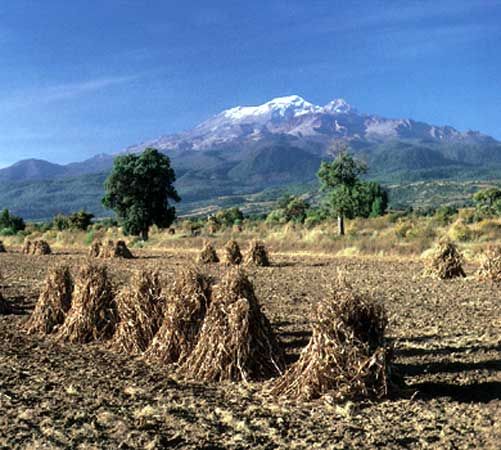
Iztaccíhuatl is a dormant volcano located on the border of the states of Mexico and Puebla in central Mexico. Situated 40 miles south-southeast of Mexico…
What is Iztaccíhuatl?
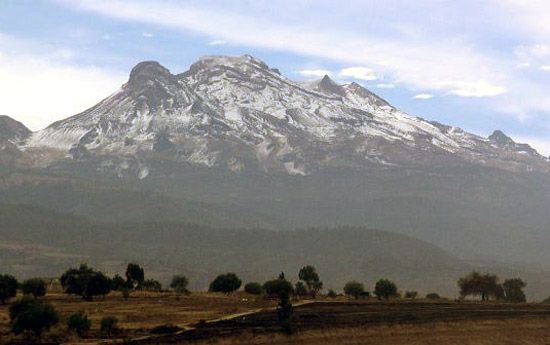
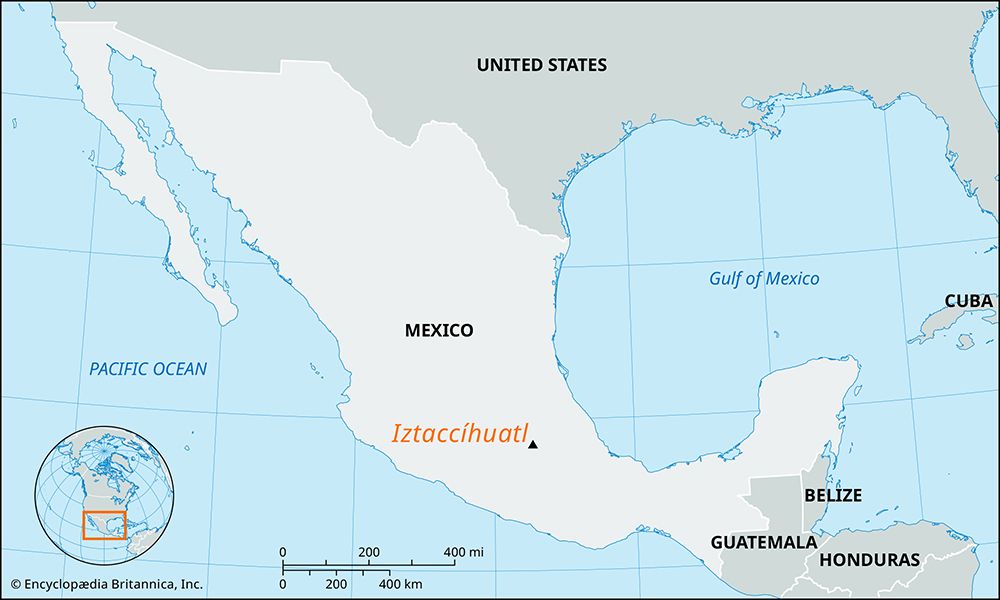
Iztaccíhuatl is a dormant volcano located on the border of the states of Mexico and Puebla in central Mexico1. Situated 40 miles south-southeast of Mexico City, it lies 10 miles north of its twin, Popocatépetl.12
The name Iztaccíhuatl is derived from the Nahuatl language, meaning “white woman”. The mountain features three summits, with the highest reaching 17,159 feet (5,230 meters). Because the snow-covered peaks resemble the head, breast, and feet of a recumbent woman when viewed from the capital, the volcano is popularly known as the “sleeping woman”. Unlike its active neighbor, Iztaccíhuatl has no crater and last erupted in 1868.1
What is the legend behind the relationship between Iztaccíhuatl and Popocatépetl?
Sorry, the Britannica knowledge base does not contain this information.
What does the name Popocatépetl mean in the Nahuatl language?
Sorry, the Britannica knowledge base does not contain this information.
How do dormant volcanoes differ from active ones like Popocatépetl?
The distinction between active and dormant volcanoes is primarily defined by their eruptive history and current state of activity. An active volcano, such as Popocatépetl, is one that has erupted in recent history and continues to show signs of potential activity, such as seismic tremors or gas emissions. Popocatépetl, for instance, experienced a period of inactivity for over 70 years before erupting in 1994, followed by subsequent activity in 1996, 1997, and 2000.2910
In contrast, the term “dormant” is often used to describe volcanoes that have long periods of repose between eruptions. A significant challenge in volcanic risk management is that these long intervals can lead to human complacency, where local populations may mistakenly perceive a dormant volcano as extinct.9
Scientists use various monitoring techniques—including tracking earthquake swarms, surface deformation, and gas emissions—to forecast potential eruptions at both active and potentially active sites. Because the science of eruption forecasting is still evolving, distinguishing between a truly extinct volcano and one that is merely dormant remains a complex and critical task for ensuring public safety.910
Sources
- Iztaccíhuatl — Encyclopædia Britannica
- Popocatépetl — Encyclopædia Britannica
- Ixtacihuatl — Merriam-Webster
- Popocatepetl — Merriam-Webster
- Popoloca — Merriam-Webster
- tepetate — Merriam-Webster
- Tepecano — Merriam-Webster
- Popolocan — Merriam-Webster
- volcano - Lava flows — Encyclopædia Britannica
- volcano - Volcano forecasting and warning — Encyclopædia Britannica
- geology - Volcanology — Encyclopædia Britannica
Published on · 2 min read