Izu Peninsula
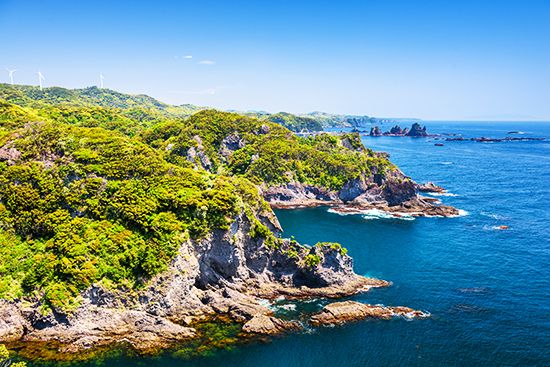
The Izu Peninsula, located in Shizuoka prefecture, Japan, is a geologically active region situated entirely within the Fuji Volcanic Zone. Its primary…
What are the main geological features of the Izu Peninsula?
The Izu Peninsula, located in Shizuoka prefecture, Japan, is a geologically active region situated entirely within the Fuji Volcanic Zone. Its primary geological features include:
- Volcanic Composition: The southern region is composed largely of volcanic breccia, while the northern section features a collection of highly eroded volcanoes, including Mount Amagi, Mount Atami, and Mount Daruma.1
- Tectonic Deformation: The landscape has been significantly altered by tectonic movements. Notably, portions of Mount Atami and Mount Daruma have been downfaulted into the sea.1
- Graben Formation: The valley of the Kano River in the north is classified as a graben, a depressed segment of the Earth’s crust bounded by faults.1
- Hot Springs: The peninsula is rich in hot springs resulting from both volcanic and tectonic activity.1
How has the volcanic activity shaped the Izu Peninsula’s landscape?
Volcanic activity has fundamentally defined the landscape of the Izu Peninsula. Situated entirely within the Fuji Volcanic Zone, the peninsula’s terrain is characterized by distinct volcanic formations and significant structural deformation.
The southern portion of the peninsula is composed primarily of volcanic breccia, while the northern section features an assembly of numerous volcanoes, including Mount Amagi, Mount Atami, and Mount Daruma. These volcanic structures have been heavily modified over time; they are highly eroded and have been further deformed by intense tectonic movements. This activity has caused parts of major peaks, such as the eastern half of Mount Atami and portions of Mount Daruma, to be downfaulted into the sea.1
Additionally, the region’s volcanic and tectonic history has created a graben—a depressed crustal segment—along the Kano River valley. This ongoing geological activity also sustains numerous hot springs throughout the peninsula, which are a defining feature of the local environment.1
What role does the Izu Peninsula play in Japan’s economy and transportation network?
The Izu Peninsula serves as one of Japan’s premier tourist centers, playing a significant role in the regional economy through its hospitality and spa industries. The peninsula’s warm winter climate and abundance of hot springs attract numerous visitors to popular resort towns such as Atami, Itō, and Shuzenji. Additionally, the region is part of the Fuji-Hakone-Izu National Park, which further bolsters its status as a major destination for domestic and international tourism.13
Regarding transportation and historical connectivity, the port of Shimoda holds historical significance as one of the first Japanese ports opened to trade with the United States in the 19th century. While the major Shinkansen railway line—which follows the historic Tōkaidō route—links the major cities of Shizuoka prefecture to the rest of Japan, the Izu Peninsula itself is primarily recognized for its role in the tourism sector rather than as a central hub for the national industrial transportation network.13
How do the hot springs (onsen) of the Izu Peninsula compare to others in Japan?
The hot springs (onsen) of the Izu Peninsula are distinguished by their diverse origins, stemming from both volcanic and tectonic activity within the Fuji Volcanic Zone. While Japan features many geothermal areas, the Izu Peninsula is unique for the high density and variety of its springs, which are bolstered by the region’s warm winter climate and its status as part of the Fuji-Hakone-Izu National Park.
Major spa centers like Atami and Itō serve as primary examples of this development. Itō, for instance, hosts several hundred hot springs and evolved into a major resort destination following the expansion of railway infrastructure in the 20th century.14
The provided search results do not contain comparative data regarding the specific chemical compositions or temperatures of Izu’s springs versus those in other regions of Japan. Therefore, I cannot provide a detailed technical comparison to other Japanese hot spring districts.
Sources
- Izu Peninsula — Encyclopædia Britannica
- Izu Islands — Encyclopædia Britannica
- Shizuoka — Encyclopædia Britannica
- Itō — Encyclopædia Britannica
Published on · 3 min read