Jackal
Jackals are members of the family Canidae and belong to the genus Canis, placing them in the same taxonomic group as wolves, coyotes, and domestic dogs.…
How do jackals compare to other members of the Canidae family, like wolves and foxes?
Jackals are members of the family Canidae and belong to the genus Canis, placing them in the same taxonomic group as wolves, coyotes, and domestic dogs. While they share the general physical characteristics of wild canines—such as a long muzzle, erect ears, and a bushy tail—they are distinct from other members like foxes, which are classified under different genera such as Vulpes.123
Key comparisons include:
- Classification: Jackals, wolves, and coyotes are all in the genus Canis, whereas foxes belong to separate genera like Vulpes or Urocyon.2
- Behavior: Like wolves and coyotes, jackals are capable of interbreeding with domestic dogs. While they are often viewed as scavengers, they are also capable hunters that can operate in packs to take down larger prey.14
- Physicality: Jackals are generally smaller than wolves, typically weighing 7–11 kg. Unlike many other canines that have uniform coloration, jackals often display contrasting markings.13
- Adaptations: Like other canines, they possess scent glands at the base of the tail for territorial marking and have nonretractile claws suited for stamina-based running.3
Where are jackals typically found in the world?
Jackals are widely distributed across several continents, primarily inhabiting open country environments. Their geographic range varies by species:
- Golden Jackal (C. aureus): This species has the broadest range, found from eastern and southeastern Europe through southern Asia, including India and Southeast Asia.12
- African Golden Wolf (C. anthus): As the name suggests, this species is native to northern and eastern Africa.1
- Black-backed (C. mesomelas) and Side-striped (C. adustus) Jackals: These species are primarily found in the regions of southern and eastern Africa.1
While there has been historical debate regarding their classification, these animals are now recognized as members of the genus Canis and are native to various landscapes across Europe, Asia, and Africa.12
What are the different species of jackals?
There are four recognized species of jackals, all of which belong to the genus Canis within the family Canidae. While the term “jackal” is sometimes incorrectly applied to the aardwolf or certain South American foxes, the following are the true jackal species:1
- Golden (or Asiatic) jackal (C. aureus): Found across a wide range extending from eastern Europe to Southeast Asia. It is characterized by its yellowish coat.1
- African golden wolf (C. anthus): Native to northern and eastern Africa, this species also features a yellowish coloration.1
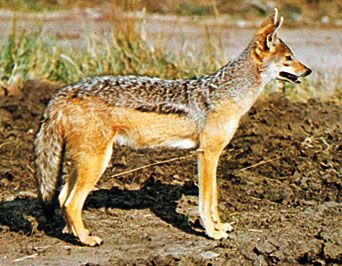
- Black-backed jackal (C. mesomelas): Found in southern and eastern Africa, this species is distinguished by its rusty red fur and a prominent black back.1
- Side-striped jackal (C. adustus): Also native to southern and eastern Africa, this jackal is grayish in color, featuring a white-tipped tail and an indistinct stripe along each side.1
How do jackals hunt and what is their diet?
Jackals are opportunistic, nocturnal hunters that emerge at dusk to forage for food. Their diet is highly varied, consisting of small animals, plant material, and carrion. As skilled scavengers, they are well-known for following large predators, such as lions, to consume the remains of a carcass once the larger animal has finished feeding.12
In addition to scavenging, jackals are fleet-footed hunters that also consume insects. While they may hunt alone or in pairs, they are capable of forming packs to take down larger prey, such as sheep or antelope. By utilizing these diverse feeding strategies, jackals successfully adapt to the open country environments they inhabit.21
Sources
- jackal — Encyclopædia Britannica
- dog - Jackals — Encyclopædia Britannica
- canine - Paleontology and classification — Encyclopædia Britannica
- canine - Form and function — Encyclopædia Britannica
Published on · 3 min read