Japan Trench
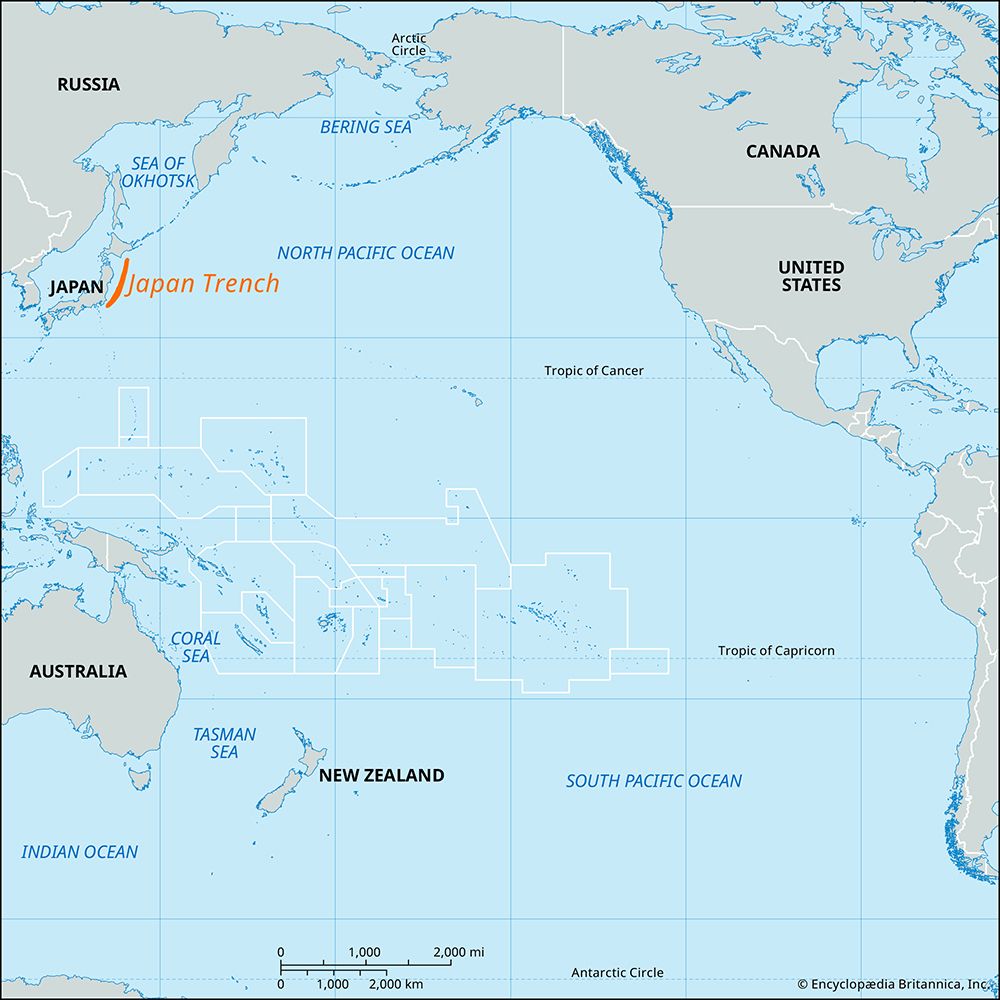
The Japan Trench is a deep submarine depression located on the floor of the western North Pacific Ocean, situated east of the Japanese islands. It is part of…
What is Japan Trench?
The Japan Trench is a deep submarine depression located on the floor of the western North Pacific Ocean, situated east of the Japanese islands. It is part of a series of oceanic trenches in the western Pacific that are associated with island arcs and subduction zones, where an oceanic plate slides beneath an overriding plate.12
Stretching south from the Kuril Trench and the Bonin Trench toward the Mariana Trench, the Japan Trench includes the Tuscarora Deep in its northern section. While the Tuscarora Deep was once historically considered the deepest point on Earth, that distinction is now held by the Mariana Trench. Like other deep-sea trenches, the Japan Trench is a site of significant geological activity, often associated with large earthquakes.12
What is a subduction zone and how does it create trenches?
A subduction zone is a geological region where two of the Earth’s tectonic plates converge, and the older, denser oceanic plate is forced downward into the upper mantle beneath an overriding plate. This process is a fundamental component of plate tectonics, serving as the mechanism by which old seafloor is consumed and recycled into the Earth’s interior.43
How Trenches Form
The characteristic V-shaped depressions known as deep-sea trenches are created directly by this subduction process. As the descending oceanic plate bends and slides beneath the overriding plate, it creates a topographic depression at the point of contact.35
The formation of these trenches depends on the nature of the overriding plate:
- Oceanic-Continental Convergence: When an oceanic plate slides beneath a continental margin, it creates a marginal trench that follows the outline of the continent.3
- Oceanic-Oceanic Convergence: When two oceanic plates meet, the older, denser one subducts, creating a trench that is typically accompanied by a parallel chain of volcanic island arcs on the overriding plate island arcs on the overriding plate.36
These zones are often sites of intense geological activity, including large earthquakes and explosive volcanism.35
How do deep-sea trenches contribute to the formation of island arcs?
Deep-sea trenches and island arcs are intrinsically linked through the process of subduction. When two oceanic plates converge, the older, denser plate is forced downward into the mantle beneath the overriding plate, creating a long, narrow deep-sea trench at the point of contact.8910
As the subducting slab descends to depths of approximately 100 km (60 miles), it encounters high temperatures that drive off volatile components like water. These volatiles lower the melting temperature of the mantle wedge above the subducting plate, stimulating the production of magma. This magma, which is predominantly basaltic, rises through the overriding plate to the surface.10
The resulting volcanic activity builds a chain of islands parallel to the trench, known as an island arc. The distance between the trench and this volcanic chain—the arc-trench gap—is determined by the angle of subduction; steeper angles typically result in narrower gaps. This dynamic system is a primary driver of geological activity, characterized by frequent, deep-focus earthquakes and explosive volcanism.91011
What is the difference between the Japan Trench and the Mariana Trench?
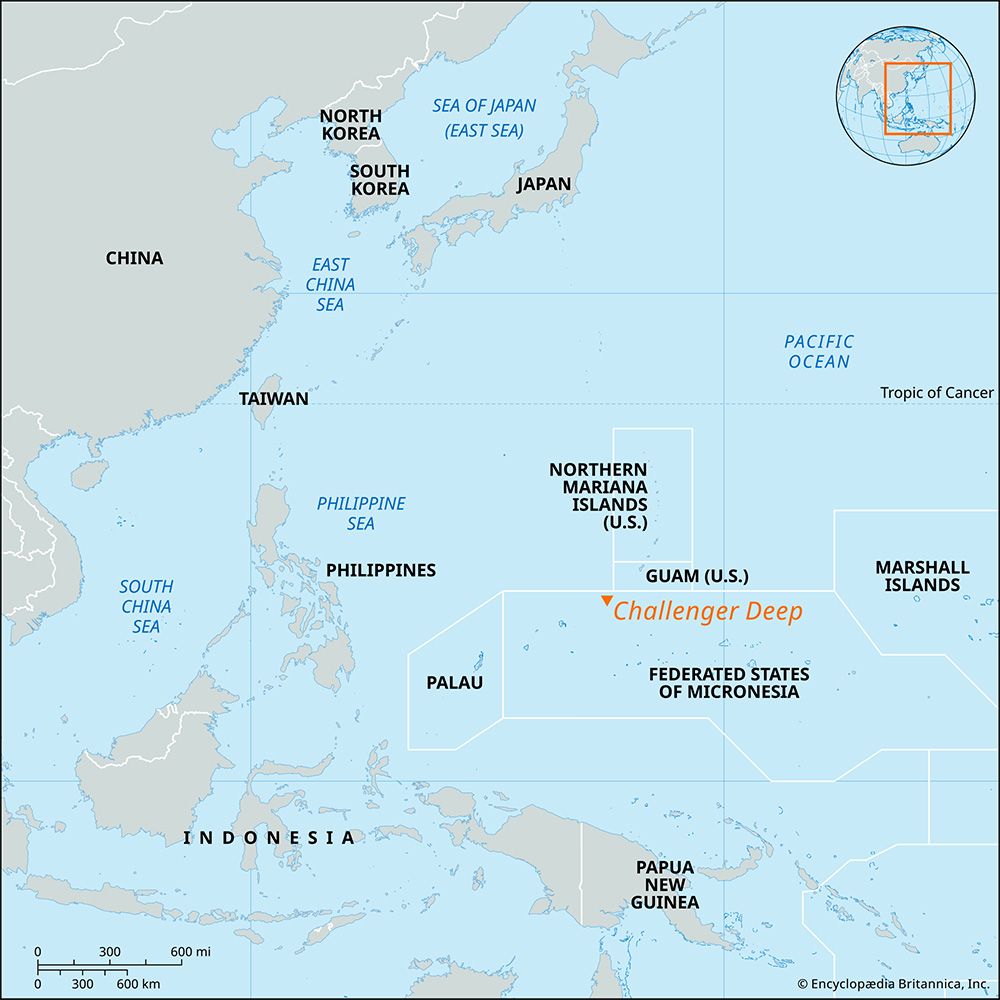
The Japan Trench and the Mariana Trench are both deep-sea trenches located in the western North Pacific Ocean, and both are integral parts of the same western Pacific system of oceanic trenches formed by subduction zones.132814
The primary differences between them relate to their specific geographic locations and their extreme depths:
- Geographic Position: The Japan Trench is situated east of the Japanese islands, forming part of a series of depressions that stretch southward toward the Mariana Trench. The Mariana Trench is located further south, primarily east and south of the Mariana Islands.2148
- Depth: While both are exceptionally deep, the Mariana Trench is distinguished as the deepest trench on Earth. Its greatest depths, found in the Challenger Deep, have been measured at approximately 36,201 feet (11,034 meters). In contrast, the Japan Trench is also a major submarine depression, but it does not reach the record-breaking depths found in the Mariana system.1382
Both trenches are associated with island arcs and are characterized by the convergence of tectonic plates, where an older, denser oceanic plate is forced beneath an overriding plate.314
Sources
- Kuril Trench — Encyclopædia Britannica
- Japan Trench — Encyclopædia Britannica
- deep-sea trench - Types — Encyclopædia Britannica
- subduction zone — Encyclopædia Britannica
- deep-sea trench - Structure — Encyclopædia Britannica
- plate tectonics - Discovery of ocean basin features — Encyclopædia Britannica
- plate tectonics - Back-arc basins — Encyclopædia Britannica
- How was the Mariana Trench formed? — Encyclopædia Britannica
- island arc — Encyclopædia Britannica
- volcano - Subduction volcanoes — Encyclopædia Britannica
- plate tectonics - Island arcs — Encyclopædia Britannica
- Asia - Cenozoic events in the island arcs and the marginal basins — Encyclopædia Britannica
- Pacific Ocean: Top Questions — Encyclopædia Britannica
- Mariana Trench — Encyclopædia Britannica
Published on · 3 min read