Jefferson River
The Jefferson River is the westernmost of the three headstreams that form the Missouri River. Located in southwestern Montana, the river originates in the…
What is Jefferson River?
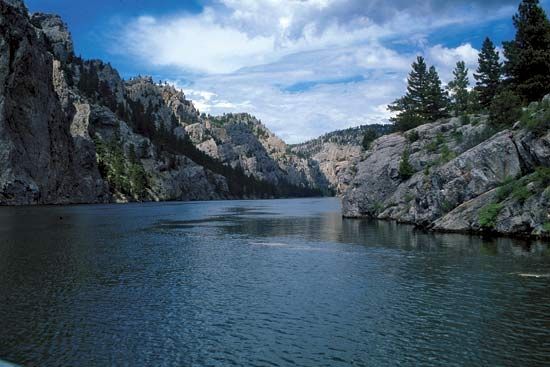
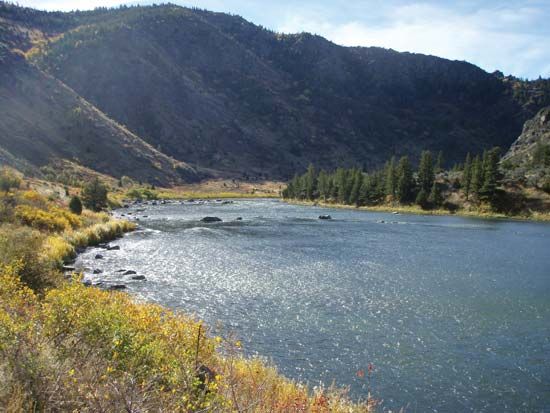
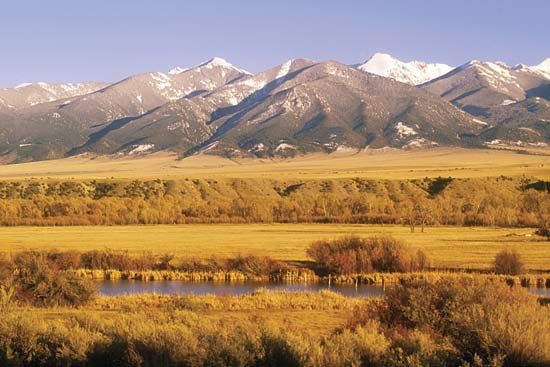
The Jefferson River is the westernmost of the three headstreams that form the Missouri River. Located in southwestern Montana, the river originates in the Gravelly Range near the Continental Divide and Yellowstone National Park, where it is initially known as the Red Rock River.1
As it flows north, the river transitions into the Beaverhead River before reaching Twin Bridges. There, it is joined by the Big Hole and Ruby rivers, officially becoming the Jefferson River. It flows for 225 miles (362 km) in a northeasterly direction until it meets the Madison and Gallatin rivers near Three Forks to form the Missouri River. The river was named in honor of President Thomas Jefferson.1
What are the other two headstreams of the Missouri River?
The Missouri River is formed by the confluence of three headstreams in southwestern Montana. In addition to the Jefferson River, the other two headstreams are:
- Madison River: This river rises in the northwestern corner of Yellowstone National Park at the junction of the Gibbon and Firehole rivers. It flows for 183 miles (294 km) before joining the other headstreams near Three Forks.1
- Gallatin River: This river also contributes to the formation of the Missouri River at the confluence located near the locality of Three Forks.34
How did the Lewis and Clark Expedition interact with the Jefferson River?
The Lewis and Clark Expedition encountered the Jefferson River as they navigated the upper reaches of the Missouri River in the summer of 1805. Upon arriving at the Three Forks—the confluence of the Jefferson, Madison, and Gallatin rivers—the expedition party utilized the Jefferson River as their primary route westward.
The river served as a critical landmark for the expedition’s guide, Sacagawea. As they traveled along the Jefferson, she recognized Beaverhead Rock, which signaled to the explorers that they were approaching the homeland of her people, the Shoshone. This recognition proved vital, as it led to a successful meeting with a Shoshone band led by her brother, Cameahwait. The Shoshone provided the expedition with the horses necessary to continue their journey across the Continental Divide and the Bitterroot Range, as the river itself was not navigable beyond that point.
What is the significance of the Continental Divide in North America?
The Continental Divide, also known as the Great Divide, is a significant geographical feature in North America consisting of a continuous ridge of mountain summits that serves as the continent’s primary drainage divide.89
Its primary significance lies in its role as a watershed that separates the flow of water across the continent. Water falling on the eastern side of this divide generally flows toward the Atlantic Ocean, often via the Mississippi or Rio Grande rivers, while water on the western side flows into the Pacific Ocean.9108
Running primarily along the crest of the Rocky Mountains, the divide stretches from Alaska through Canada, the United States, and into Mexico and Central America. A notable point along this line is the “Parting of the Waters” in Wyoming, where a single stream diverges to flow toward both the Atlantic and Pacific oceans. Today, the Continental Divide National Scenic Trail allows for exploration along this historic boundary.810
Sources
- Jefferson River — Encyclopædia Britannica
- Jefferson — Merriam-Webster
- Madison River — Encyclopædia Britannica
- Missouri River — Encyclopædia Britannica
- Three Forks — Merriam-Webster
- Lewis and Clark Expedition - Expedition from May 14, 1804, to October 16, 1805 — Encyclopædia Britannica
- Lewis and Clark Expedition - Commissioning and preparation — Encyclopædia Britannica
- Continental Divide — Encyclopædia Britannica
- Continental Divide — Merriam-Webster
- Parting of the Waters — Encyclopædia Britannica
Published on · 2 min read