Jeseník Mountains
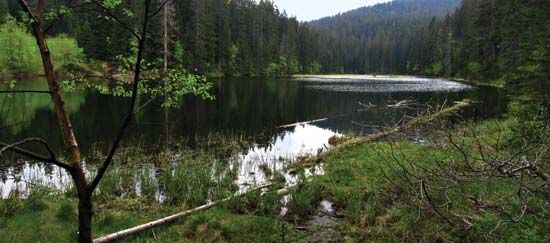
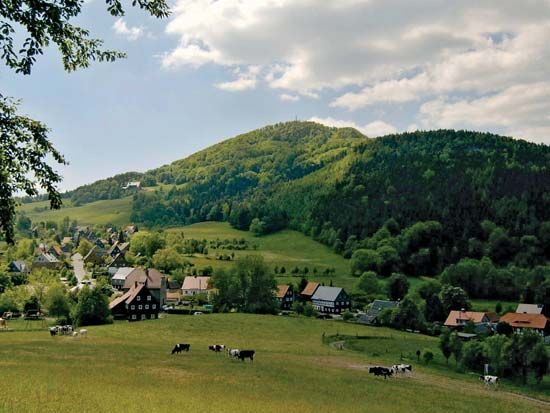
The Jeseník Mountains are a mountain range forming the eastern section of the Sudeten system in the northern Czech Republic. Located in northern Moravia…
What is Jeseník Mountains?
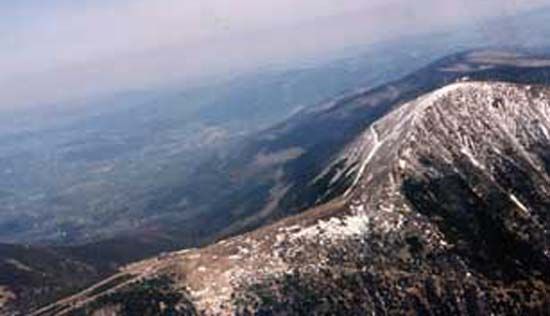
The Jeseník Mountains are a mountain range forming the eastern section of the Sudeten system in the northern Czech Republic. Located in northern Moravia along the Polish border, the range consists of the Hrubý (High) Jeseník, which reaches its peak at Praděd (4,892 feet [1,491 m]), and the lower Nízký (Low) Jeseník to the east.1
Geologically, these mountains are the remnants of an ancient uplifted crystalline massif. Historically, the region was known for iron mining, though many of these sites are now abandoned. Today, the area serves as a popular destination for tourism and health, with key locations including Šumperk, Jeseník, Karlova Studánka, and the health resort at Dolní Lipová.1
What is the Sudeten mountain system?
The Sudeten is a system of east-west mountain ranges located along the border of the northern Czech Republic and Poland. Geologically, these mountains are the broken remnants of an ancient Bohemian Massif and are characterized by peaks with flattened summits, such as Sněžka (5,256 feet [1,602 m]) in the Giant Mountains.234
The system is divided into three primary subgroups:
- West Sudeten: Includes the Lusatian Mountains, the Jizera Mountains, and the Giant Mountains.2
- Middle Sudeten: Composed of the Orlice Mountains and the Broumovské range.2
- East Sudeten: Comprised of the Jeseník Mountains.2
While the region historically supported mining, those activities have largely declined. Today, the area is known for its textile industry, craftsmanship, and a developing tourism sector, particularly in the Giant Mountains.24
How do the Hrubý and Nízký Jeseník differ?
The Hrubý (High) Jeseník and Nízký (Low) Jeseník are the two primary components of the Jeseník Mountains, a range within the Sudeten system. They differ primarily in their elevation and topography:
- Hrubý Jeseník: Also referred to as Vysoký Jeseník, this group represents the higher portion of the range. It contains the highest peak in the entire system, Praděd, which reaches an elevation of 4,892 feet (1,491 meters).1
- Nízký Jeseník: Situated to the east of the Hrubý Jeseník, this section is characterized by a significantly lower profile.1
Both areas are part of an ancient uplifted crystalline massif and share a history of iron mining, though these operations are now largely abandoned.1
What are some popular outdoor activities in this region?
The Sudeten mountain system offers a variety of outdoor activities that support a robust, year-round tourist industry.
In the Giant Mountains, the landscape is well-suited for:
- Hiking: Extensive trails wind through the region’s beech, pine, and fir forests, providing access to the mountains’ natural beauty.1
- Skiing: The area features numerous ski slopes that attract visitors throughout the winter months.1
These activities are centered around popular tourist hubs such as Vrchlabí, Špindlerův Mlýn, and Janské Lázně in the Czech Republic, as well as Szklarska Poręba and Karpacz in Poland.1
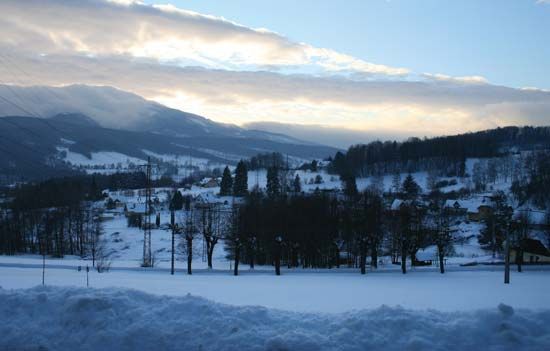
In the Jeseník Mountains, tourism is also a significant focus. Visitors often congregate in towns like Šumperk, Jeseník, and Karlova Studánka, while Dolní Lipovlá serves as a destination for those seeking health resorts.6
Sources
- Jeseník Mountains — Encyclopædia Britannica
- Sudeten — Encyclopædia Britannica
- Czech Republic - Relief — Encyclopædia Britannica
- Lusatian Mountains — Encyclopædia Britannica
- Poland - The Sudeten of Poland — Encyclopædia Britannica
- Giant Mountains — Encyclopædia Britannica
Published on · 2 min read