Jizera Mountains
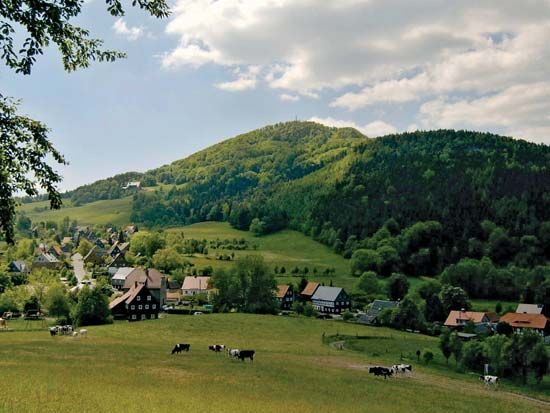
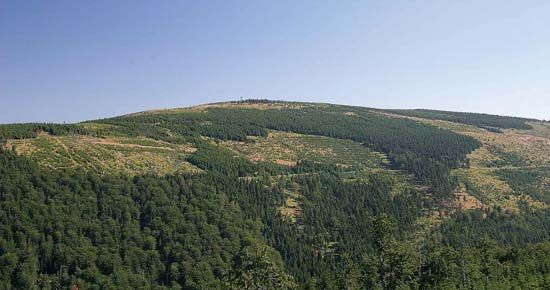
The Jizera Mountains are a mountain range forming part of the Sudeten system. Located in northern Bohemia in the Czech Republic, the range extends across the…
What is Jizera Mountains?
The Jizera Mountains are a mountain range forming part of the Sudeten system. Located in northern Bohemia in the Czech Republic, the range extends across the border into Poland.1
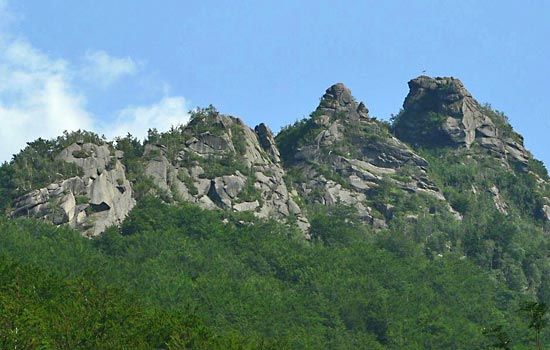
The mountains consist of a small group of peaks. While the highest point in the Czech portion is Jizera (3,681 feet [1,122 m]), the range’s overall highest peak is Wysoka Kopa in Poland (3,698 feet [1,127 m]). The range is separated from the Lusatian Mountains by the Neisse (Nisa) River, near the city of Liberec the city of Liberec. Geologically, the area is a significant source of granite used for construction.12
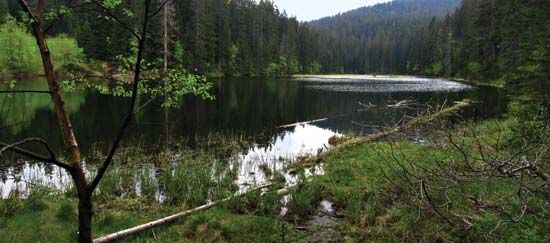
Recognizing their ecological importance, the Czech government has designated parts of the range as a nature reserve to preserve the landscape.3
What are the Sudeten mountains?
The Sudeten are a system of east-west mountain ranges located along the border of the Czech Republic and Poland. These mountains are the broken remnants of an ancient massif and are part of the larger Bohemian Massif.45
The system is categorized into three primary subgroups:
- West Sudeten: Includes the Lusatian Mountains, the Jizera Mountains, and the Giant (Krkonoše) Mountains.4
- Middle Sudeten: Comprises the Orlice Mountains and the Broumovské range.4
- East Sudeten: Composed of the Jeseník Mountains.4
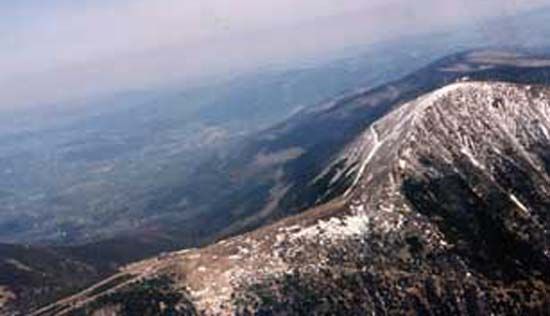
The region is characterized by flattened summits, such as Sněžka, which reaches 5,256 feet (1,602 m) in the Giant Mountains. While the terrain makes farming difficult, the area is known for its mineral deposits, including coking coal and granite. Historically, the region developed a strong textile industry, and it remains a hub for glass and porcelain production. Today, the area also supports a growing tourist industry and features various resorts and spas.45
How does the Neisse River shape the local landscape?
The Neisse River (specifically the Lusatian Neisse, or Nysa Łużycka) plays a significant role in shaping the physical and human geography of the region:
- Topographical Separation: The river acts as a natural boundary that separates the Jizera Mountains from the Lusatian Mountains in northern Bohemia.61
- Urban Development: The city of Liberec is situated within the river’s valley. The river’s presence has historically influenced the city’s expansion, with northern suburbs extending up the slopes of the Jizera Mountains.67
- Geopolitical Significance: The Lusatian Neisse forms a critical portion of the Oder–Neisse Line, which serves as the modern border between Germany and Poland. This boundary was established following the territorial shifts of World War II.82
Both the Lusatian Neisse and the shorter Nysa Kłodzka rise in the Sudeten mountains and flow northward, eventually emptying into the Oder River.8
What kind of wildlife lives in the Czech mountain forests?
The forests of the Czech Republic support a diverse array of wildlife, ranging from large predators to specialized mountain species.
Mammals
The country’s forested regions are home to several large mammals, including:
- Predators: Bears, wolves, lynx, and wildcats.3
- Smaller Mammals: Marmots, otters, martens, and minks inhabit the forests and wetlands.3
- Specialized Species: Rare or endangered species, such as the mouflon (a mountain sheep), are actively bred in game reserves to support conservation efforts.3
Birds
The forests and surrounding areas host a variety of game birds and raptors:
- Common Species: Pheasants, partridges, wild geese, and ducks.3
- Protected Species: Rarer birds such as eagles, vultures, ospreys, storks, eagle owls, bustards, and capercaillies are generally protected by law.3
Conservation remains a priority, with national parks like Krkonoše protecting unique glacial landscapes and relict species, such as the Alpine shrew (Sorex alpinus).3
Sources
- Jizera Mountains — Encyclopædia Britannica
- Lusatian Mountains — Encyclopædia Britannica
- Czech Republic - Plant and animal life — Encyclopædia Britannica
- Sudeten — Encyclopædia Britannica
- Poland - The Sudeten of Poland — Encyclopædia Britannica
- Neisse River — Encyclopædia Britannica
- Liberec — Encyclopædia Britannica
- Oder–Neisse Line — Encyclopædia Britannica
- Czech Republic - Agriculture and forestry — Encyclopædia Britannica
- Slovakia - Plant and animal life — Encyclopædia Britannica
Published on · 3 min read