Lusatian Mountains
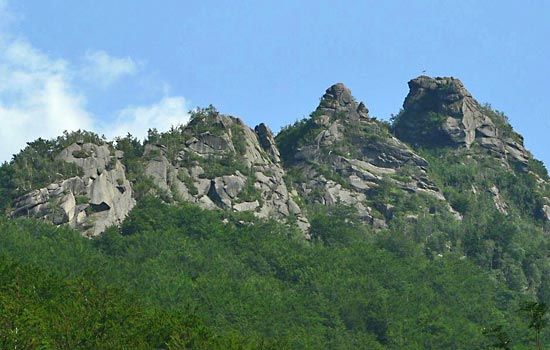
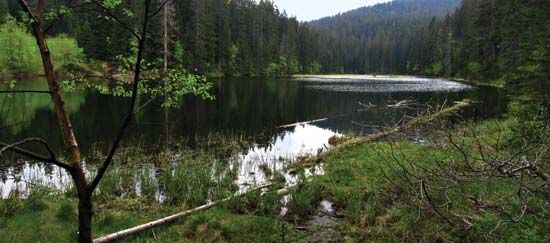
The Lusatian Mountains are a mountain group located in the northernmost part of Bohemia in the Czech Republic. As a segment of the Sudeten range, they…
What is Lusatian Mountains?
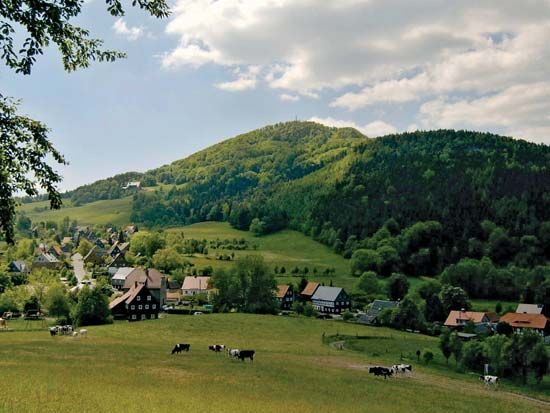
The Lusatian Mountains are a mountain group located in the northernmost part of Bohemia in the Czech Republic. As a segment of the Sudeten range, they stretch from the Ještěd ridge in the east to the Elbe River gorge at Děčín in the west, with extensions into Poland and Germany.1
The region is primarily composed of sandstone, though it also features distinct volcanic rock formations that appear as conical hills. The range is geographically separated from the Jizera Mountains by the Neisse River.1
What are the Sudeten mountains?
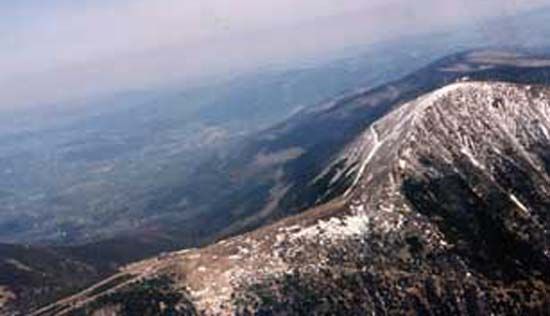
The Sudeten are a system of east-west mountain ranges located along the border of the Czech Republic and Poland, spanning northeastern Bohemia and northern Moravia. These mountains are the remnants of an ancient Bohemian Massif and are characterized by flattened summits, such as Sněžka, which reaches 5,256 feet (1,602 meters) in the Giant Mountains.23
The system is divided into three primary subgroups:
- West Sudeten: Includes the Lusatian Mountains, the Jizera Mountains, and the Giant Mountains.2
- Middle Sudeten: Includes the Orlice Mountains and the Broumovské range.2
- East Sudeten: Composed of the Jeseník Mountains.2
Economically, the region is known for its textile industry, glass, and porcelain production. While mineral deposits are abundant, traditional mining has declined. The area also supports a developing tourist industry. Historically, the term Sudetenland refers to the regions in the vicinity of these mountains that were a focal point of geopolitical tension leading up to World War II.231
How do volcanic rocks form in mountain ranges?
Volcanic rocks in mountain ranges form primarily through the process of volcanism, where molten rock, or magma, rises from the Earth’s upper mantle—typically 70 to 200 km below the surface—to the crust and eventually the surface.56
Formation Processes
- Magma Generation: At convergent plate boundaries, subducting oceanic plates release volatile components that stimulate the partial melting of the mantle wedge above them, creating magma.7
- Ascent and Eruption: Because magma is generally less dense than the surrounding solid rock, it rises due to buoyancy. It may collect in underground magma chambers before erupting onto the surface as lava.56
- Compositional Changes: As magma ascends through the thick continental crust, it may assimilate surrounding host rocks, altering its chemical composition and increasing its silica content.76
Resulting Landforms
The physical characteristics of the erupted material, such as viscosity (influenced by silica content), determine the shape and height of the resulting mountains. These range from gently sloping shield volcanoes formed by fluid lava to steep stratovolcanoes created by explosive eruptions.58
What is the significance of the Elbe River in Europe?
The Elbe River is a vital waterway in central Europe, stretching 724 miles from the Giant Mountains in the Czech Republic to the North Sea at Cuxhaven, Germany. Its significance is multifaceted:
- Economic Hub: The river serves as a major transportation artery. Through a network of canals—including the Mittelland Canal, Elbe-Havel Canal, and Kiel Canal—it connects industrial centers in Germany and the Czech Republic to the Baltic Sea and other major rivers like the Weser and Rhine. Hamburg, located on the Elbe, remains one of Europe’s largest seaports.111213
- Historical Significance: Historically, the river served as a boundary between northern Slavs and Germanic peoples. In the 20th century, it became a symbolic and physical demarcation line between East and West Germany following World War II, during which it also served as a meeting point for U.S. and Soviet forces.11
Sources
- Lusatian Mountains — Encyclopædia Britannica
- Sudeten — Encyclopædia Britannica
- Sudetenland — Encyclopædia Britannica
- Poland - The Sudeten of Poland — Encyclopædia Britannica
- mountain - Volcanism — Encyclopædia Britannica
- plate tectonics - Island arcs — Encyclopædia Britannica
- tectonic landform — Encyclopædia Britannica
- igneous rock - Convergent plate boundaries — Encyclopædia Britannica
- volcano - Lava flows — Encyclopædia Britannica
- volcano - Determinants of size and shape — Encyclopædia Britannica
- Elbe River — Encyclopædia Britannica
- Germany - Waterways — Encyclopædia Britannica
- Elbe-Lübeck Canal — Encyclopædia Britannica
Published on · 3 min read