Junggar Basin
Sorry, the Britannica knowledge base does not contain information regarding the specific environmental concerns associated with the Junggar Basin or the…
What are the major environmental concerns associated with the Junggar Basin, and how are they being addressed?
Sorry, the Britannica knowledge base does not contain information regarding the specific environmental concerns associated with the Junggar Basin or the measures being taken to address them.
How does the Junggar Basin’s climate affect its ecosystem and human activities?
The Junggar Basin experiences a continental, dry climate characterized by extreme temperature fluctuations and limited precipitation, typically ranging from 6 to 12 inches (150–300 mm) annually. These harsh conditions fundamentally shape the region’s ecology and human activity.12
Ecosystem Impacts
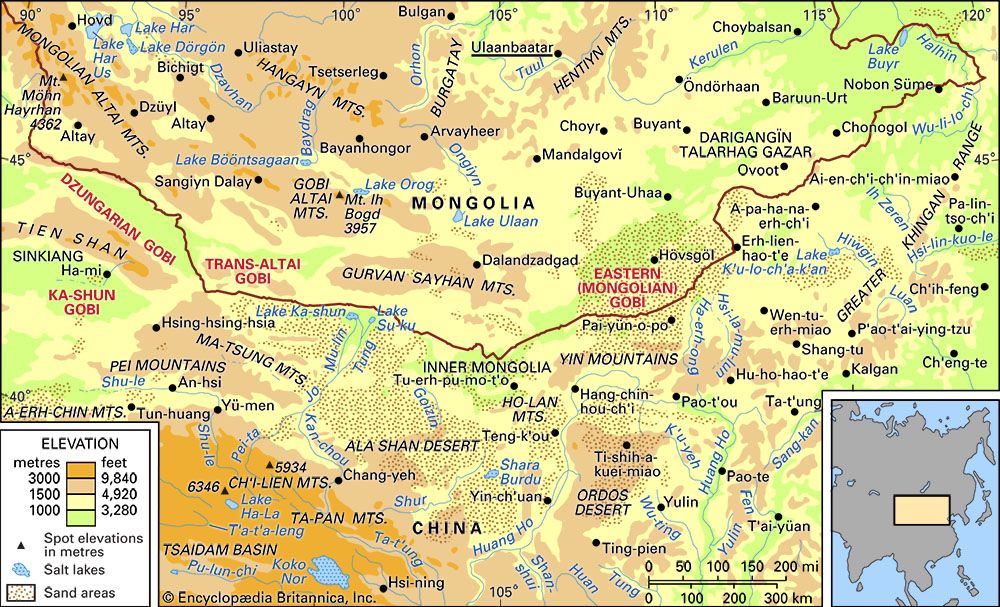
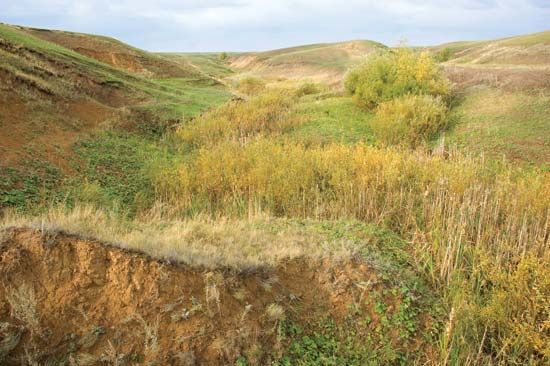
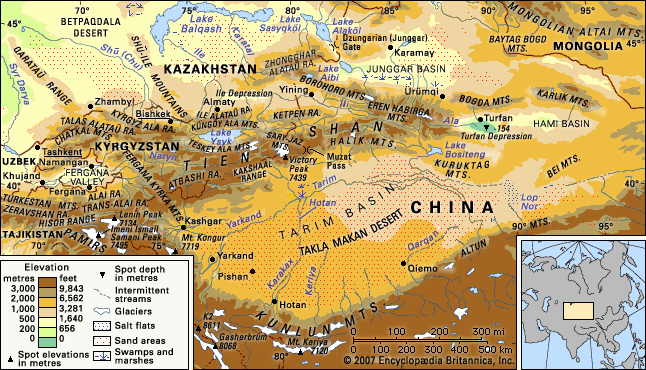
The basin’s climate creates a diverse but challenging environment. The east-central region is dominated by the Dzungarian Gobi, a desert landscape that is not entirely barren. Surrounding this desert are zones of steppe and semisteppe, which are supported by seasonal watercourses that often terminate in saline marshes. While the basin itself is arid, the surrounding mountain ranges receive significantly more precipitation, which sustains forests in the north and provides essential water to the basin’s internal drainage systems.13
Human Activities
The climate dictates the patterns of human settlement and industry:
- Pastoralism: North of the Tien Shan, the grasslands support pastoralist communities who rely on the steppe for animal husbandry.4
- Industrial Development: The basin’s resources have driven significant industrial growth. Karamay was established as a major center for the petroleum industry, while Ürümqi evolved from an agricultural center into a hub for commerce and industry.4
- Agriculture: Settlement is concentrated in oases and on state farms, particularly near the southern edges of the basin, where Shihezi serves as a key agricultural processing center.4
What role does the Junggar Basin play in China’s energy production and national economy?
The Junggar Basin is a critical region for China’s energy production and national economy, primarily due to its significant reserves of petroleum and natural gas.
Energy Production
The basin’s industrial development is anchored by the petroleum sector. Karamay has served as a major center for oil production since the first well was developed there in 1955. This activity has expanded to include Dushanzi, where additional exploitation occurs. Beyond extraction, the region hosts significant petrochemical infrastructure, including plants in Karamay, Dushanzi, and the regional capital, Ürümqi. Furthermore, thermal power generation remains an essential component of the region’s energy output.56
Economic Integration
The Junggar Basin plays a vital role in connecting the regional economy to the rest of China and international markets:
- Infrastructure: A strategic railway network crosses the basin through the Dzungarian Gate, linking China’s rail system with Kazakhstan.
- Resource Transport: Pipelines have been constructed to transport natural gas from Xinjiang to major cities on China’s east coast, integrating the basin’s resources into the national energy grid.51
What indigenous peoples have historically inhabited the Junggar Basin region?
The Junggar Basin has historically been inhabited by a variety of nomadic and oasis-dwelling peoples, reflecting the region’s position as a crossroads of Central Asian cultures.
Historical Inhabitants
- Oirat (Dzungar) Mongols: The region derives its name from the Dzungars, a federation of four western Mongol tribes—including the Oirat—who dominated the area from the 17th century until their power was largely eliminated by the Qianlong emperor in the mid-18th century.178
- Turkic Peoples: Historically, the basin and its surrounding oases were home to various Turkic-speaking groups. These populations, often settled in oases, were integral to the region’s trade and social structure, maintaining literate traditions independent of Chinese models.78
- Kazakhs: The Kazakhs have long been a significant presence in the region, traditionally practicing pastoral nomadism across the steppes of the basin.910
Modern Demographics
Today, the population of the Junggar Basin is diverse, consisting primarily of Uyghurs and various Turkic or Mongol peoples. While the region was historically defined by nomadic and oasis-based cultures, the demographic landscape has been significantly altered by the migration of Han Chinese industrial workers and settlers, who are primarily concentrated in the southern oases and state-run agricultural farms.1110
Sources
- Junggar Basin — Encyclopædia Britannica
- Xinjiang - Settlement patterns — Encyclopædia Britannica
- Xinjiang - Climate of Xinjiang — Encyclopædia Britannica
- Gobi - Physiography — Encyclopædia Britannica
- Xinjiang - Resources and manufacturing — Encyclopædia Britannica
- Xinjiang - Transportation — Encyclopædia Britannica
- history of Kazakhstan - Burunduk Khan, Kasym Khan, and the Kazakh khanate — Encyclopædia Britannica
- history of Central Asia: Top Questions — Encyclopædia Britannica
- Xinjiang - Population composition — Encyclopædia Britannica
- Mongolia - Internecine strife — Encyclopædia Britannica
- history of Mongolia - Internecine strife — Encyclopædia Britannica
Published on · 3 min read