Tien Shan
The Tien Shan, or "Celestial Mountains," is a major mountain system in Central Asia covering approximately 386,000 square miles (1,000,000 square km).…
How do the Tien Shan mountains compare in size and elevation to other major mountain ranges in Asia?
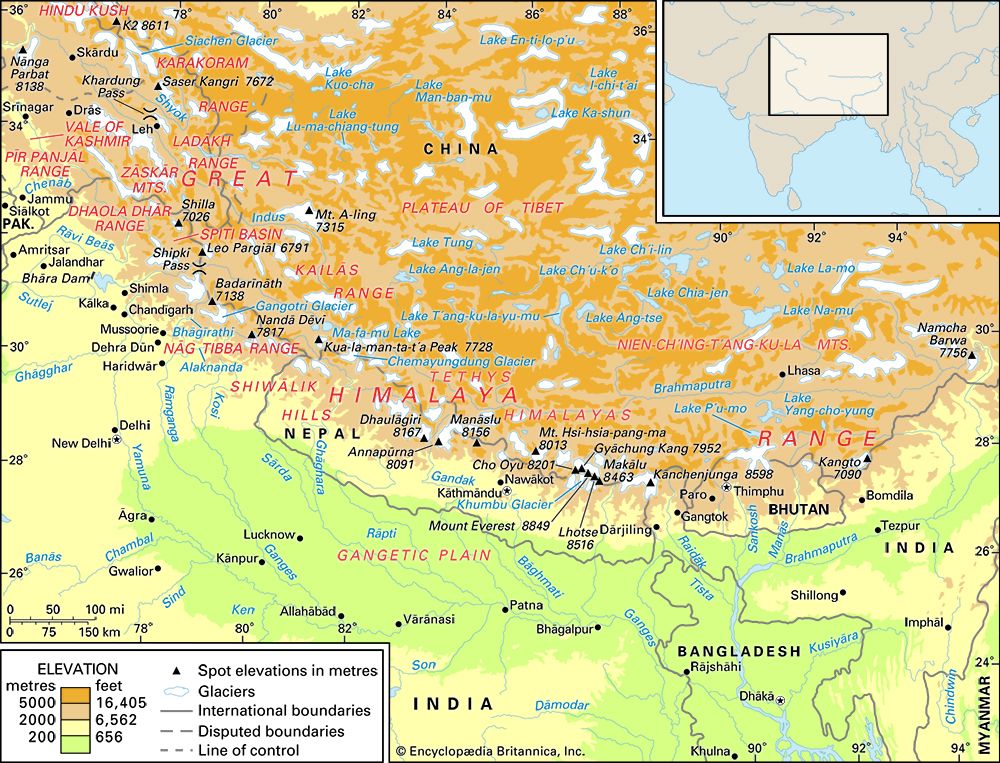
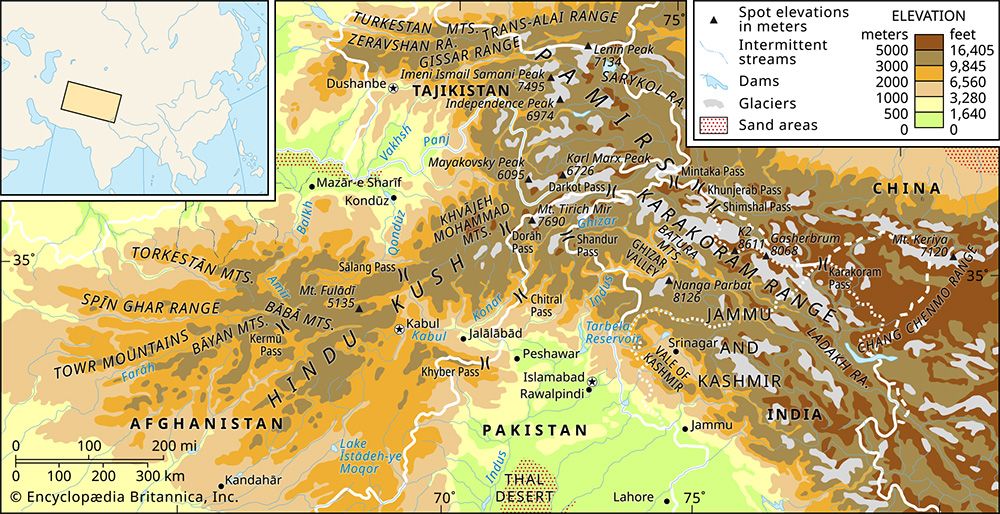
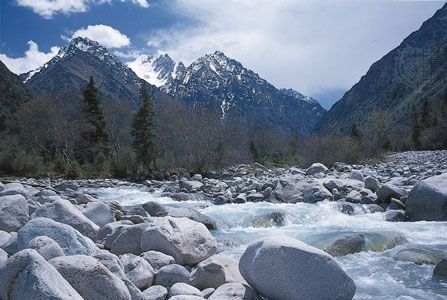
The Tien Shan, or “Celestial Mountains,” is a major mountain system in Central Asia covering approximately 386,000 square miles (1,000,000 square km). Stretching 1,500 miles (2,500 km) in length, it is a significant component of “High Asia,” a region that includes other massive ranges such as the Himalayas, the Karakoram Range, the Kunlun Mountains, and the Pamirs.12
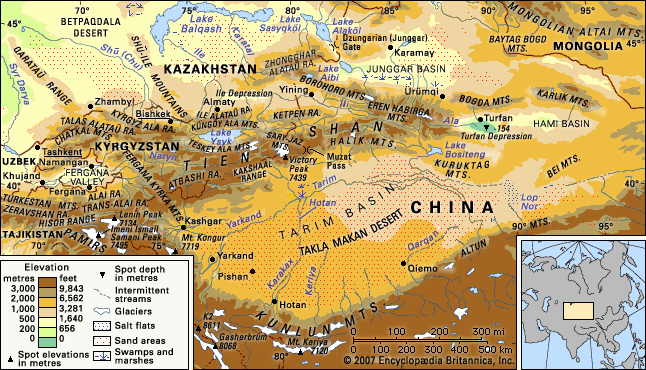
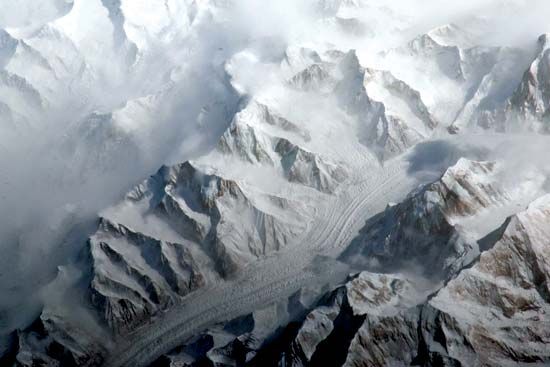
In terms of elevation, the Tien Shan features extreme relief, with differences exceeding 4.5 miles (7 km) between its lowest point in the Turfan Depression—which lies 505 feet (154 meters) below sea level—and its highest peaks. The range’s tallest summits, Victory Peak (24,406 feet/7,439 meters) and Khan Tängiri Peak (22,949 feet/6,995 meters), are comparable to the high-altitude peaks found in the neighboring Pamir system, where Imeni Ismail Samani Peak reaches 24,590 feet (7,495 meters). While the Tien Shan is characterized by alpine-type ridges and extensive glaciation similar to other major Asian ranges, it is distinct for its east-west trending basins and ranges formed by Paleozoic folded structures.3142
Where exactly are the Tien Shan mountains located in Asia?
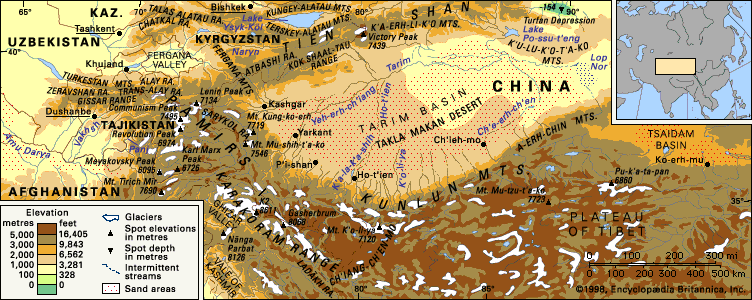
The Tien Shan, or “Celestial Mountains,” is a vast mountain system located in Central Asia. It stretches approximately 1,500 miles (2,500 km) from west-southwest to east-northeast, primarily straddling the border between China and Kyrgyzstan, while also extending into Kazakhstan and Tajikistan.1
The system is bounded by several major geographic features:
- North: The Junggar Basin of northwestern China and the southern Kazakhstan plains.1
- Southeast: The Tarim Basin.1
- South/Southwest: The Pamirs and the Alay and Hisor ranges.1
The range bisects the ancient territory of Turkistan and varies in width from about 220 miles (350 km) at its center to 300 miles (500 km) at its extremities. Its complex topography includes numerous mountain knots, high-altitude peaks like Victory Peak, and deep depressions such as the Turfan Depression.12
What types of wildlife can be found in the Tien Shan mountain range?
The Tien Shan mountain range supports a diverse array of wildlife, with species distribution largely determined by elevation and habitat zones.89
High Mountain and Forest Zones
The high-altitude regions are home to iconic Central Asian species, including snow leopards, mountain sheep (such as the argali), and mountain goats or ibex. The forest and meadow zones provide habitats for brown bears, lynx, gray wolves, wild boars, badgers, and ermines. Additionally, the region hosts various rodents, including field voles, marmots, and members of the jerboa and Ochotonidae (pika) families.81011
Desert and Lower Zones
In the lower desert and semiarid regions, the fauna includes species from neighboring plains, such as antelopes, gazelles, Tolai hares, and gray hamsters. In the desert fringes, one may also find yellow gophers, large-eared hedgehogs, and, in specific areas, wild camels and wild asses.81011
Avian and Other Life
The range is rich in birdlife, featuring species such as the golden eagle (birket), Himalayan snow cock, mountain partridge, alpine chough, and various vultures. Reptiles, including snakes and lizards, are present, alongside a variety of insects like butterflies, scorpions, and centipedes.811
How do the Tien Shan mountains impact the climate and ecosystems of the surrounding regions?
The Tien Shan mountain system acts as a critical climatic and hydrological barrier in Central Asia, profoundly shaping the environments of the surrounding regions.1012
Climatic Influence
The mountains serve as a major barrier to moisture-bearing westerly winds from the Atlantic Ocean. This creates a sharp climatic divide:10
- Windward Slopes: The western and northwestern slopes receive significantly higher precipitation, often ranging from 28 to 79 inches (710 to 2,000 mm), which supports more humid conditions and diverse vegetation.1012
- Leeward and Interior Regions: The mountains cast a “rain shadow,” causing precipitation to drop drastically to as little as 4–16 inches (100–400 mm) in the east and interior. This contributes to the extreme aridity of surrounding basins, such as the Tarim Basin and the Junggar Basin, which are among the driest regions in Eurasia.10121314
Hydrological and Ecological Impact
The Tien Shan functions as a “water tower” for the region. Its extensive glaciers and snowpack feed major river systems, including the Naryn, Ili, and Aksu. These rivers are essential for sustaining life in the arid lowlands, supporting steppe ecosystems and enabling irrigation-based agriculture in foothill oases. However, human diversion of these waters for agriculture and energy has significantly altered natural drainage patterns, impacting downstream environments like the Aral Sea and the Tarim River’s lower reaches.1516141713
Sources
- Tien Shan — Encyclopædia Britannica
- Tien Shan - Physiography — Encyclopædia Britannica
- Pamirs - Physiography — Encyclopædia Britannica
- Asia - Central Asia and South Siberia — Encyclopædia Britannica
- Asia - Geologic and climatic influences — Encyclopædia Britannica
- Pamirs — Encyclopædia Britannica
- China - The Tien Shan — Encyclopædia Britannica
- Tien Shan - Animal life — Encyclopædia Britannica
- Kyrgyzstan - Plant and animal life — Encyclopædia Britannica
- Tien Shan - Plant life — Encyclopædia Britannica
- Xinjiang - Plant and animal life — Encyclopædia Britannica
- Tien Shan - Climate — Encyclopædia Britannica
- Tien Shan - Glaciation — Encyclopædia Britannica
- Xinjiang - Climate of Xinjiang — Encyclopædia Britannica
- Tien Shan - Drainage — Encyclopædia Britannica
- Kyrgyzstan - Climate — Encyclopædia Britannica
- Junggar Basin — Encyclopædia Britannica
- Tarim River — Encyclopædia Britannica
Published on · 4 min read