Kalambo Falls
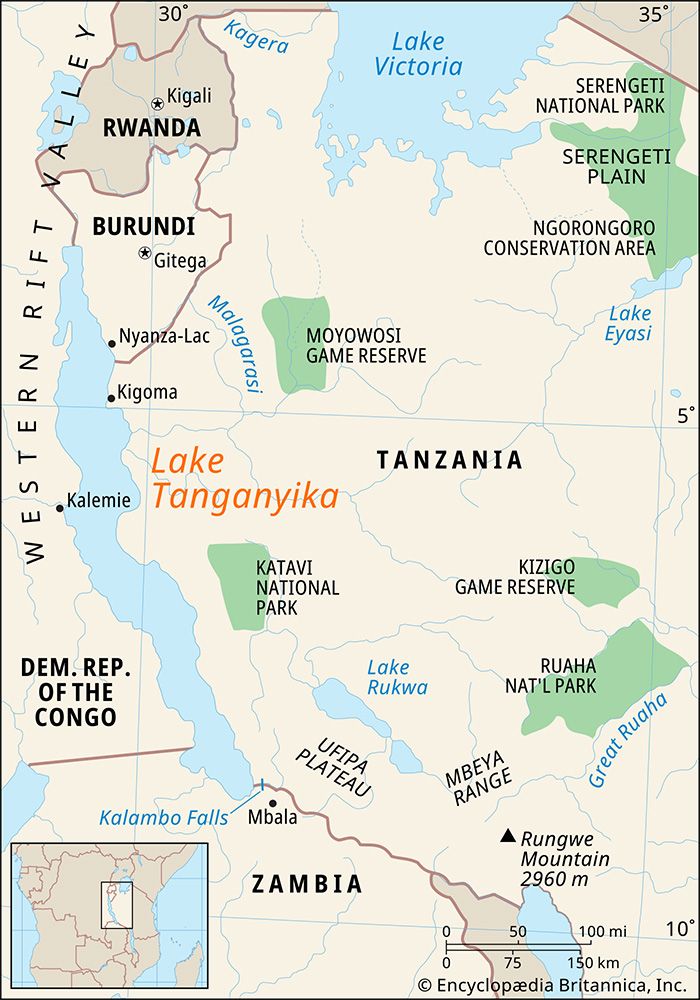
Kalambo Falls is a waterfall located on the Kalambo River near the southeastern shore of Lake Tanganyika, on the border between Tanzania and Zambia. It is…
What is Kalambo Falls?
Kalambo Falls is a waterfall located on the Kalambo River near the southeastern shore of Lake Tanganyika, on the border between Tanzania and Zambia. It is recognized as the second-highest uninterrupted waterfall in Africa, surpassed only by Tugela Falls in South Africa.12
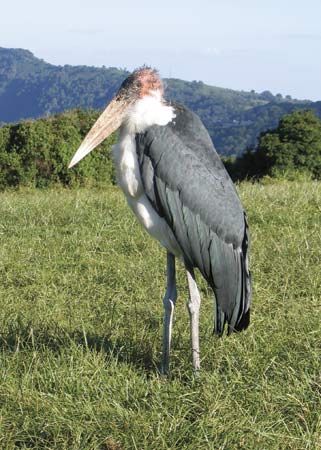
The falls feature a 704-foot (215-metre) drop, which is part of a larger 3,000-foot (900-metre) descent along a 6-mile (10-kilometre) stretch of the river. The surrounding Kalambo Gorge is ecologically and historically significant; it serves as a breeding ground for the rare, giant marabou stork and has yielded primitive tools excavated from the area that date back to 300,000 BCE.1
What kind of ancient tools were found at the Kalambo Falls archaeological site?
The archaeological site at Kalambo Falls is significant for the discovery of primitive tools that have been excavated from the surrounding gorge. These artifacts have been dated by radiocarbon analysis to as early as 300,000 BCE, indicating that the area was inhabited by early types of humans during the Paleolithic Period.134
While the specific types of tools found directly at the Kalambo Falls site are broadly categorized as primitive stone tools, excavations in the broader region of central and northern Zambia have revealed evidence of various industries associated with early human development. By 20,000 BCE, these populations had developed sophisticated tools and survival technologies, including:
These findings highlight the long history of human technological adaptation in the region, transitioning from early stone-tool industries to more specialized implements used for hunting, gathering, and food processing.34
How does the height of Kalambo Falls compare to other famous waterfalls in Africa?
Kalambo Falls, located on the border between Tanzania and Zambia, is one of the most notable waterfalls in Africa. When comparing its height to other famous African waterfalls, it is often cited as the second-highest uninterrupted waterfall on the continent, trailing only Tugela Falls in South Africa.1
In terms of total vertical drop, Kalambo Falls has a total height of 427 metres (1,400 feet), with a single uninterrupted leap of 215 metres (704 feet). By comparison, Tugela Falls is significantly taller, with a total height of 948 metres. While other famous African waterfalls, such as Victoria Falls, are renowned for their massive volume of water and width, they are much shorter in height, with Victoria Falls measuring 108 metres.167
The following table provides a comparison of these notable African waterfalls:
Waterfall
Country
Total Height (m)
Tugela Falls
South Africa
948
Kalambo Falls
Tanzania-Zambia
427
Victoria Falls
Zambia-Zimbabwe
108
What makes the marabou stork unique as a bird species?
The marabou (Leptoptilos crumeniferus) is a unique and imposing species within the stork family, distinguished by several remarkable physical and behavioral traits:
- Size: It is the largest stork species, standing 150 cm (5 feet) tall with an impressive wingspan of 2.6 metres (8 1/2 feet).9
- Distinctive Appearance: Unlike many other birds, it features a naked, pinkish head and neck. It is also characterized by a heavy, straight bill and a pendant, reddish, inflatable throat pouch.9
- Dietary Habits: While most storks feed on small animals in shallow water, the marabou is a specialized scavenger. It feeds primarily on carrion and is often found alongside vultures, which it frequently dominates at feeding sites.910
- Vocalization: Like other members of the Ciconiidae family, the marabou is nearly voiceless due to the lack of a fully developed syrinx, though it may produce loud clattering sounds with its bill when excited.10
Sources
- Kalambo Falls — Encyclopædia Britannica
- East African lakes - Physiography — Encyclopædia Britannica
- Zambia - Archaeology and early history — Encyclopædia Britannica
- history of Zambia - Archaeology and early history of Zambia — Encyclopædia Britannica
- Central Africa - Early toolmakers — Encyclopædia Britannica
- waterfall — Encyclopædia Britannica
- river - High plateaus — Encyclopædia Britannica
- river - Waterfalls — Encyclopædia Britannica
- Marabou — Encyclopædia Britannica
- Stork — Encyclopædia Britannica
Published on · 3 min read