Stork
Storks are diurnal birds that primarily feed during the day, searching for food in shallow water, marshy ground, or dry fields. Their diet is varied and…
What are the feeding habits and diet of storks?
Storks are diurnal birds that primarily feed during the day, searching for food in shallow water, marshy ground, or dry fields. Their diet is varied and consists mostly of small animals, which are typically swallowed whole; any indigestible remains are later regurgitated as pellets.12
Common prey includes:
- Small animals: Fish, amphibians, reptiles, small mammals, and birds.12
- Invertebrates: Insects (such as swarming locusts), worms, crustaceans, and mollusks.2
- Specialized diets: Some species have specific dietary adaptations. For example, open-billed storks feed on water snails, using their unique bill structure—which leaves a gap when closed—to hold them.1
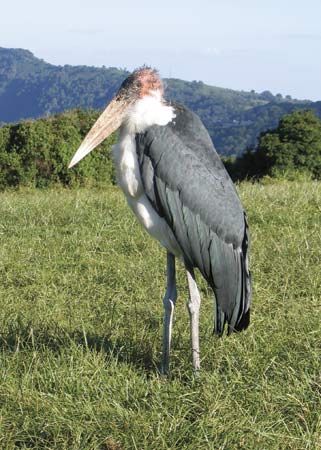
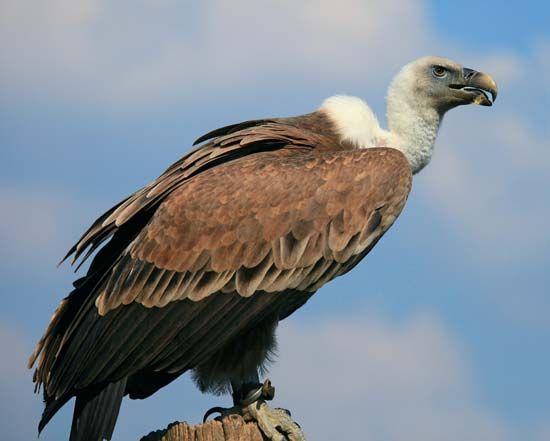
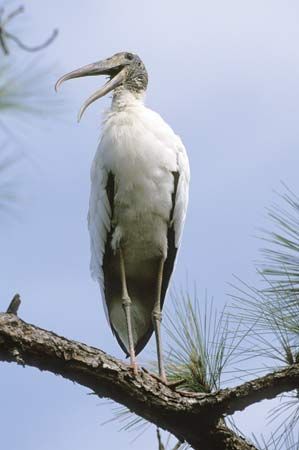
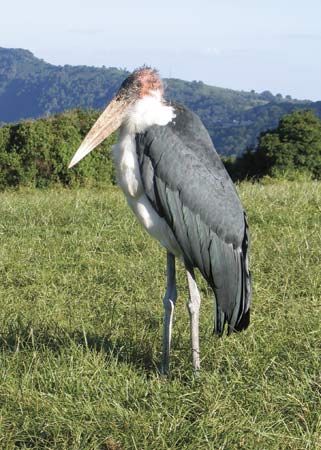
While many storks are active hunters, others are scavengers. The marabou stork and adjutant storks are well-known for feeding primarily on carrion, often congregating with vultures at carcasses. Hunting techniques also vary; for instance, wood storks forage by wading through shallow water with their bills open and partially submerged, plowing the water to catch prey.12
How do storks build their nests, and what materials do they use?
Storks are known for building large, sturdy nests, a task shared by both the male and female of the pair. These structures are typically designed as loose platforms constructed primarily from sticks and stems. In marshy environments, storks frequently incorporate rushes into their nests to provide additional stability.34
The choice of nesting site is varied, though most species prefer to build in tall trees. Depending on the species and local environment, storks may also utilize rock ledges, buildings, or chimneys. In some regions, such as parts of Europe, the white stork often makes use of artificial platforms—such as a cartwheel placed horizontally atop a high pole—to support its heavy nest. These nests are often situated in colonial groupings, where multiple pairs may nest in close proximity to one another.34
What are the distinctive physical characteristics of storks?
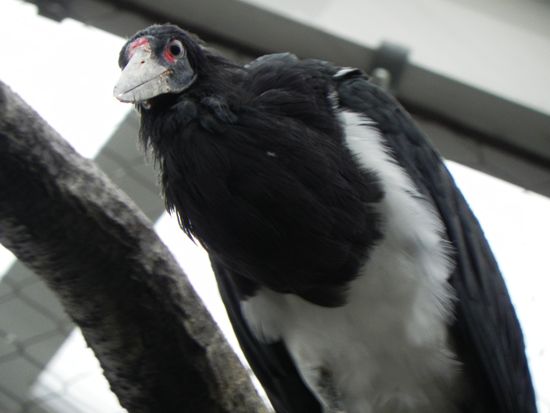
Storks (family Ciconiidae) are large, long-legged, and long-necked birds that exhibit several distinctive physical characteristics. They range in height from approximately 60 cm to over 150 cm (2 to 5 feet), with some species possessing wingspans reaching up to 2.6 meters (8.5 feet).15
Key physical features include:
- Head and Neck: In many species, all or part of the head and upper neck is bare of feathers and often brightly colored.1
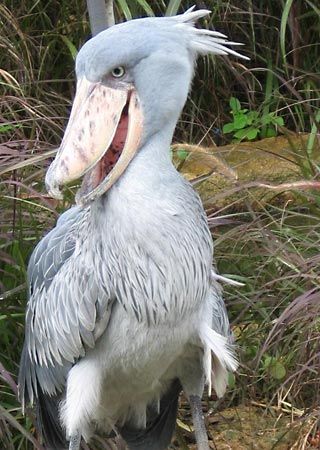
- Bills: Storks typically possess long, strong bills. While “typical” storks have straight bills, there is significant diversity: wood storks have decurved bills, while open-billed storks feature a unique gap between their mandibles when closed, an adaptation for holding snails.61
- Flight and Posture: When flying, storks characteristically extend their necks forward while their legs trail behind them. They move through the air by alternating between flapping and soaring.1
- Vocalization: Storks are largely voiceless due to the lack of a fully developed syrinx (vocal organ); instead, they often communicate by clattering their bills loudly when excited.1
How are storks distributed around the world, and in which habitats do they typically live?
Storks are widely distributed across the globe, primarily occurring in Africa, Asia, and Europe. While the majority of species are found within these regions, the black-necked stork is also present in Australia, and three species are native to the New World, ranging from the southern United States to Argentina.18
These birds are typically associated with open habitats where they are often conspicuous, both on the ground and in the air. As long-legged, long-necked wading birds, they are well-adapted to foraging in shallow water and open fields, where they hunt for small animals.91
Many stork species are migratory, particularly those that breed in northern regions with harsh winters. For example, the white stork follows well-defined flyways to reach tropical Africa during the winter months, often avoiding long flights over large bodies of water. While some storks are highly migratory, others are confined to the tropics, and some populations may be sedentary depending on their specific geographic location.510
Sources
- Stork — Encyclopædia Britannica
- Ciconiiform - Feeding habits — Encyclopædia Britannica
- Nest — Encyclopædia Britannica
- Ciconiiform - Reproduction and nesting — Encyclopædia Britannica
- Ciconiiform - Size range and diversity of structure — Encyclopædia Britannica
- Ciconiiform - Relations with humans — Encyclopædia Britannica
- Ciconiiform - Bill shape — Encyclopædia Britannica
- Ciconiiform - Migration — Encyclopædia Britannica
- stork — Merriam-Webster
- Migration - In Europe — Encyclopædia Britannica
Published on · 3 min read