Lukuga River
The Lukuga River is a 200-mile (320-km) waterway located in the eastern Democratic Republic of the Congo. It serves as the sole outlet for Lake Tanganyika…
What is Lukuga River?
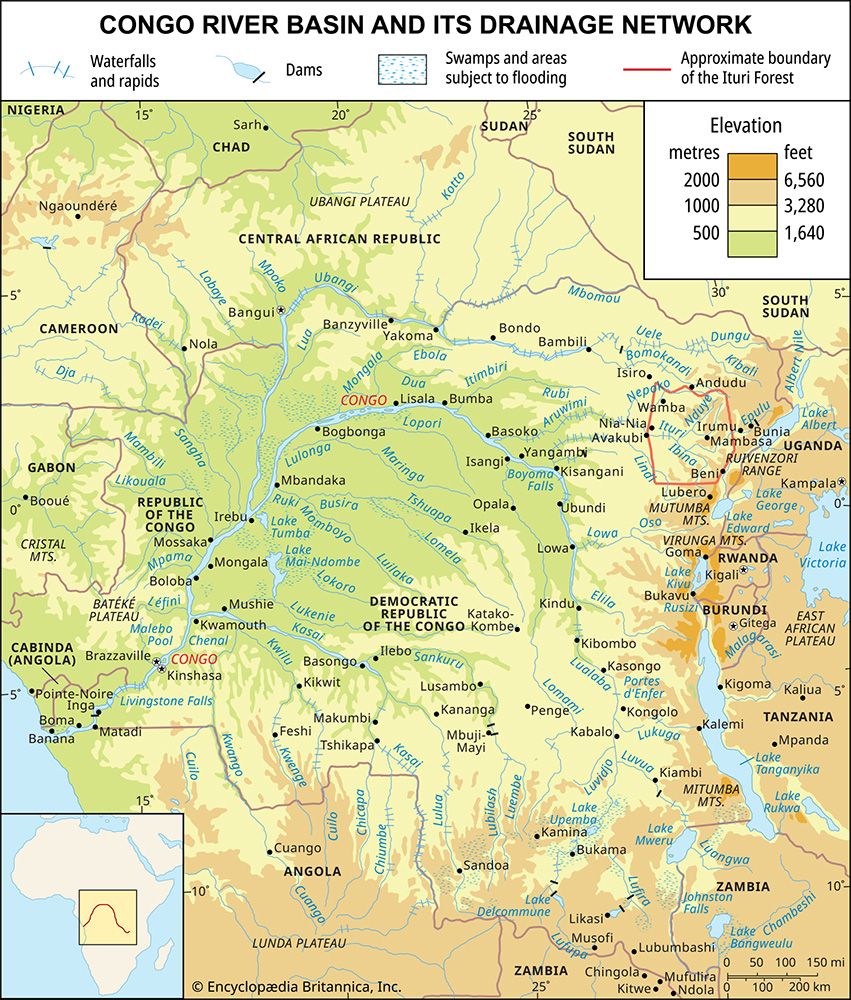
The Lukuga River is a 200-mile (320-km) waterway located in the eastern Democratic Republic of the Congo. It serves as the sole outlet for Lake Tanganyika, emerging from the lake’s western shore at the port of Kalemie.12
The river flows westward, eventually joining the Lualaba River approximately 25 miles (40 km) north of the town of Kabalo. The region surrounding the river’s tributaries, particularly near Kalemie and Moluba, is noted for containing low-grade coal deposits.1
What is the Lualaba River?
The Lualaba River is the headstream of the Congo River, flowing for approximately 1,100 miles (1,800 km) entirely within the Democratic Republic of the Congo.3
Course and Geography
The river originates on the Katanga (Shaba) plateau near Musofi at an elevation of about 4,600 feet (1,400 m). Its upper course is characterized by a descent marked by falls and rapids, including a significant drop to the Kamolondo Trough that is utilized for hydroelectric power at the Nzilo Dam.3
Within the trough, the river becomes navigable at Bukama for 400 miles (644 km), expanding into marshy lakes such as Upemba and Kisale. Below Kongola, the river enters a narrow, impassable gorge known as the Portes d’Enfer. While some sections remain navigable, the river is frequently broken by rapids until it reaches Boyoma Falls. These seven cataracts mark the end of the Lualaba and the beginning of the Congo River proper.3
Tributaries and Basin
The Lualaba receives several major tributaries, including the Lufira, Luvua, and Lukuga rivers. It is a vital component of the vast Congo basin, which is defined by a complex network of rivers and a central depression.34
How was Lake Tanganyika formed?
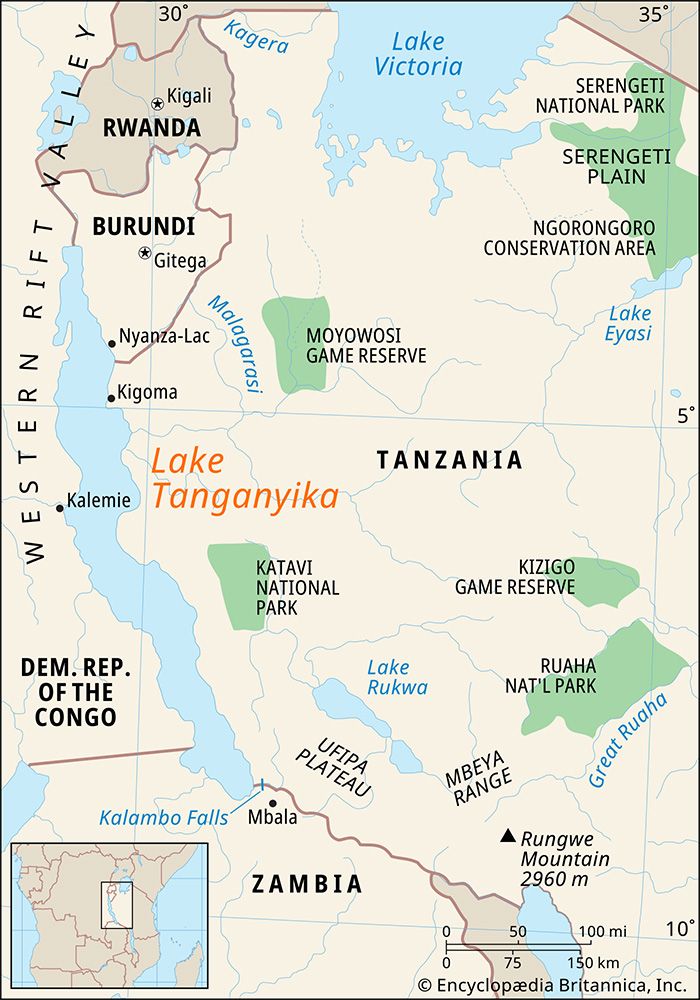
Lake Tanganyika was formed as part of the East African Rift System, a massive geological feature that stretches for about 4,000 miles across the continent. Specifically, the lake occupies the southern portion of the Western Rift Valley, a branch of the rift system that includes several other deep lakes such as Lake Kivu, Lake Edward, and Lake Albert.2
The rift system attained its present form primarily through earth movements during the Pleistocene Epoch, which occurred approximately 2,600,000 to 11,700 years ago. As the tectonic plates pulled apart, the land collapsed along parallel faults, creating deep, narrow troughs. These basins, including the one holding Lake Tanganyika, are characterized by steep, rising shores and significant depths, with the lake reaching 4,710 feet (1,436 meters) at its deepest point.627
What are the major rivers that feed into Lake Tanganyika?
Lake Tanganyika is fed by several rivers, though it is not the center of an extensive drainage area. The largest rivers discharging into the lake include:
- Malagarasi River: This river system enters the lake approximately 25 miles (40 km) south of Kigoma, Tanzania, after flowing through extensive swamps and highland country.
- Ruzizi River: Flowing southward from Lake Kivu, this turbulent river drops more than 2,200 feet (670 meters) before reaching Lake Tanganyika.
- Kalambo River: Located at the southern end of the lake on the frontier with Zambia, this river is notable for Kalambo Falls, which features one of the highest waterfalls in the world.
While these rivers feed the lake, its primary outlet is the Lukuga River, which flows westward into the Lualaba River.
Sources
- Lukuga River — Encyclopædia Britannica
- Lake Tanganyika — Encyclopædia Britannica
- Lualaba River — Encyclopædia Britannica
- Lualaba — Merriam-Webster
- Congo River - Physiography — Encyclopædia Britannica
- Africa - Relief — Encyclopædia Britannica
- East African lakes - Geology, climate, and hydrology — Encyclopædia Britannica
- Tanzania: Top Questions — Encyclopædia Britannica
- Malagarasi River — Encyclopædia Britannica
- East African lakes - Physiography — Encyclopædia Britannica
Published on · 2 min read