Kaskaskia River
The Kaskaskia River is historically significant primarily due to its association with the village of Kaskaskia, which served as the first capital of Illinois…
What is the historical significance of the Kaskaskia River in the development of Illinois?
The Kaskaskia River is historically significant primarily due to its association with the village of Kaskaskia, which served as the first capital of Illinois from 1818 to 1820.12
Founded in 1703 as a Jesuit mission, the original settlement developed into a vital French trading post and farming community. Its strategic importance was underscored in 1778 when George Rogers Clark captured the area for the United States during the American Revolution. The region’s heritage is preserved through sites like the home of Pierre Menard, the first lieutenant governor of Illinois, and the Kaskaskia Bell, a gift from Louis XV that became known as the “Liberty Bell of the West”.2
The river itself, named for a tribe of the Illinois confederation, is notorious for its volatile volume. In the late 19th century, severe flooding caused the Mississippi River to shift its course, eventually inundating the original capital and creating the present-day Kaskaskia Island.12
How has human activity, such as dams or channelization, affected the Kaskaskia River’s ecosystem?
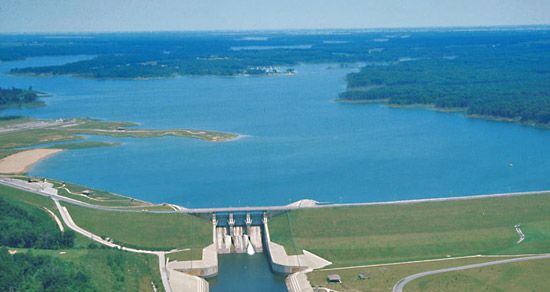
Human activity has significantly altered the Kaskaskia River through the construction of large-scale water management projects. The river’s natural flow is now interrupted by two major impoundments: Lake Shelbyville, created by a dam approximately 50 miles from the river’s source, and Carlyle Lake, which serves as the largest impounded lake in Illinois.
These dams were designed to manage the river’s historically volatile volume and mitigate the severe flooding that once characterized the region, such as the 19th-century floods that permanently altered the landscape near the river’s confluence with the Mississippi River. While these structures provide flood control and water storage, they fundamentally change the river’s hydrology and the ecosystems that depend on its natural flow patterns.
Where is the Kaskaskia River located in Illinois, and what are its major tributaries?
The Kaskaskia River is located in central and southern Illinois, U.S. It originates in Champaign county near Urbana and flows southwest for 320 miles (515 km) before entering the Mississippi River north of Chester in Randolph county.13
Regarding your request for its major tributaries, the provided search results do not contain information identifying the specific tributaries of the Kaskaskia River.
What is the origin of the name ‘Kaskaskia’ and its significance to Native American history?
The name “Kaskaskia” is derived from one of the tribes belonging to the Illinois confederation, a group of Native American peoples who were early inhabitants of the region2.2
The significance of the name is deeply tied to the history of the Illinois territory. The village of Kaskaskia, which served as the first capital of Illinois, was named after this tribe. The Kaskaskia River, which flows through central and southern Illinois, also takes its name from the same confederation. Historically, the area was a site of significant cultural interaction, where the Kaskaskia people lived alongside Jesuit missionaries and French settlers who established a mission and trading post there in 1703.12
Sources
- Kaskaskia River — Encyclopædia Britannica
- Kaskaskia — Encyclopædia Britannica
- Kaskaskia — Merriam-Webster
Published on · 2 min read